


If the thermostat says AUX or EM Heat and the PECO statement just jumped, the outdoor unit is no longer doing the real work. The backup heater is.
AUX or EM Heat stuck on and the bill climbing?
That is backup electric heat carrying your house, not your heat pump. Get the system diagnosed before another PECO cycle.
What auxiliary heat and emergency heat actually are
A heat pump does not make heat the way a toaster does. It moves heat from outdoor air into the house. That is why a working heat pump can deliver two to four units of heat for every unit of electricity it uses. An electric resistance coil, the backup strips in most air handlers, delivers one unit of heat for every unit of electricity. Same comfort. Three times the bill, or worse.
Auxiliary heat (AUX on the thermostat) turns on automatically. The heat pump is still trying. The indoor strips or a paired furnace add extra heat because the outdoor unit cannot keep up with the setpoint. That is normal on a standard system when it is below freezing, during a defrost cycle, or when someone raises the thermostat several degrees at once.
Emergency heat (EM Heat) is a manual setting. It shuts the outdoor unit off and runs only the backup. Use it when the outdoor unit is dead, iced beyond a normal defrost, or a technician told you to. Leaving EM Heat on all January is how an all-electric house burns four figures on one winter bill.
How a regular heat pump behaves
On a conventional single-stage or two-stage heat pump, capacity falls hard as the outdoor temperature drops through the 30s. Below freezing, many of these units are already leaning on backup. By the teens, a normal design-night range across Montgomery County, Philadelphia, Bucks County, Chester County, and Delaware County, the compressor is doing a fraction of the work and the strips or furnace are carrying the house. The AUX light is not a fault code. It is the system admitting the outdoor unit has run out of cheap heat.
How a high-end inverter and cold-climate system behaves
A variable-speed inverter compressor can spin faster when the air is thin and cold. A cold-climate heat pump is built to keep extracting heat well below freezing, often holding most of its rated capacity into the single digits, with usable output below zero. Auxiliary heat still exists as a safety net. It should not be the nightly plan. On a well-set system you may see AUX for a few minutes during defrost or a big morning recovery. You should not see it locked on at 38°F.
Every house is wired and programmed a little differently. Balance points, lockouts, and dual-fuel changeover are set at install. If AUX runs constantly in mild weather, or the house will not hold setpoint, do not guess at the thermostat. Have the system diagnosed, starting with the original installer or a shop that actually works your brand.
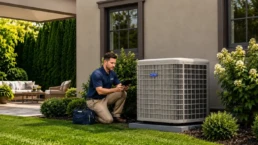
If the unit is down today, that is a heat pump repair call, not an equipment lecture.
Why the electric bill explodes when backup heat takes over
Heat-pump mode is cheap heat. Strip mode is an electric furnace wearing a heat-pump costume. On PECO rates, a house that lives on backup for a cold week can add hundreds of dollars. A full month of strips carrying an older or undersized system is how some homeowners see a winter bill they do not recognize, sometimes crossing into four figures.
That is not “the heat pump is inefficient.” That is the heat pump having left the building. The compressor is the efficient machine. The coil in the air handler is a space heater. If winters stay sharp, paying for a system that remains in heat-pump mode at 10°F or 5°F is not a luxury feature. It is the difference between moving heat and manufacturing it.
A higher first cost on a cold-climate or high-efficiency inverter system pays back in the winters where a standard unit would have handed the load to strips. The payback is fastest in leaky or all-electric homes, and in houses that already watch AUX light up every time the forecast dips below freezing.
Three ways Greater Philly homes heat with a heat pump now
EMCO Tech is a Carrier preferred dealer serving Montgomery County, Philadelphia, Bucks County, Chester County, and Delaware County. The Carrier residential lineup is the frame we use with homeowners: a straightforward system that needs backup sooner, a premium communicating system built for deep cold, and a high-efficiency inverter crossover that puts serious low-ambient heating on the ductwork you already have, without the full premium-tier price.
1. Standard-efficiency heat pumps
Single-stage or two-stage outdoor units. Fine in October and April. They lose a large share of heating capacity as outdoor air falls through freezing. Backup, electric strips or a gas furnace in a dual-fuel setup, is not a rare event. It is the January plan. Upfront cost is the lowest of the three. Operating cost on the coldest mornings is the highest if the backup is electric.
Best fit: milder winters, dual-fuel with a healthy gas furnace, or a house where first cost has to win.
Watch-out: AUX that starts in the mid-30s and stays on. That is a PECO problem, not a comfort badge.
2. Premium cold-climate systems
Variable-speed inverter compressors, matched indoor equipment, and controls that actually talk to each other. Carrier’s Infinity line with Greenspeed intelligence is the example we install when the homeowner wants the outdoor unit to keep working in heat-pump mode deep into a Delaware Valley cold snap, published heating well below zero on the right model, not a marketing footnote.
You pay more on day one because the indoor coil or furnace, the thermostat, and the outdoor unit are a matched system. You buy back that money on the nights a standard unit would have been a strip heater. Quiet, steady supply air. Fewer on and off swings. Aux heat as a last resort, not a lifestyle.
Best fit: all-electric homes, older houses that already punish a weak outdoor unit, anyone who is tired of watching AUX.
The catch: it is the top of the ladder. It is worth it when the bill and the comfort both justify the match.
3. The crossover: high-efficiency inverter, side-discharge, on your existing ducts
This is the option most quotes still skip. A compact side-discharge outdoor unit, the slim cabinet people associate with ductless, can be piped to a conventional air handler or furnace and push heat through the vents you already have.
Those outdoor units use the same family of hyper-inverter technology that keeps a ductless head heating when it is ugly outside. You get low-ambient capacity and a quiet cabinet without buying a full premium communicating indoor suite. The indoor side can stay a standard air handler or a regular furnace in dual-fuel. That is how you get cold-weather inverter performance without the Infinity price tag.
Best fit: a house with decent ducts, a furnace or air handler that still has life, and a homeowner who wants sub-freezing heat-pump mode without a full premium swap.
Not a loophole: it still has to be sized, charged, and controlled correctly. A pretty outdoor cabinet on the wrong indoor coil is just a pretty outdoor cabinet.
Which of the three belongs in your house
There is no single right answer for every rowhome in Fishtown and every colonial in Horsham. Ducts, electrical service, existing furnace, and how hard the house leaks all change the math. What does not change: if AUX is a habit above the mid-30s, you are paying electric-heater prices for heat-pump comfort. That is the upgrade conversation.
What a planned upgrade looks like here
We work from 2424 Wyandotte Rd in Willow Grove and 7934 State Rd in Philadelphia. A heat pump installation visit is a load look at the house, not a model number first. Cold-climate ducted, dual-fuel with the furnace you have, or a side-discharge inverter on existing ducts. Then a written quote, current incentives we can document, and a schedule that does not wait for the outdoor unit to die on a Tuesday night.
If the system is already in the last third of its life, read planning a heat pump replacement before you buy another compressor for a 14-year-old box. If you want the equipment family in one place, start with Carrier residential HVAC systems.
Two maintenance visits a year keep defrost, charge, and airflow honest. That is how an inverter system stays in heat-pump mode instead of quietly sliding back onto strips.
The temperature where backup heat takes over is the whole ballgame
Every heat pump has a point where it can no longer pull enough heat out of the outdoor air to keep up with what the house is losing. Installers call it the balance point. Below it, the strips or the furnace start filling the gap. That single temperature decides your winter bill more than the efficiency sticker on the side of the cabinet does.
Two different numbers get quoted, and they are not the same thing:
Operating limit. The lowest outdoor temperature at which the compressor is still allowed to run and make heat. This is the number in the brochure, like heating down to -13°F.
Balance point. The temperature in your specific house where the heat pump alone stops holding setpoint and backup joins in. This depends on the equipment, the size of the house, the insulation, and the ductwork. It is calculated, not printed on a box.
A brochure number that reads well does not automatically shut the strips off. What it does is give the balance point room to fall. On a standard unit, the compressor is running out of capacity in the 30s, so backup starts early no matter how the system is set up. On a cold-climate inverter, the compressor is still producing real output in the single digits, so a properly sized system can hold the house on heat-pump mode through nearly every night of a Delaware Valley winter. That is where the money is.
Our winter design nights around Philadelphia and the surrounding counties land in the mid-teens. A system that gives up at 35°F and a system that is still working at 5°F both keep the house warm. Only one of them does it without running an electric space heater in your air handler to get there.
Carrier heat pump tiers compared
EMCO Tech is a Carrier preferred dealer, so this is the lineup we quote from every day. Three tiers, and a crossover option in the middle that most quotes skip entirely.
Scroll the table sideways to see all three tiers.
| Standard grade Comfort series |
Cold-temperature crossover Side-discharge inverter |
Premium cold climate Infinity with Greenspeed |
|
|---|---|---|---|
| Example models | 27SCA5, 27TPA8 (legacy 25HCE4) |
38MURA, 37MUHA | 27VNA3 Infinity 23 27VNA1 Ultimate Cold Climate |
| Compressor | Single-stage or two-stage | Variable-speed twin rotary inverter | Variable-speed, modulates 30 to 100 percent |
| Cooling efficiency | Up to 16 to 18.5 SEER2 | Up to 18 to 19 SEER2 | Up to 21.2 to 23 SEER2 |
| Heating efficiency | Up to 7.8 to 8.5 HSPF2 | Up to 9.7 to 10.8 HSPF2 | Up to 10.5 to 12 HSPF2 |
| Keeps making heat down to | Capacity falls off hard through the 30s | -22°F on the 38MURA | -13°F on the Infinity 23 -23°F on the Ultimate Cold Climate |
| When backup heat joins in | Routinely, starting near freezing. The January plan | Rarely. Defrost and deep-cold nights | Rarely. Designed as a safety net, not a schedule |
| Indoor side | Standard air handler or furnace | Works with a standard air handler or your existing furnace in dual fuel | Matched communicating indoor unit and Infinity control |
| Outdoor cabinet | Conventional top-discharge | Compact side-discharge, installs inches from the wall, stackable | Conventional top-discharge, full size |
| First cost | Lowest | Middle | Highest |
| Winter operating cost | Highest if backup is electric | Low | Lowest |
| Best fit | Dual fuel with a healthy gas furnace, or first cost has to win | Good ducts, tight side yard, furnace or air handler with life left | All-electric homes, older leaky houses, anyone tired of watching AUX |
Efficiency and operating-temperature figures are published Carrier ratings for the model families listed and vary by size and by matched indoor equipment. The operating limit is not a promise that backup never runs. Actual balance point comes from a load calculation on your house.
Tier 1: standard-efficiency heat pumps
Carrier Comfort series, models like 27SCA5 and the two-stage 27TPA8. Roughly 16 to 18.5 SEER2 cooling, 7.8 to 8.5 HSPF2 heating.
Single-stage or two-stage outdoor units. They run at full tilt or not at all, or flip between two speeds. Fine in October and April. The problem is what happens in January: capacity falls off sharply as outdoor air drops through freezing, so the strips or the furnace are not an emergency, they are the plan. Upfront cost is the lowest of everything here.
Best fit: dual fuel paired with a gas furnace that still has years on it, or a house where first cost has to win.
Watch-out: AUX that starts in the mid-30s and stays on. On an all-electric house, that is the setup behind the winter bills people bring us.
Tier 2: the crossover, high-efficiency inverter on the ducts you already have
This is the option most quotes still skip, and it is the one that solves the aux-heat problem for the largest number of Philly-area homes. A compact side-discharge outdoor unit, the slim cabinet people associate with ductless, piped to a conventional air handler or your existing furnace, pushing heat through the vents you already have.
Those outdoor units run the same family of inverter technology that keeps a ductless head heating when it is ugly outside. You get low-ambient capacity and a quiet cabinet without buying a full premium communicating indoor suite. There are two we reach for.
Carrier Performance 38MURA. Up to 18.8 SEER2 cooling, up to 9.8 HSPF2 heating, variable-speed twin rotary inverter compressor, published heating performance down to -22°F, sound down around 55 decibels.
The workhorse of the middle tier. It pairs with the 40MUAA fan coil for an all-electric setup, or it can run alongside a properly sized gas furnace as dual fuel so the furnace only wakes up on the worst nights. Intelligent defrost keeps it from wasting cycles clearing ice. The cabinet installs as close as six inches from the house, which matters on a rowhome or a twin where the side yard is a walkway.
Best fit: decent ductwork, tight exterior clearances, and a homeowner who wants sub-freezing heat-pump mode without a full premium swap.
Carrier Comfort 19 crossover, 37MUHA. Up to 19 SEER2 cooling, up to 10.8 HSPF2 heating, Puron Advance refrigerant, sound as low as 59 decibels.
The higher heating number here is the headline. HSPF2 of 10.8 is premium-tier heating efficiency in a crossover cabinet, which is why this one keeps showing up on quotes where the budget will not stretch to Infinity but the house is all-electric and the winter bill is the whole reason for the call. It installs as close as four inches from the exterior wall and the units stack, which makes it workable on twins, multi-unit buildings, and city lots with no side yard at all. Paired with the 45MUAA fan coil it takes a four-inch MERV 13 filter, so the air quality side does not get downgraded to buy the efficiency.
Best fit: all-electric homes and tight lots where heating efficiency is the priority and the premium tier is out of budget.
Not a loophole. A crossover system still has to be sized, charged, and controlled correctly, and the changeover or lockout settings have to be programmed for your house. A compact outdoor cabinet on the wrong indoor coil with a default lockout is just a compact outdoor cabinet that still runs your strips.
Tier 3: premium cold-climate Infinity systems
Variable-speed inverter compressors, matched indoor equipment, and controls that actually talk to each other. This is where the compressor holds output furthest into the cold and where aux heat genuinely becomes a last resort instead of a nightly habit.
Carrier Infinity 23 heat pump, 27VNA3, with Greenspeed intelligence. Up to 23 SEER2 cooling, up to 10.5 HSPF2 heating, heating operation down to -13°F, cooling capacity up to 125°F.
The efficiency flagship. Adaptable-speed technology paired with the Infinity System Control means it makes constant small adjustments instead of slamming on and off, so supply air stays steady and quiet. Advanced defrost keeps ice cycles short. Over-the-air software updates mean the system can be improved after it is installed, and a Quiet Mode is there for the nights the outdoor unit sits under a bedroom window.
Best fit: homeowners who want the highest combined cooling efficiency and cold-weather heating in a conventional ducted system.
Carrier Infinity variable-speed Ultimate Cold Climate heat pump, 27VNA1. Up to 21.2 SEER2 cooling, up to 12 HSPF2 heating, heating operation down to -23°F, modulates between 30 and 100 percent capacity.
This is the one built specifically for the problem this whole article describes. HSPF2 of 12 is the highest heating efficiency in the ducted lineup, and heating operation to -23°F means the compressor is still the machine making your heat on nights the Delaware Valley almost never sees. On a correctly sized install in a normal Montgomery or Bucks County house, the balance point lands low enough that the strips become a genuine safety net rather than a line item on the PECO bill.
Best fit: all-electric homes, older houses that punish a weak outdoor unit, and anyone who has watched a winter bill cross four figures and decided it is not happening again.
The honest catch on Tier 3. You pay more on day one because the indoor coil or furnace, the thermostat, and the outdoor unit are a matched set and have to be installed as one. You buy that money back on every night a standard unit would have handed the house to a strip heater. If the house is on gas and the furnace is healthy, dual fuel with a Tier 2 crossover often gets most of the same result for less. We will tell you which one your house actually needs.
What this actually looks like on a PECO bill
This is not theoretical for us. Every winter we walk into all-electric houses in Montgomery, Bucks, Chester, Delaware, and Philadelphia counties where the January statement crossed fifteen hundred dollars, and in most of them the equipment was never broken. The heat pump was simply out of capacity, the strips picked up the load, and nobody told the homeowner that was going to happen.
Regional reporting backs up what we see in the field. During a recent cold stretch, PECO residential customers used about twelve percent more electricity in January than the typical winter average over the previous ten years, and the utility recorded its highest natural gas demand on record that February. Local homeowners interviewed during that stretch described electric bills that landed near or above a thousand dollars and roughly doubled from one month to the next.
Cold weather explains part of that. What it does not explain is why two houses on the same block, both electric, both the same size, can be six hundred dollars apart on the same statement. The difference is usually which machine was making the heat. Moving heat costs a fraction of manufacturing it. The tier you buy decides how many nights a winter you get to keep moving it.
A higher first cost on a crossover or Infinity system pays back in exactly those winters. The payback runs fastest in leaky homes, all-electric homes, and any house already watching AUX light up every time the forecast dips below freezing.
Which of the three belongs in your house
There is no single right answer for every rowhome in Fishtown and every colonial in Horsham. Ducts, electrical service, existing furnace, and how hard the house leaks all change the math. What does not change: if AUX is a habit above the mid-30s, you are paying electric-heater prices for heat-pump comfort. That is the upgrade conversation, and it starts with a load calculation, not a model number.
Quick answers
No. AUX is automatic help while the heat pump still runs. Emergency heat is a manual override that turns the outdoor unit off. One is normal in real cold. The other is a temporary bridge when the outdoor unit should not run.
A heat pump changes temperature slowly. A jump of several degrees looks like a rush job to the control board, so it calls backup to catch up. Set it and leave it. Large setbacks are how people train a system to waste electricity.
Yes. A standard unit can still run. It just makes less heat, so backup fills the gap. An inverter cold-climate unit is built to keep that gap small, which is the entire point of paying more for the outdoor unit.
In heat-pump mode, yes, by a wide margin. The day the strips take over, you are paying electric-heat prices. The upgrade is not that heat pumps are magic. The upgrade is staying in heat-pump mode longer.
There is no single number, because it depends on your house, not just your equipment. The point where the heat pump alone stops holding setpoint is called the balance point, and it comes from the size of the system against how fast the house loses heat. On a standard single-stage system that balance point often lands near freezing, which is why AUX becomes routine in January. On a cold-climate inverter system the compressor keeps producing real output far lower, so a correctly sized install pushes that point down into the single digits or below. Published operating limits run from -13 degrees on a Carrier Infinity 23 to -23 degrees on the Ultimate Cold Climate model.
Often no. A side-discharge crossover heat pump such as the Carrier 38MURA can be installed on the ductwork you already have and paired with your existing furnace as a dual-fuel system. The heat pump carries the house on efficient heat-pump mode through most of the winter, and the furnace only takes over on the coldest nights or during recovery. That keeps the equipment cost down and still gets the strips out of the picture.
If the AUX light is the reason you opened this
Short burst on a single-digit night: expected. AUX locked on during a 40-degree afternoon, or a bill that no longer looks like last winter’s: get the system looked at. Sometimes it is a dirty coil, a tired charge, or a lockout set too high. Sometimes the outdoor unit is simply the wrong machine for how cold this region actually gets.
Call 215-366-1001, book online, or use the contact form. Tell us the age of the outdoor unit and whether AUX or EM Heat has become a habit. We will tell you whether this is a setting, a repair, or a different class of heat pump.
Serving Montgomery County, Philadelphia, Bucks County, Chester County, and Delaware County, from Willow Grove to West Chester and everywhere in between.
Latest Updates – Keep Cool, Feel Warm, Breathe Clean Air with EMCO Tech
Planning a Heat Pump Replacement: Upgrade Before It Fails
The worst time to replace a heat pump is the morning it dies. A planned swap lets you choose the equipment, lock in better pricing, and stay warm on…
Weatherizing Your Home Before Winter (The Cheap Fixes That Make Your Furnace’s Job Easier)
Before you blame the furnace for a cold house, check the holes it is fighting. Most homes leak a surprising amount of heat through gaps you never…