


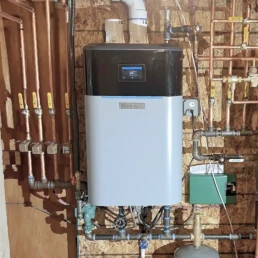
How Does a Combi Boiler Work?
One System for Home Heating and Hot Water
A combi boiler, short for combination boiler, provides two essential functions: central heating through a hot-water system and domestic hot water for showers, sinks, and other fixtures. Instead of installing a conventional boiler and a separate water heater, homeowners can combine both functions into one efficient appliance.
Separate Water Circuits for Safe Operation
Modern gas combi boilers use a closed-loop heating circuit for radiators, baseboards, or radiant floors and a separate domestic hot water circuit. The two water supplies remain separated through heat exchanger technology.
Many models prioritize domestic hot water during periods of use, automatically managing output between the home’s heating and hot water needs. Unlike conventional gas boiler systems, a combination boiler can eliminate the need for a separate domestic water heater.
Is a Combi Boiler Right for Your Home?
Ideal for Existing Hydronic Heating Systems
Combination boilers are an excellent option for many Philadelphia-area homes equipped with hot-water baseboard heating, cast-iron radiators, panel radiators, or hydronic radiant floors. Compact wall-hung models are particularly attractive when basement or mechanical room space is limited.
Homeowners replacing an aging gas boiler and separate water heater may benefit from combining both appliances into a single system.
Proper Equipment Selection Makes the Difference
Not every home is a perfect candidate. Large households with several bathrooms, unusually high simultaneous hot water demand, or heating systems requiring high water temperatures may need a different configuration.
EMCO Tech evaluates heat loss, existing radiation, incoming water temperature, hot water flow requirements, and available gas capacity before recommending a combination boiler. Our goal is a properly matched installation, not simply replacing two appliances with the smallest unit available.
Benefits of High-Efficiency Combi Boilers
A properly designed high-efficiency combi boiler system can improve comfort, simplify mechanical equipment, and reduce fuel consumption compared with some older heating arrangements.
- Two Functions in One Appliance: Provides home heating and domestic hot water without requiring a separate traditional water heater.
- Space-Saving Installation: Wall-mounted models free valuable floor space in basements, utility rooms, and compact Philadelphia homes.
- High-Efficiency Condensing Technology: Recovers additional heat from combustion gases, with the greatest efficiency benefit when heating-system return water temperatures are sufficiently low.
- Modulating Burner Operation: Adjusts firing rates to changing heating loads instead of operating continuously at full capacity.
- Hydronic Heating Compatibility: Can serve hot-water baseboards, radiators, and radiant floors when properly designed and sized.
- Modern Controls and Zoning: Many models support outdoor temperature reset, advanced diagnostics, and integration with multiple heating zones.
EMCO Tech helps homeowners compare modern combination gas boilers with conventional heating equipment to determine which system offers the best long-term value.
Combi Boiler vs. Tankless Water Heater: What’s the Difference?
Although combi boilers and tankless water heaters can look similar, they are designed for different applications. Choosing the correct system depends on whether your home requires domestic hot water alone or both domestic hot water and central hydronic heating.
Combi Boiler: Heating and Hot Water Together
A combination boiler is designed to operate your home’s hot-water heating system while also supplying domestic hot water. It can replace a conventional hot-water boiler and a separate water heater when the heating load and household hot water demand are compatible with the selected model.
Tankless Water Heater: Domestic Hot Water Only
A conventional tankless water heater primarily supplies hot water to plumbing fixtures. It is not automatically a substitute for a listed and properly designed central-heating boiler.
If your home already has a furnace or another heating system and you only need to upgrade domestic hot water, explore our tankless water heater installation and repair services instead.
Not sure which system you need? EMCO Tech can evaluate your existing heating equipment and recommend whether a combination boiler, conventional gas boiler, or dedicated water heater is the appropriate solution.
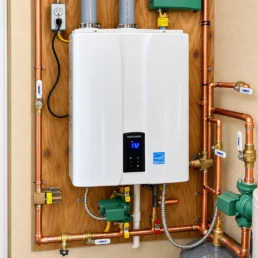
Combi Boiler Installation, Repair & Replacement Services
EMCO Tech installs, repairs, replaces, and maintains combination boiler systems throughout Greater Philadelphia, with equipment selected for your home's heating load and domestic hot water needs.
Combi Boiler Installation
Our combi boiler installers in Philadelphia design new systems around your home’s heating requirements, radiator or baseboard capacity, and domestic hot water demand. We assess gas supply, venting, condensate drainage, water quality, controls, and near-boiler piping before installing the equipment.
From compact wall-hung Navien systems to high-efficiency Weil-McLain, Rinnai, and Lochinvar models, we focus on precise sizing, safe installation, and dependable long-term operation.
Combi Boiler Replacement
Replacing an older boiler and separate water heater with a modern combination system may reduce mechanical-room equipment and improve overall heating efficiency. EMCO Tech handles equipment removal, hydronic piping modifications, gas connections, and system commissioning.
We also evaluate existing high-efficiency combi boilers when declining performance, repeated breakdowns, or major component failures make replacement a better investment than another repair.
Combi Boiler Repair & Maintenance
No heat, no hot water, frequent error codes, or unstable system pressure? Our technicians diagnose combustion, ignition, circulation, diverter valve, domestic hot water, and control problems in modern combination boilers.
We provide combi boiler repair and maintenance for major brands, including Navien, Rinnai, Weil-McLain, and Lochinvar. Emergency and same-day scheduling may be available when your heating or hot water stops working.
Combi Boiler Brands We Install & Service
EMCO Tech Heating & Cooling works with established boiler manufacturers known for advanced hydronic heating technology. Our team frequently installs and services combination boiler systems from:
- Navien Combi Boilers: NCB-H and NFC-H condensing combination boiler systems, designed for high-efficiency home heating and domestic hot water production.
- Weil-McLain Combi Boilers: ECO Tec combination models, with stainless steel heat exchangers and advanced heating controls.
- Rinnai Combi Boilers: I-SERIES+ condensing combination boiler systems for residential heating and domestic hot water applications.
- Lochinvar Combi Boilers: Noble combination boiler models with integrated heating and hot water functions.
Whether you’re planning a Navien combi boiler installation, replacing an existing Weil-McLain system, or scheduling repairs on a Rinnai or Lochinvar unit, our technicians can evaluate the model and recommend the appropriate service.
Proper Combi Boiler Sizing & System Design
Choosing a combination boiler requires more than comparing BTU ratings. A successful installation must satisfy two separate demands: the home’s heating load and the amount of domestic hot water required during peak usage.
EMCO Tech evaluates the details that influence performance, efficiency, and service life:
- Heating Load: Room-by-room or whole-building heat-loss calculations instead of copying the capacity of an old oversized boiler.
- Domestic Hot Water Capacity: Gallons per minute at the required temperature rise, including simultaneous shower and fixture demand.
- Hydronic Compatibility: Existing baseboard or radiator output, system flow rates, zoning, and operating water temperatures.
- Gas Supply & Venting: Adequate gas piping capacity, approved combustion air and exhaust arrangements, and required condensate management.
- System Protection: Appropriate water treatment, circulation, air and dirt separation, and manufacturer-required startup procedures.
Since 2006, our family-owned company has served the Philadelphia region with practical heating-system design, installation, and repair experience. We prioritize correct equipment selection and workmanship over unnecessary upgrades.
Combi Boiler Repair in Philadelphia: Common Problems We Diagnose
Combination boilers contain heating controls, circulation components, domestic hot water sensors, and heat exchangers that must operate together. When one component malfunctions, your home may lose heating, hot water, or both.
EMCO Tech provides combi boiler troubleshooting and repair throughout the Philadelphia region. Our technicians diagnose the underlying cause of the failure before recommending replacement parts or additional work.
Signs Your Combination Boiler Needs Professional Repair
- No Heat but Hot Water Works: Possible circulation problems, faulty zone controls, diverter valve issues, or heating-side sensor failures.
- No Hot Water but Heating Works: Potential domestic hot water flow sensor, plate heat exchanger, temperature sensor, or control problems.
- Frequent Error Codes or Lockouts: Ignition failures, gas supply concerns, venting restrictions, overheating, or faulty safety components.
- Low Boiler Pressure: Leaking connections, expansion tank problems, pressure relief valve issues, or insufficient system fill pressure.
- Unstable Hot Water Temperature: Restricted water flow, mineral deposits, sensor problems, or improper equipment settings.
- Short Cycling or Unusual Noises: Inadequate circulation, incorrect system settings, air in the heating loop, or heat exchanger fouling.
If your combi boiler repeatedly shuts down or struggles to maintain heat, schedule a professional evaluation through our boiler repair department. We service modern combination heating systems as well as conventional boilers.
Annual Combi Boiler Maintenance
High-efficiency combination boilers require routine maintenance to operate safely and efficiently. Depending on the manufacturer’s instructions and system condition, service may include combustion analysis, heat exchanger inspection and cleaning, condensate trap maintenance, venting inspection, water pressure testing, circulation checks, and evaluation of domestic hot water performance.
Annual professional servicing can help identify developing problems before they interrupt heating or hot water. Our boiler maintenance services include preventive care for residential hydronic heating equipment.
Replacing an Existing Heating System with a Combi Boiler
Many homes in Philadelphia and the surrounding suburbs have a traditional gas or oil boiler paired with a separate domestic water heater. When one or both appliances reach the end of their service life, installing a high-efficiency combination boiler may be a practical alternative.
Replacing a Gas Boiler and Separate Water Heater
A properly sized combi boiler can sometimes replace both appliances while retaining existing hot-water radiators or baseboard heating. During the conversion, our installers evaluate system piping, circulation, heating zones, gas capacity, venting, and domestic hot water requirements.
Existing heating-system components may be reused where appropriate, while outdated or incompatible piping, pumps, controls, and accessories may require modification.
Converting an Oil-Fired Heating System to a Gas Combi Boiler
For homeowners considering oil-to-gas conversion, combination boilers may offer an efficient alternative to replacing an old oil boiler and installing another separate water heater.
Conversion feasibility depends on natural gas availability, gas service capacity, existing hydronic distribution, venting requirements, and the overall project cost. EMCO Tech provides gas line installation and gas piping services for qualifying boiler replacement and conversion projects.
Can a Combi Boiler Replace a Steam Heating System?
A combination boiler is designed for hot-water hydronic heating, not direct steam production. Converting an existing steam system to hot water requires a separate engineering assessment and potentially substantial changes to piping, radiators, and controls. A combi boiler should not be treated as a direct replacement for a conventional steam boiler.
How Much Does Combi Boiler Installation Cost in Philadelphia?
The cost of installing a combination boiler depends on much more than the equipment price. A straightforward replacement of an existing combi boiler may require less work than converting an older boiler and water heater arrangement into one integrated system.
Factors that influence combi boiler installation and replacement costs include:
- Equipment brand, capacity, and domestic hot water output.
- Existing boiler and water heater removal.
- Gas line sizing, piping modifications, and venting requirements.
- Hydronic heating zones, circulators, and existing radiator compatibility.
- Condensate drainage, water treatment, and required installation accessories.
- Local permits, inspections, and mechanical room accessibility.
EMCO Tech provides free installation estimates so homeowners can compare equipment options and understand the full scope of work before committing to a replacement. Schedule your free combi boiler installation estimate or call 215-366-1001 to discuss your project.
Schedule Combi Boiler Service or a Free Installation Estimate
Whether you’re upgrading to a new high-efficiency combination boiler, replacing outdated equipment, or dealing with a system that has stopped heating your home, EMCO Tech Heating & Cooling is ready to help.
Our team has served residential and commercial customers since 2006, providing heating solutions throughout Montgomery County, Philadelphia, Bucks County, Chester County, and Delaware County. From Willow Grove, Abington, and Horsham to Northeast Philadelphia, Doylestown, West Chester, and Media, we provide professional boiler diagnostics, equipment selection, and installation.
Planning a new installation? Request a free combi boiler estimate to discuss equipment options and pricing.
Need repair or maintenance? Book a service appointment online or call 215-366-1001 for scheduling assistance.
Frequently Asked Questions About Combi Boilers
A combi boiler (short for combination boiler) is one appliance that supplies hydronic space heating and domestic hot water. The heating side circulates water through hot-water radiators, baseboards, or radiant floors. A separate domestic hot water circuit serves showers, faucets, and other fixtures, typically without a conventional hot water storage tank.
Most modern models are gas-fired condensing boilers with modulating burners. How they allocate heat between space heating and hot water varies by manufacturer and model: some prioritize a domestic hot water call, while certain models support simultaneous operation. Correct sizing must account for both functions.
No. A conventional tankless water heater is primarily designed to produce domestic hot water for plumbing fixtures. A combination boiler is specifically designed to produce that hot water and circulate heated water through a home’s hydronic heating system. Both may heat domestic water on demand, which explains the overlapping terminology, but their applications are different.
If your home already has another heating system and you only need hot water for showers and sinks, see our tankless water heater services. If you want one appliance for home heating and domestic hot water, a combi boiler may be the better fit.
Advantages can include a smaller mechanical-room footprint, elimination of a separate domestic hot water tank, modulating heat output, and improved fuel efficiency when a condensing system operates at suitable water temperatures. A wall-hung unit can be particularly attractive in a Philadelphia rowhome or a smaller basement.
Disadvantages include limits on simultaneous domestic hot water flow, greater reliance on one appliance for both heating and hot water, and sensitivity to improper sizing, water quality, and existing hydronic system design. A large home with several showers running at once might be better served by a boiler paired with an indirect water heater or another high-capacity arrangement. We evaluate these trade-offs before recommending equipment.
Often, yes. For a home with hot-water baseboard, radiator, or radiant-floor heating, a properly sized combi boiler may replace a traditional boiler and separate domestic hot water heater. The existing heating zones and radiation may be reusable, depending on their condition, flow requirements, and design temperatures.
A conversion is not simply a wall-hung appliance swap. The installer must check the home’s heat loss, peak hot water demand, gas piping capacity, venting, condensate drainage, controls, and near-boiler piping. An existing steam heating system is not a direct combi boiler replacement; converting steam to hot-water heat typically requires major distribution-system modifications.
A combination boiler can serve hot-water radiators, baseboard zones, and hydronic radiant floors when the heating loop and controls are designed correctly. For domestic hot water, the important number is not just the advertised BTU rating: it is the model’s gallons-per-minute output at the required temperature rise, especially during cold Pennsylvania winters.
One shower and a kitchen faucet create a very different load from three simultaneous showers. Some homes need a larger combi model, a different hot water arrangement, or separate equipment. EMCO Tech evaluates space-heating capacity and peak fixture demand independently before recommending a model.
There is no universal best brand for every house. Navien NCB-H and NFC-H, Rinnai I-SERIES+, Weil-McLain ECO Tec, and Lochinvar Noble are established combination boiler product families worth comparing. The best choice depends on your home’s heating load, required domestic hot water flow, zoning, venting, available fuel, service access, and manufacturer warranty terms.
EMCO Tech regularly installs and services these manufacturers. We compare models based on the actual application rather than selecting equipment solely by brand reputation or the largest published input rating. Model availability and equipment specifications should be confirmed at the time of your estimate.
Yes. EMCO Tech provides Navien combi boiler installation, diagnostics, repair, and replacement in Philadelphia and nearby communities. Our experience includes Navien combination boiler product lines such as NCB-H and NFC-H, along with Rinnai, Weil-McLain, and Lochinvar equipment.
If a Navien unit displays an error code, loses hot water, cycles repeatedly, or stops heating, record the model number and displayed code before scheduling service. Those details help the technician prepare, but the code alone does not confirm the failed component. Call 215-366-1001 to arrange an appointment; same-day service may be available.
Combi boiler installation cost depends on the equipment, heating and domestic hot water capacity, and the work required at your property. A straightforward installation in an existing compatible hydronic system differs substantially from replacing two appliances, increasing gas line capacity, changing venting, or correcting outdated piping and controls.
We consider equipment selection, removal, circulators and zoning, condensate management, water treatment, permits, and startup testing when preparing a proposal. Because every home’s existing equipment and piping are different, an accurate local price requires an assessment. Learn about our boiler installation process and request an estimate for your specific combi system.
Combi boiler replacement cost depends on whether you already have a combination boiler or are converting a conventional boiler plus water heater. A same-type replacement may reuse suitable connections, while a conversion can require substantial gas, venting, piping, and control changes. Model capacity and household hot water demand also affect the proposal.
Replacement deserves serious consideration when an older unit suffers repeated breakdowns, has an expensive heat exchanger or control failure, or requires parts that are no longer supported. A smaller sensor or valve repair on an otherwise sound system often makes more sense. For broader comparisons, see our Philadelphia boiler replacement guide.
Combi boiler repair costs depend on the diagnostic findings, replacement parts, accessibility, and whether the issue involves a sensor, circulation component, diverter valve, heat exchanger, ignition system, or controls. A boiler displaying an error code is not necessarily facing a major repair; a proper diagnosis should come before an estimate for replacing components.
EMCO Tech handles combi-specific problems as part of our boiler repair services. We prioritize no-heat calls and may have same-day or emergency appointments, depending on availability. If you smell gas or suspect carbon monoxide, leave the area and contact the appropriate emergency service or utility rather than attempting a reset.
Because a combi boiler performs two different jobs, it is possible for one function to fail while the other still works. Heating with no domestic hot water may involve a flow sensor, plate heat exchanger restriction, diverter valve, mixing component, or domestic hot water control fault. Hot water with no room heating can point to a thermostat, zone valve, circulator, heating sensor, or hydronic flow problem.
The exact diagnostic path varies by brand and model. A qualified technician checks fault history, operating temperatures, circulation, water flow, and controls before recommending repairs. Avoid repeatedly resetting a unit that locks out or displays a combustion-related fault.
Low pressure on the closed-loop heating side can result from a plumbing or system leak, faulty expansion tank, relief-valve discharge, trapped air, or a problem with the filling assembly. Low incoming domestic water pressure is a separate issue and may affect hot water flow at the fixtures.
Some manufacturers provide homeowner instructions for checking or restoring heating-system pressure, but the correct procedure and target pressure depend on the equipment. Follow your exact model’s manual; do not keep adding water to a system that repeatedly loses pressure. Continuous refilling can introduce oxygen and minerals and may hide an active leak. Persistent pressure loss needs professional diagnosis.
Most of the combi boilers we install are high-efficiency gas-fired systems. Selected models are designed for natural gas or liquid propane (LP), sometimes with manufacturer-approved conversion components or settings. Fuel compatibility must be verified for the exact model, and any gas conversion must be performed by a qualified technician following the manufacturer’s instructions.
Electric combination heating-and-hot-water equipment also exists, but its electrical requirements, available output, and suitability differ substantially from a gas-fired combi boiler. EMCO Tech evaluates your available fuel, electrical service, heating demand, and hot water needs before recommending an installation.
A typical combi boiler heats domestic hot water on demand, so it does not normally need a separate storage tank. However, some homes have unusually high or simultaneous hot water demands that are better served by storage or a different boiler-and-water-heater configuration.
A water softener is not automatically required for every installation. Water hardness and the manufacturer’s water-quality limits determine whether treatment is advisable, particularly where scale could affect a domestic plate heat exchanger. Domestic hot water recirculation may also be possible with certain models or approved accessories, but the design must follow the manufacturer’s specifications to avoid wasted energy or improper operation.
A properly installed and maintained combi boiler may serve a home for many years, but there is no guaranteed 20-year lifespan. Longevity depends on model quality, water chemistry, system design, cycling, installation workmanship, and maintenance. Manufacturer warranties differ for the primary heat exchanger, domestic plate heat exchanger, other parts, and labor; registration and maintenance conditions may apply.
Plan for annual professional combi boiler maintenance in accordance with the model’s instructions. Service can include combustion and venting checks, condensate inspection, heat exchanger care, hydronic pressure and expansion-tank checks, and domestic hot water performance testing. See our boiler maintenance services for scheduling information.
EMCO Tech Blog - Helpful Boiler Guides & News
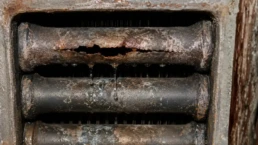
Cracked Boiler Heat Exchanger: Why Cast Iron Sections Leak and What to Do
Your boiler is losing pressure, or there is water on the floor, and someone mentioned the heat exchanger. Before you accept a replacement quote, it is worth knowing that cast iron…
Who Fixes Boilers? When to Call a Boiler Repair Technician
If your boiler stops heating, starts leaking, or keeps shutting down, the right call matters. This guide explains who fixes boilers, when you need a boiler repair technician…
Boiler Service vs Boiler Repair: What’s the Difference?
Boiler service and boiler repair are not the same thing, and mixing them up costs people time and money. This guide breaks down what annual service actually includes, what counts…

Best Heating System for Your Home in Pennsylvania: Furnace vs Boiler vs Heat Pump
Choosing the best heating system for your home in Pennsylvania isn’t about copying your neighbor. It’s about climate, insulation, operating cost, and long-term reliability. This…
Cracked Heat Exchanger: Signs, Inspection, Cost, and When Replacement Is Real
Were you just told your furnace has a cracked heat exchanger? It is a real failure, not a myth, but it is also one of the most misdiagnosed problems in heating, and the repair…

Alternative Heat Sources to Gas Furnaces for Winter Heating
Furnaces are one of the most common methods of heating homes. However, it’s not wise to assume that using a gas furnace is the optimal or safest option for winter heating. In…