


Signs Your Commercial HVAC System Is Failing in Greater Philadelphia
When a commercial heating or cooling system starts to fail, it almost never quits all at once. It warns you first—warmer air at the registers, a floor that won’t hold temperature, a bill that creeps up for no obvious reason. Catching those early signals is the difference between a quick service call and a shut-down dining room, a server closet over 90°F, or a waiting room full of uncomfortable patients.
For a business, a down HVAC system isn’t just discomfort—it’s lost productivity, walk-outs, spoiled inventory, and overtime to recover. Below are the 12 most common signs of a failing commercial HVAC system we diagnose for businesses across Philadelphia, Montgomery, Bucks, Chester, and Delaware counties—what each symptom usually means, and how urgent it is. Most appear in summer on the cooling side, but the same warning signs apply to your heating system in winter.
★★★★★
4.9 from 359 Google reviews — see why local businesses call us
Business AC down or barely cooling?
Don't lose a day of business to a failing system. Our team provides emergency commercial AC service across Greater Philadelphia—fast response any time.
12 Signs Your Commercial HVAC System Is Failing
1. Your energy bill spiked for no reason
If your cooling habits haven’t changed but your bill jumped, the system is working harder than it should to deliver the same comfort. A commercial AC can keep running while it loses efficiency—low refrigerant, a dirty coil, a failing capacitor, or a fan motor dragging all force the unit to pull more power. Because the unit still “runs,” the problem is easy to miss until the bill arrives. A sudden climb of 15–30% is worth a professional look.
2. Strange noises that weren’t there before
A healthy system hums. Anything louder is a clue:
- Rattling or banging — loose hardware, a failing blower assembly, or a motor mount coming apart.
- Squealing — a worn or slipping belt on a belt-driven rooftop unit, or a bearing going bad.
- Hissing or bubbling — a refrigerant leak under pressure.
- Clicking that won’t stop — an electrical/relay or control issue.
- Grinding — metal-on-metal; shut the unit down and call before it seizes.
New noise is the cheapest warning you’ll ever get. Acting on it early usually means a small part instead of a compressor.
3. Odors coming from the vents
What you smell narrows the cause fast. A musty smell points to mold or mildew in the ductwork, drain pan, or on a damp coil. A burning or hot-electrical smell means stop the unit now—it can signal overheating wiring or a motor. A rotten-egg smell near a gas-fired rooftop unit can indicate a gas issue and warrants leaving the area and calling immediately. In a commercial space, poor air quality also shows up as headaches, stuffiness, and staff complaints, not just odor.
4. It’s running but blowing warm air
One of the most common calls we get: the unit is on, the fan is moving air, but the air isn’t cold. Usual culprits are low refrigerant from a leak, a frozen evaporator coil, a tripped compressor, or a controls/thermostat fault. On rooftop units, a failed contactor or capacitor can leave the fan running while the compressor is dead. This one rarely fixes itself—warm air on a hot day is a same-day issue for most businesses.
5. Some areas cool fine, others never do
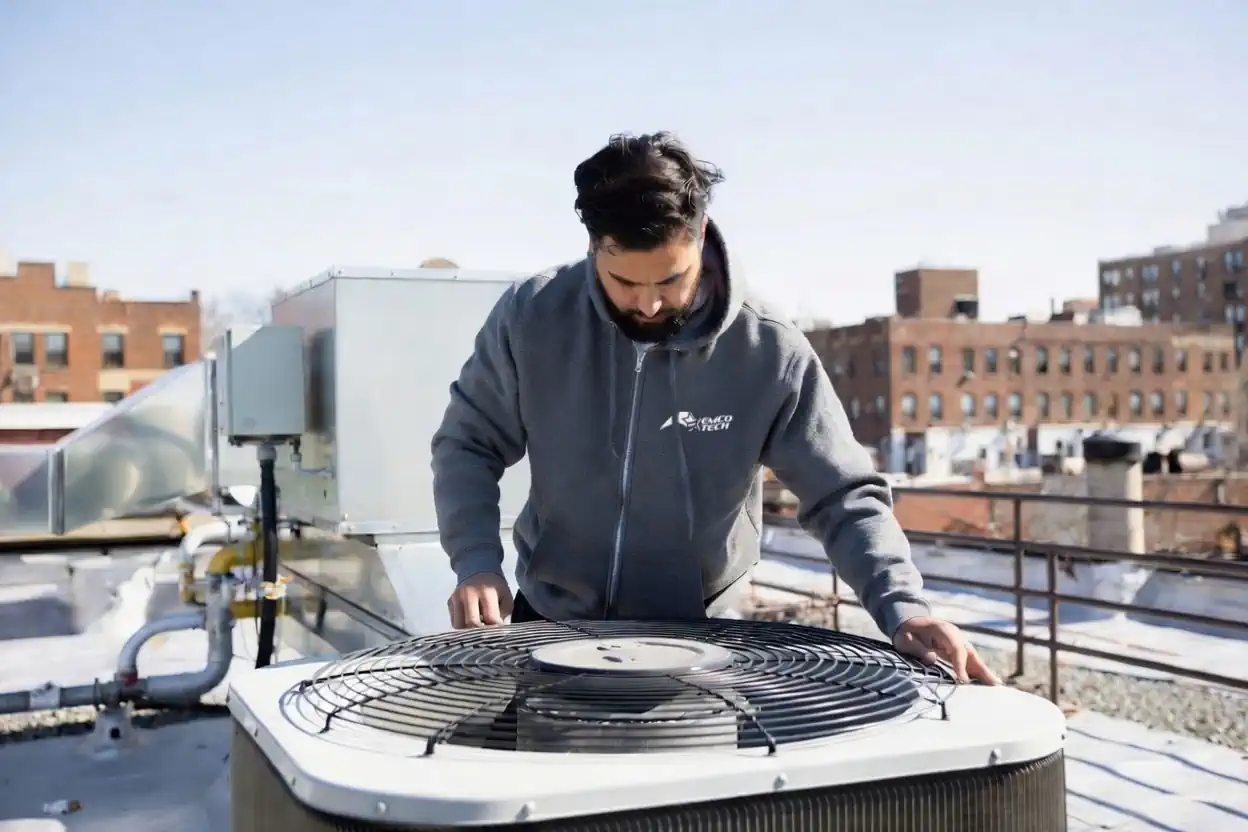 Uneven cooling across floors, wings, or zones is classic in larger commercial buildings. Causes include blocked or leaky ductwork, a dirty filter starving airflow, a zoning damper stuck shut, or—commonly—a system that’s undersized or out of balance for how the space is actually used. If one conference room is an icebox and the one next door is sweltering, the system is straining to compensate, which wears components faster.
6. Weak airflow at the registers
If the air coming out is noticeably feeble, the system isn’t moving the volume it should. Think clogged filters, a failing blower motor, a slipping belt, or duct obstructions. Weak airflow makes everything downstream worse—it’s a leading cause of frozen coils (see #8) and short cycling (see #7).
7. It turns on and off every few minutes (short cycling)
A commercial AC should run in steady cycles. When it switches on and off rapidly, it’s short cycling—and that’s hard on the most expensive part you own, the compressor. Causes range from an oversized unit, to low refrigerant, to a dirty coil, to a thermostat placed in a bad spot. Short cycling burns energy, never properly dehumidifies the space, and shortens equipment life. Don’t wait this one out.
8. Ice on the coil or refrigerant lines
Ice on a cooling system in summer feels backwards, but it’s a real warning sign. Restricted airflow (dirty filter, weak blower) or low refrigerant drops the coil temperature below freezing and moisture freezes onto it. Once iced, the unit can’t cool and the backup of pressure can damage the compressor. If you see ice, shut the system off, let it thaw, and have it diagnosed before running it again.
9. Water leaking or pooling around the unit
A commercial AC pulls humidity out of the air and drains it away. When you see water pooling near an air handler or dripping from a ceiling below a rooftop unit, the condensate drain is usually clogged with algae or sludge, the drain pan has rusted through, or the coil froze and is now thawing. Left alone, this leads to water damage, ceiling stains, and mold—an expensive secondary problem on top of the AC repair.
10. The air feels sticky even when the AC is on
Commercial cooling should control humidity as it cools. If the space feels damp and clammy despite the thermostat reading “cool,” the system isn’t removing moisture properly—often from short cycling, an oversized unit, or low refrigerant. High indoor humidity is uncomfortable, encourages mold, and can damage paper goods, electronics, and inventory.
11. The thermostat or controls aren’t responding
A blank thermostat, settings that won’t hold, or a building-management system reading that doesn’t match reality can all point to control faults, wiring problems, sensor drift, or simply dead batteries. Because the thermostat is the brain of the system, a fault here can masquerade as a much bigger mechanical problem—worth ruling out early.
12. You’re calling for repairs more than once a season
One repair is normal wear. A pattern of repairs is the system telling you it’s near the end of its useful life. Most commercial AC units last roughly 10–15 years with regular maintenance; past that point, efficiency drops, parts get harder to source, and small failures multiply. When repair calls cluster, it’s time for a straight repair-versus-replace conversation (see below).
Rooftop & Packaged Units: What’s Different for Commercial Buildings
Most Philadelphia-area businesses cool with rooftop units (RTUs) or packaged systems rather than the split systems found in homes. They live outdoors year-round, run long hours, and are out of sight—so problems often go unnoticed until comfort drops. A few rooftop-specific warning signs to watch:
- Belt squeal or shredded belt on belt-driven RTUs—an easy, inexpensive fix if caught early.
- Standing water or rust streaks on the curb, which can lead to leaks into the ceiling below.
- Debris, nests, or storm damage blocking the condenser—common after Philadelphia summer storms.
- Economizer dampers stuck open or closed, quietly wasting energy or pulling in hot outside air.
Because rooftop access and safety matter, RTU diagnosis is a job for a technician with the right equipment. If your roof unit is showing any of the symptoms above, our team handles commercial AC service across Greater Philadelphia, and we keep restaurants and other high-runtime spaces cooling through peak season.
Why Commercial AC Problems Aren’t the Same as Home AC
Commercial systems are built for tougher demands—multiple zones, longer runtimes, bigger loads, and tighter requirements for places like medical offices and schools. That complexity means more places for things to go wrong: zoning dampers, economizers, building controls, and multi-stage compressors all add failure points a home system doesn’t have. It also means the cost of downtime is higher, so early diagnosis pays off faster. A problem that’s an inconvenience at home can stop a business cold.
What You Can Check Yourself vs. When to Call a Pro
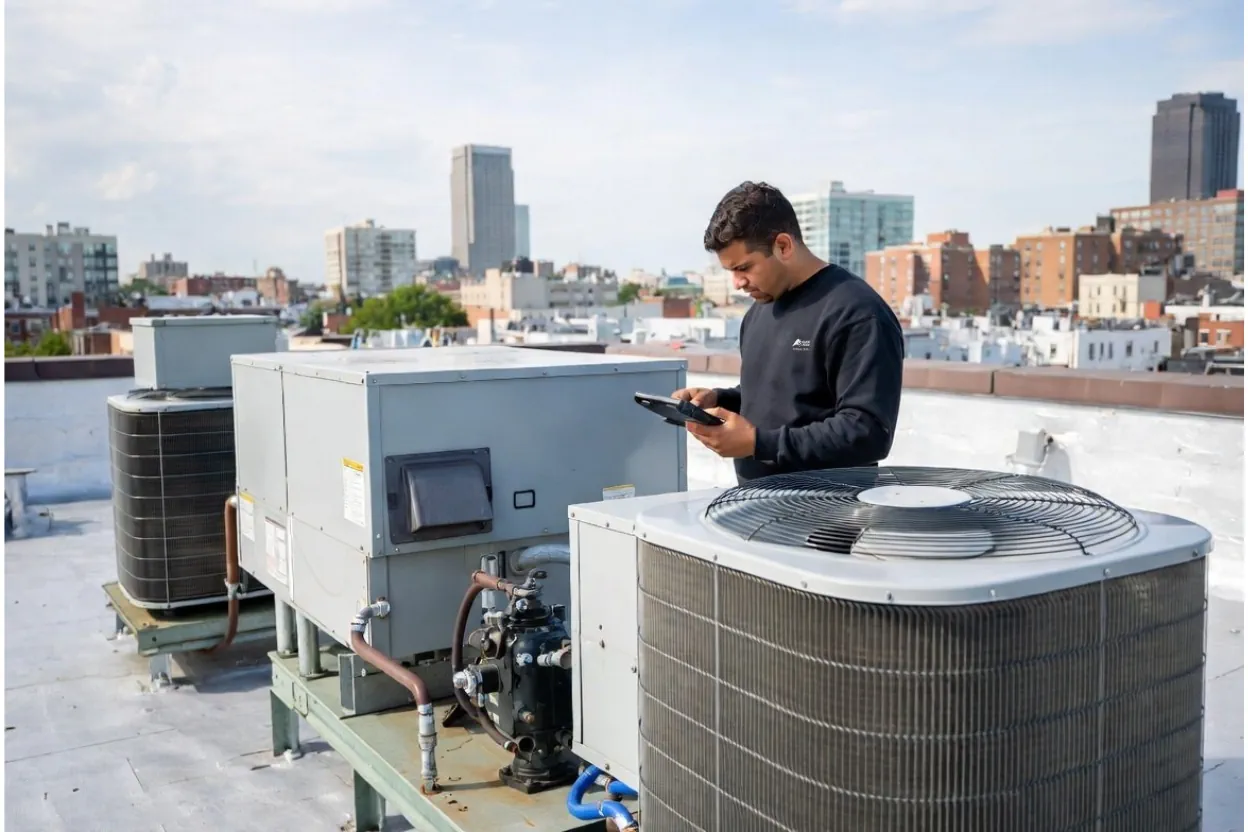 A few quick checks are safe for any facility manager before you pick up the phone:
- Confirm the thermostat is set to cool, at the right temperature, with live batteries.
- Check the breaker—a tripped breaker is a common, simple cause.
- Look at the air filter; a clogged filter causes weak airflow, freezing, and short cycling.
- Make sure supply and return vents aren’t blocked by furniture, stock, or equipment.
Stop and call a professional for anything involving refrigerant, electrical components, the compressor, rooftop access, gas, ice, or burning smells. These aren’t DIY territory—handling refrigerant requires EPA certification, and rooftop work carries real safety risk. If your business is already without cooling, our emergency HVAC team offers fast response any time, and routine commercial maintenance plans catch most of these problems before they start.
Repair or Replace? How to Think About It
A useful rule of thumb: if a major repair costs more than about half the price of a new system and the unit is already past 10 years old, replacement usually wins over time. Beyond age and repair cost, factor in how often it’s breaking down, how much it’s adding to your energy bills, and whether it’s keeping up with the space at all.
One more piece for 2026: newer commercial equipment now uses next-generation low-GWP refrigerants such as R-454B, while older systems run on R-410A. Your existing R-410A system is fine to keep, service, and recharge—you don’t have to replace a working unit. But as R-410A supply tightens, the cost to recharge an older system is climbing, which can tip a borderline repair-versus-replace decision. It’s worth asking your technician which refrigerant your system uses and what that means for future service costs. When you’re ready to weigh options, our team walks you through commercial AC service and replacement with no pressure.
This is general guidance, not a recommendation for your specific system—an on-site diagnosis is the only way to know for sure.
This is a custom heading element.
A commercial AC that runs but blows warm air usually has low refrigerant from a leak, a frozen evaporator coil, a tripped or failed compressor, or a controls/thermostat fault. On rooftop units, a failed contactor or capacitor can keep the fan running while the compressor is dead. Because warm air on a hot day stops most businesses, it’s typically a same-day repair.
Short cycling—turning on and off every few minutes—means the system can’t complete a normal cooling cycle. Common causes are an oversized unit, low refrigerant, a dirty coil, or a poorly placed thermostat. It strains the compressor, wastes energy, and leaves the space humid, so it should be diagnosed quickly.
Rooftop units pull humidity from the air and drain it away. Leaks usually mean a clogged condensate drain, a rusted-through drain pan, or a coil that froze and is now thawing. Because the water can drip into the ceiling below, it’s worth addressing promptly to avoid stains, water damage, and mold.
Most commercial AC systems last about 10 to 15 years with regular maintenance. Past the 10-year mark, efficiency declines, parts get harder to source, and repairs cluster. If you’re calling for service more than once a season on an older unit, it’s a good time to weigh repair against replacement.
A healthy system runs with a steady hum. Rattling or banging points to loose parts or a failing blower, squealing to a worn belt or bearing, hissing to a refrigerant leak, and grinding to metal-on-metal wear. New or louder noises are early warnings—acting on them usually means a small repair instead of a major one.
Ice forms when airflow is restricted (a dirty filter or weak blower) or refrigerant is low, dropping the coil below freezing. A frozen coil can’t cool and can damage the compressor. Shut the unit off, let it thaw, and have it diagnosed before running it again.
Plan on professional maintenance at least twice a year, with filter checks more often in high-dust or high-traffic spaces. Regular service catches most of the warning signs in this guide early, extends equipment life, and keeps energy costs down. A commercial maintenance plan makes this routine and adds priority scheduling.
Commercial HVAC Problems FAQ
Latest Updates – Keep Cool, Feel Warm, Breathe Clean Air with EMCO Tech
Emergency Heat (AUX) Won’t Turn Off? Here’s Which Heat Pump Fixes It
If AUX or emergency heat runs all winter, the heat pump has handed your house to electric backup strips, and the PECO bill shows it. See how…
Planning a Heat Pump Replacement: Upgrade Before It Fails
The worst time to replace a heat pump is the morning it dies. A planned swap lets you choose the equipment, lock in better pricing, and stay warm on…