



Emergency Heat (AUX) Won't Turn Off? Here's Which Heat Pump Fixes It
If the thermostat says AUX or EM Heat and the PECO statement just jumped, the outdoor unit is no longer doing the real work. The backup heater is.
AUX or EM Heat stuck on and the bill climbing?
That is backup electric heat carrying your house, not your heat pump. Get the system diagnosed before another PECO cycle.
What auxiliary heat and emergency heat actually are
A heat pump does not make heat the way a toaster does. It moves heat from outdoor air into the house. That is why a working heat pump can deliver two to four units of heat for every unit of electricity it uses. An electric resistance coil, the backup strips in most air handlers, delivers one unit of heat for every unit of electricity. Same comfort. Three times the bill, or worse.
Auxiliary heat (AUX on the thermostat) turns on automatically. The heat pump is still trying. The indoor strips or a paired furnace add extra heat because the outdoor unit cannot keep up with the setpoint. That is normal on a standard system when it is below freezing, during a defrost cycle, or when someone raises the thermostat several degrees at once.
Emergency heat (EM Heat) is a manual setting. It shuts the outdoor unit off and runs only the backup. Use it when the outdoor unit is dead, iced beyond a normal defrost, or a technician told you to. Leaving EM Heat on all January is how an all-electric house burns four figures on one winter bill.
On the thermostat itself, this usually shows up as two separate settings, not one. “Heat” or “Auto” mode is normal operation, the heat pump runs on its own and calls AUX automatically if it needs help. “Em Heat” or “Emergency Heat” is a separate mode you have to select manually, and choosing it turns the outdoor unit off completely. If the system is stuck on Em Heat and nobody meant to put it there, switching the thermostat back to Heat or Auto returns it to normal heat pump operation immediately. Not every heat pump system has this option in the first place. If the outdoor unit is paired with electric backup strips or a dual-fuel furnace, the Em Heat setting will be there. A straight air conditioner with no heat pump function, or a system with no backup heat source at all, will not show it.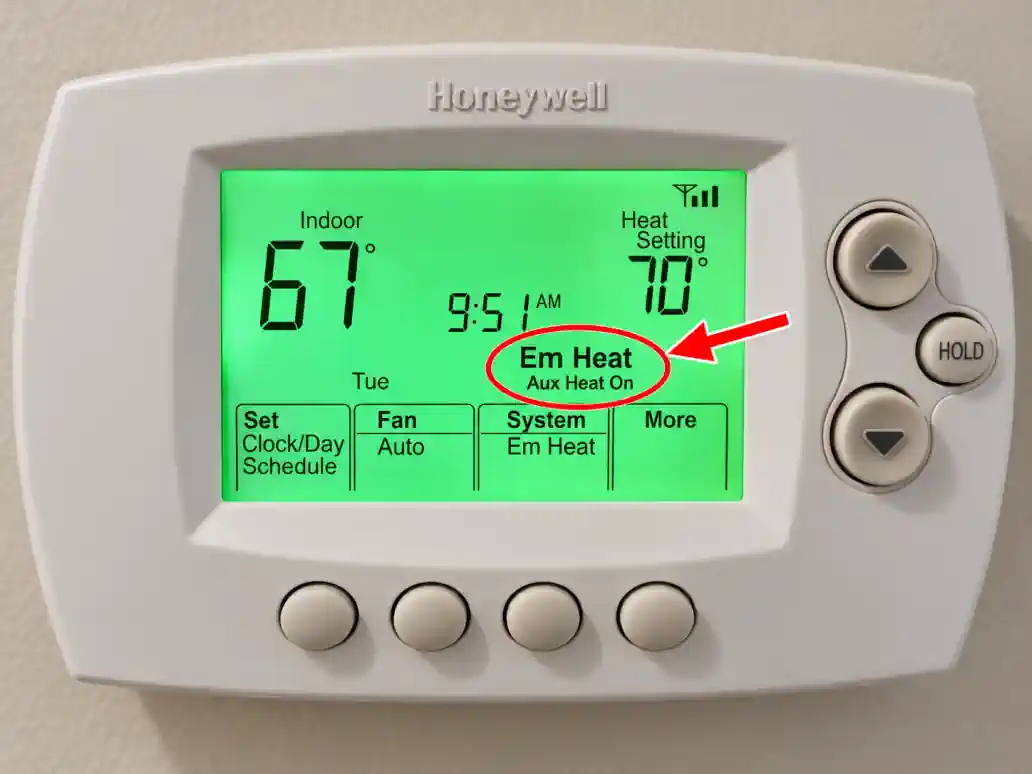
How a regular heat pump behaves
On a conventional single-stage or two-stage heat pump, capacity falls hard as the outdoor temperature drops through the 30s. Below freezing, many of these units are already leaning on backup. By the teens, a normal design-night range across Montgomery County, Philadelphia, Bucks County, Chester County, and Delaware County, the compressor is doing a fraction of the work and the strips or furnace are carrying the house. The AUX light is not a fault code. It is the system admitting the outdoor unit has run out of cheap heat.
How a high-end inverter and cold-climate system behaves
A variable-speed inverter compressor can spin faster when the air is thin and cold. A cold-climate heat pump is built to keep extracting heat well below freezing, often holding most of its rated capacity into the single digits, with usable output below zero. Auxiliary heat still exists as a safety net. It should not be the nightly plan. On a well-set system you may see AUX for a few minutes during defrost or a big morning recovery. You should not see it locked on at 38°F.
Every house is wired and programmed a little differently. Balance points, lockouts, and dual-fuel changeover are set at install. If AUX runs constantly in mild weather, or the house will not hold setpoint, do not guess at the thermostat. Have the system diagnosed, starting with the original installer or a shop that actually works your brand.
If the unit is down today, that is a heat pump repair call, not an equipment lecture.
Why the electric bill explodes when backup heat takes over
Heat-pump mode is cheap heat. Strip mode is an electric furnace wearing a heat-pump costume. On PECO rates, a house that lives on backup for a cold week can add hundreds of dollars. A full month of strips carrying an older or undersized system is how some homeowners see a winter bill they do not recognize, sometimes crossing into four figures.
In plain numbers: a heat pump in normal operation can move two to four units of heat for every unit of electricity it uses. Emergency heat makes one unit of heat per unit of electricity, the same as a space heater. That is not a small gap. Running on backup instead of heat-pump mode can roughly double, triple, or worse the electric cost of keeping the house the same temperature, depending on the system and the weather. That is not “the heat pump is inefficient.” That is the heat pump having left the building. The compressor is the efficient machine. The coil in the air handler is a space heater. If winters stay sharp, paying for a system that remains in heat-pump mode at 10°F or 5°F is not a luxury feature. It is the difference between moving heat and manufacturing it.
A higher first cost on a cold-climate or high-efficiency inverter system pays back in the winters where a standard unit would have handed the load to strips. The payback is fastest in leaky or all-electric homes, and in houses that already watch AUX light up every time the forecast dips below freezing.
Three ways Greater Philly homes heat with a heat pump now
EMCO Tech is a Carrier preferred dealer serving Montgomery County, Philadelphia, Bucks County, Chester County, and Delaware County. The Carrier residential lineup is the frame we use with homeowners: a straightforward system that needs backup sooner, a premium communicating system built for deep cold, and a high-efficiency inverter crossover that puts serious low-ambient heating on the ductwork you already have, without the full premium-tier price.
1. Standard-efficiency heat pumps
Single-stage or two-stage outdoor units. Fine in October and April. They lose a large share of heating capacity as outdoor air falls through freezing. Backup, electric strips or a gas furnace in a dual-fuel setup, is not a rare event. It is the January plan. Upfront cost is the lowest of the three. Operating cost on the coldest mornings is the highest if the backup is electric.
Best fit: milder winters, dual-fuel with a healthy gas furnace, or a house where first cost has to win.
Watch-out: AUX that starts in the mid-30s and stays on. That is a PECO problem, not a comfort badge.
2. Premium cold-climate systems
Variable-speed inverter compressors, matched indoor equipment, and controls that actually talk to each other. Carrier’s Infinity line with Greenspeed intelligence is the example we install when the homeowner wants the outdoor unit to keep working in heat-pump mode deep into a Delaware Valley cold snap, published heating well below zero on the right model, not a marketing footnote.
You pay more on day one because the indoor coil or furnace, the thermostat, and the outdoor unit are a matched system. You buy back that money on the nights a standard unit would have been a strip heater. Quiet, steady supply air. Fewer on and off swings. Aux heat as a last resort, not a lifestyle.
Best fit: all-electric homes, older houses that already punish a weak outdoor unit, anyone who is tired of watching AUX.
The catch: it is the top of the ladder. It is worth it when the bill and the comfort both justify the match.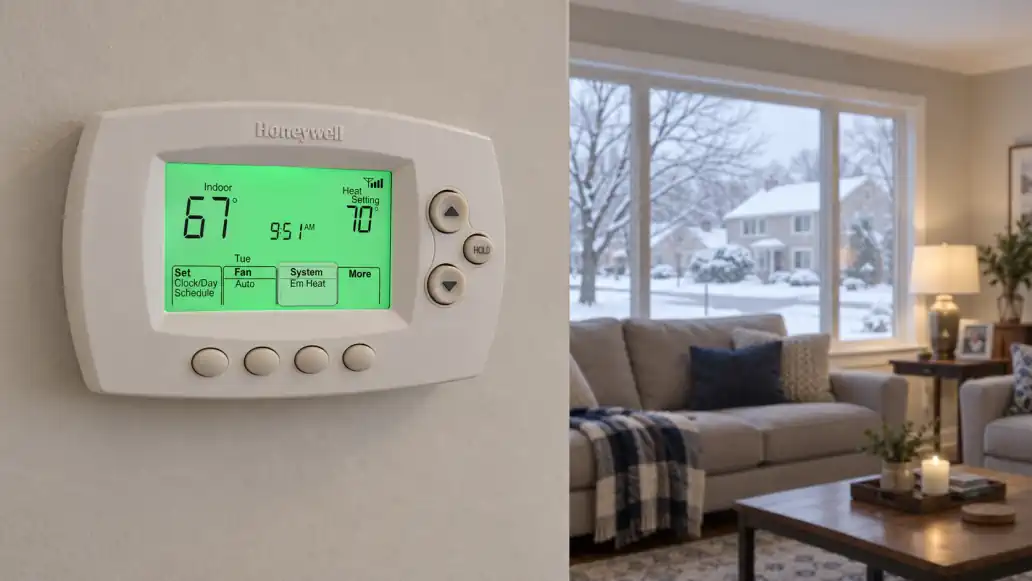
3. The crossover: high-efficiency inverter, side-discharge, on your existing ducts
This is the option most quotes still skip. A compact side-discharge outdoor unit, the slim cabinet people associate with ductless, can be piped to a conventional air handler or furnace and push heat through the vents you already have.
Those outdoor units use the same family of hyper-inverter technology that keeps a ductless head heating when it is ugly outside. You get low-ambient capacity and a quiet cabinet without buying a full premium communicating indoor suite. The indoor side can stay a standard air handler or a regular furnace in dual-fuel. That is how you get cold-weather inverter performance without the Infinity price tag.
Best fit: a house with decent ducts, a furnace or air handler that still has life, and a homeowner who wants sub-freezing heat-pump mode without a full premium swap.
Not a loophole: it still has to be sized, charged, and controlled correctly. A pretty outdoor cabinet on the wrong indoor coil is just a pretty outdoor cabinet.
Which of the three belongs in your house
| Standard | Premium cold-climate | Inverter crossover | |
| Heat-pump mode in the teens | Weak. Backup carries a lot of the night. | Strong. Aux is the exception. | Strong on a correctly sized unit. |
| PECO exposure | High if backup is electric strips. | Lowest of the three. | Low when the inverter is doing the work. |
| Upfront cost | Lowest. | Highest. Matched indoor + controls. | Middle. Premium outdoor, standard indoor. |
| Indoor equipment | Standard air handler or furnace. | Matched communicating indoor. | Existing or standard air handler / furnace. |
There is no single right answer for every rowhome in Fishtown and every colonial in Horsham. Ducts, electrical service, existing furnace, and how hard the house leaks all change the math. What does not change: if AUX is a habit above the mid-30s, you are paying electric-heater prices for heat-pump comfort. That is the upgrade conversation.
What a planned upgrade looks like here
We work from 2424 Wyandotte Rd in Willow Grove and 7934 State Rd in Philadelphia. A heat pump installation visit is a load look at the house, not a model number first. Cold-climate ducted, dual-fuel with the furnace you have, or a side-discharge inverter on existing ducts. Then a written quote, current incentives we can document, and a schedule that does not wait for the outdoor unit to die on a Tuesday night.
If the system is already in the last third of its life, read planning a heat pump replacement before you buy another compressor for a 14-year-old box. If you want the equipment family in one place, start with Carrier residential HVAC systems.
Two maintenance visits a year keep defrost, charge, and airflow honest. That is how an inverter system stays in heat-pump mode instead of quietly sliding back onto strips.
The temperature where backup heat takes over is the whole ballgame
Every heat pump has a point where it can no longer pull enough heat out of the outdoor air to keep up with what the house is losing. Installers call it the balance point. Below it, the strips or the furnace start filling the gap. That single temperature decides your winter bill more than the efficiency sticker on the side of the cabinet does.
Two different numbers get quoted, and they are not the same thing:
Operating limit. The lowest outdoor temperature at which the compressor is still allowed to run and make heat. This is the number in the brochure, like heating down to -13°F.
Balance point. The temperature in your specific house where the heat pump alone stops holding setpoint and backup joins in. This depends on the equipment, the size of the house, the insulation, and the ductwork. It is calculated, not printed on a box.
A brochure number that reads well does not automatically shut the strips off. What it does is give the balance point room to fall. On a standard unit, the compressor is running out of capacity in the 30s, so backup starts early no matter how the system is set up. On a cold-climate inverter, the compressor is still producing real output in the single digits, so a properly sized system can hold the house on heat-pump mode through nearly every night of a Delaware Valley winter. That is where the money is.
Our winter design nights around Philadelphia and the surrounding counties land in the mid-teens. A system that gives up at 35°F and a system that is still working at 5°F both keep the house warm. Only one of them does it without running an electric space heater in your air handler to get there.
Carrier heat pump tiers compared
EMCO Tech is a Carrier preferred dealer, so this is the lineup we quote from every day. Three tiers, and a crossover option in the middle that most quotes skip entirely.
Scroll the table sideways to see all three tiers.
| Standard grade Comfort series |
Cold-temperature crossover Side-discharge inverter |
Premium cold climate Infinity with Greenspeed |
|
|---|---|---|---|
| Example models | 27SCA5, 27TPA8 (legacy 25HCE4) |
38MURA, 37MUHA | 27VNA3 Infinity 23 27VNA1 Ultimate Cold Climate |
| Compressor | Single-stage or two-stage | Variable-speed twin rotary inverter | Variable-speed, modulates 30 to 100 percent |
| Cooling efficiency | Up to 16 to 18.5 SEER2 | Up to 18 to 19 SEER2 | Up to 21.2 to 23 SEER2 |
| Heating efficiency | Up to 7.8 to 8.5 HSPF2 | Up to 9.7 to 10.8 HSPF2 | Up to 10.5 to 12 HSPF2 |
| Keeps making heat down to | Capacity falls off hard through the 30s | -22°F on the 38MURA | -13°F on the Infinity 23 -23°F on the Ultimate Cold Climate |
| When backup heat joins in | Routinely, starting near freezing. The January plan | Rarely. Defrost and deep-cold nights | Rarely. Designed as a safety net, not a schedule |
| Indoor side | Standard air handler or furnace | Works with a standard air handler or your existing furnace in dual fuel | Matched communicating indoor unit and Infinity control |
| Outdoor cabinet | Conventional top-discharge | Compact side-discharge, installs inches from the wall, stackable | Conventional top-discharge, full size |
| First cost | Lowest | Middle | Highest |
| Winter operating cost | Highest if backup is electric | Low | Lowest |
| Best fit | Dual fuel with a healthy gas furnace, or first cost has to win | Good ducts, tight side yard, furnace or air handler with life left | All-electric homes, older leaky houses, anyone tired of watching AUX |
Efficiency and operating-temperature figures are published Carrier ratings for the model families listed and vary by size and by matched indoor equipment. The operating limit is not a promise that backup never runs. Actual balance point comes from a load calculation on your house.
Tier 1: standard-efficiency heat pumps
Carrier Comfort series, models like 27SCA5 and the two-stage 27TPA8. Roughly 16 to 18.5 SEER2 cooling, 7.8 to 8.5 HSPF2 heating.
Single-stage or two-stage outdoor units. They run at full tilt or not at all, or flip between two speeds. Fine in October and April. The problem is what happens in January: capacity falls off sharply as outdoor air drops through freezing, so the strips or the furnace are not an emergency, they are the plan. Upfront cost is the lowest of everything here.
Best fit: dual fuel paired with a gas furnace that still has years on it, or a house where first cost has to win.
Watch-out: AUX that starts in the mid-30s and stays on. On an all-electric house, that is the setup behind the winter bills people bring us.
Tier 2: the crossover, high-efficiency inverter on the ducts you already have
This is the option most quotes still skip, and it is the one that solves the aux-heat problem for the largest number of Philly-area homes. A compact side-discharge outdoor unit, the slim cabinet people associate with ductless, piped to a conventional air handler or your existing furnace, pushing heat through the vents you already have.
Those outdoor units run the same family of inverter technology that keeps a ductless head heating when it is ugly outside. You get low-ambient capacity and a quiet cabinet without buying a full premium communicating indoor suite. There are two we reach for.
Carrier Performance 38MURA. Up to 18.8 SEER2 cooling, up to 9.8 HSPF2 heating, variable-speed twin rotary inverter compressor, published heating performance down to -22°F, sound down around 55 decibels.
The workhorse of the middle tier. It pairs with the 40MUAA fan coil for an all-electric setup, or it can run alongside a properly sized gas furnace as dual fuel so the furnace only wakes up on the worst nights. Intelligent defrost keeps it from wasting cycles clearing ice. The cabinet installs as close as six inches from the house, which matters on a rowhome or a twin where the side yard is a walkway.
Best fit: decent ductwork, tight exterior clearances, and a homeowner who wants sub-freezing heat-pump mode without a full premium swap.
Carrier Comfort 19 crossover, 37MUHA. Up to 19 SEER2 cooling, up to 10.8 HSPF2 heating, Puron Advance refrigerant, sound as low as 59 decibels.
The higher heating number here is the headline. HSPF2 of 10.8 is premium-tier heating efficiency in a crossover cabinet, which is why this one keeps showing up on quotes where the budget will not stretch to Infinity but the house is all-electric and the winter bill is the whole reason for the call. It installs as close as four inches from the exterior wall and the units stack, which makes it workable on twins, multi-unit buildings, and city lots with no side yard at all. Paired with the 45MUAA fan coil it takes a four-inch MERV 13 filter, so the air quality side does not get downgraded to buy the efficiency.
Best fit: all-electric homes and tight lots where heating efficiency is the priority and the premium tier is out of budget.
Not a loophole. A crossover system still has to be sized, charged, and controlled correctly, and the changeover or lockout settings have to be programmed for your house. A compact outdoor cabinet on the wrong indoor coil with a default lockout is just a compact outdoor cabinet that still runs your strips.
Tier 3: premium cold-climate Infinity systems
Variable-speed inverter compressors, matched indoor equipment, and controls that actually talk to each other. This is where the compressor holds output furthest into the cold and where aux heat genuinely becomes a last resort instead of a nightly habit.
Carrier Infinity 23 heat pump, 27VNA3, with Greenspeed intelligence. Up to 23 SEER2 cooling, up to 10.5 HSPF2 heating, heating operation down to -13°F, cooling capacity up to 125°F.
The efficiency flagship. Adaptable-speed technology paired with the Infinity System Control means it makes constant small adjustments instead of slamming on and off, so supply air stays steady and quiet. Advanced defrost keeps ice cycles short. Over-the-air software updates mean the system can be improved after it is installed, and a Quiet Mode is there for the nights the outdoor unit sits under a bedroom window.
Best fit: homeowners who want the highest combined cooling efficiency and cold-weather heating in a conventional ducted system.
Carrier Infinity variable-speed Ultimate Cold Climate heat pump, 27VNA1. Up to 21.2 SEER2 cooling, up to 12 HSPF2 heating, heating operation down to -23°F, modulates between 30 and 100 percent capacity.
This is the one built specifically for the problem this whole article describes. HSPF2 of 12 is the highest heating efficiency in the ducted lineup, and heating operation to -23°F means the compressor is still the machine making your heat on nights the Delaware Valley almost never sees. On a correctly sized install in a normal Montgomery or Bucks County house, the balance point lands low enough that the strips become a genuine safety net rather than a line item on the PECO bill.
Best fit: all-electric homes, older houses that punish a weak outdoor unit, and anyone who has watched a winter bill cross four figures and decided it is not happening again.
The honest catch on Tier 3. You pay more on day one because the indoor coil or furnace, the thermostat, and the outdoor unit are a matched set and have to be installed as one. You buy that money back on every night a standard unit would have handed the house to a strip heater. If the house is on gas and the furnace is healthy, dual fuel with a Tier 2 crossover often gets most of the same result for less. We will tell you which one your house actually needs.
When backup heat should be running and isn't
Everything above covers backup heat running too much. The opposite problem is less common but more serious: a house that stays cold on a freezing night because Emergency or AUX heat never kicked in when it should have. If the heat pump is straining to keep up and the backup never engages to help, that usually points to a failed relay, a control board issue, or a backup heat source that has stopped working entirely, not just a thermostat setting.
This is not a wait-and-see situation, especially overnight in real cold. If the house cannot hold temperature and the AUX or Em Heat indicator never lights up even as it gets colder, that is worth a same-day repair call, not a system reset attempt.
What this actually looks like on a PECO bill
This is not theoretical for us. Every winter we walk into all-electric houses in Montgomery, Bucks, Chester, Delaware, and Philadelphia counties where the January statement crossed fifteen hundred dollars, and in most of them the equipment was never broken. The heat pump was simply out of capacity, the strips picked up the load, and nobody told the homeowner that was going to happen.
Regional reporting backs up what we see in the field. During a recent cold stretch, PECO residential customers used about twelve percent more electricity in January than the typical winter average over the previous ten years, and the utility recorded its highest natural gas demand on record that February. Local homeowners interviewed during that stretch described electric bills that landed near or above a thousand dollars and roughly doubled from one month to the next.
Cold weather explains part of that. What it does not explain is why two houses on the same block, both electric, both the same size, can be six hundred dollars apart on the same statement. The difference is usually which machine was making the heat. Moving heat costs a fraction of manufacturing it. The tier you buy decides how many nights a winter you get to keep moving it.
A higher first cost on a crossover or Infinity system pays back in exactly those winters. The payback runs fastest in leaky homes, all-electric homes, and any house already watching AUX light up every time the forecast dips below freezing.
Which of the three belongs in your house
There is no single right answer for every rowhome in Fishtown and every colonial in Horsham. Ducts, electrical service, existing furnace, and how hard the house leaks all change the math. What does not change: if AUX is a habit above the mid-30s, you are paying electric-heater prices for heat-pump comfort. That is the upgrade conversation, and it starts with a load calculation, not a model number.
Quick answers
No. AUX is automatic help while the heat pump still runs. Emergency heat is a manual override that turns the outdoor unit off. One is normal in real cold. The other is a temporary bridge when the outdoor unit should not run.
A heat pump changes temperature slowly. A jump of several degrees looks like a rush job to the control board, so it calls backup to catch up. Set it and leave it. Large setbacks are how people train a system to waste electricity.
Yes. A standard unit can still run. It just makes less heat, so backup fills the gap. An inverter cold-climate unit is built to keep that gap small, which is the entire point of paying more for the outdoor unit.
In heat-pump mode, yes, by a wide margin. The day the strips take over, you are paying electric-heat prices. The upgrade is not that heat pumps are magic. The upgrade is staying in heat-pump mode longer.
There is no single number, because it depends on your house, not just your equipment. The point where the heat pump alone stops holding setpoint is called the balance point, and it comes from the size of the system against how fast the house loses heat. On a standard single-stage system that balance point often lands near freezing, which is why AUX becomes routine in January. On a cold-climate inverter system the compressor keeps producing real output far lower, so a correctly sized install pushes that point down into the single digits or below. Published operating limits run from -13 degrees on a Carrier Infinity 23 to -23 degrees on the Ultimate Cold Climate model.
Often no. A side-discharge crossover heat pump such as the Carrier 38MURA can be installed on the ductwork you already have and paired with your existing furnace as a dual-fuel system. The heat pump carries the house on efficient heat-pump mode through most of the winter, and the furnace only takes over on the coldest nights or during recovery. That keeps the equipment cost down and still gets the strips out of the picture.
No, and that is the key difference between the two backup modes. AUX heat runs alongside the heat pump automatically, both are working together to keep up with demand. Emergency heat is different: selecting it manually shuts the outdoor heat pump off completely and runs only the backup heat source by itself.
No, emergency heat itself is a normal, safe backup function built into the system, it is not a fire risk on its own. The real issue is cost, not safety: since it makes heat the way a space heater does, leaving it on for extended periods runs the electric bill up fast. As with any electric heating equipment, keeping the system maintained and the filter clean reduces strain on the backup heater during the times it does run.
If the AUX light is the reason you opened this
Short burst on a single-digit night: expected. AUX locked on during a 40-degree afternoon, or a bill that no longer looks like last winter’s: get the system looked at. Sometimes it is a dirty coil, a tired charge, or a lockout set too high. Sometimes the outdoor unit is simply the wrong machine for how cold this region actually gets.
Call 215-366-1001, book online, or use the contact form. Tell us the age of the outdoor unit and whether AUX or EM Heat has become a habit. We will tell you whether this is a setting, a repair, or a different class of heat pump.
Serving Montgomery County, Philadelphia, Bucks County, Chester County, and Delaware County, from Willow Grove to West Chester and everywhere in between.

Weatherizing Your Home Before Winter (The Cheap Fixes That Make Your Furnace's Job Easier)
Why a Cold House Usually Is Not the Furnace
A furnace can only replace the heat a house loses. If the house leaks faster than the system can keep up, you get a unit running nonstop, uneven rooms, and a bill that climbs every winter, all while the equipment is working perfectly. Sealing the leaks is the cheapest comfort upgrade there is, and it makes every other part of the system work less. If your thermostat reads fine but rooms still feel cold, drafts are usually the reason.
Where Greater Philadelphia Homes Lose the Most Heat
Older housing stock across Willow Grove, Abington, Horsham, and Northeast Philadelphia leaks in the same handful of spots. In rough order of how much they cost you:
- The attic and attic hatch. Heat rises and escapes through gaps around the hatch, recessed lights, and top plates. This is usually the single biggest loss in an older home.
- Windows and door frames. Not the glass, the gaps around the frame where old caulk has cracked and shrunk.
- Under exterior doors. A worn door sweep or flattened weather-strip is a visible daylight gap in a lot of homes.
- The rim joist. The band of framing at the top of the foundation, where the basement meets the first floor, is often bare and leaks cold air straight in.
- Pipe, wire, and vent penetrations. Every hole cut for a pipe or cable is a small draft unless it was sealed.
The Cheap Fixes, In Order of Payback
1. Seal the attic hatch and top-floor gaps
Weather-strip the attic hatch and add a batt of insulation on top of it. Seal around recessed lights and any gaps where walls meet the attic floor. This is the highest-payback job in most older homes because it stops the heat that is actively rising out of the house.
2. Weather-strip doors and add sweeps
Replace flattened weather-stripping around exterior door frames and add or replace door sweeps at the bottom. If you can see daylight or feel a draft with the door closed, that gap is costing you all winter.
3. Caulk the windows
Run fresh exterior caulk where the window frame meets the siding, and interior caulk or rope caulk where the trim meets the wall. This is a low-cost afternoon job that kills the draft most people blame on “old windows.”
4. Seal the rim joist
In the basement, seal and insulate the rim joist band. It is out of sight, so it gets ignored, but it is one of the leakier parts of the whole house.
5. Plug the small penetrations
Caulk or foam around pipes, wires, and vents where they pass through exterior walls, the basement ceiling, and the attic floor. Individually small, collectively real.
Sealed the leaks and still cold?
If the house is tight and rooms still will not warm up, the system is worth a look. Book a heating tune-up and rule out the equipment.
Air Sealing Versus Insulation: Do Both, Seal First
Insulation slows heat moving through a surface. Air sealing stops heat riding out on moving air through gaps. Insulation over unsealed gaps underperforms, because the air just leaks around it, so seal first, then insulate. For most homeowners the order is: seal the attic and rim joist, top up attic insulation, then handle windows and doors.
What This Does for Your Heating System
A tighter house means shorter, calmer heating cycles, lower bills, and less wear on the furnace or boiler. It also makes a correctly sized system feel correctly sized, since a leaky house makes even good equipment look weak. If your system still struggles after sealing, that is the point to book a heating tune-up or have the equipment looked at, because now you know the house is not the leak.
One Caution: Do Not Seal a House Too Tight Without Airflow
A very tight house needs a plan for fresh air, or you trap moisture and stale air indoors. For most older homes, sealing the obvious leaks gets you comfort without going airtight. If you are doing a deep seal, or you notice condensation, stuffiness, or lingering humidity afterward, that is a good time to talk about ventilation and indoor air quality.
Fall Timing
Do this work in the mild weeks before the first hard freeze. Caulk cures better in moderate temperatures, you can test for drafts on the first cold morning, and you are not fighting the leaks and the cold at the same time. A weekend of sealing before winter pays back all season.
Get Winter-Ready: Tune-Ups & Maintenance
Learn about our heating services if your heater is not starting or acting up, and book maintenance before the cold months so your system runs at full capacity all winter.
Home Weatherizing FAQ
In most older homes, the attic is the biggest loss, since heat rises and escapes through gaps around the hatch, lights, and top plates. After that come windows and door frames, the rim joist at the top of the foundation, and small penetrations for pipes and wires.
For most homes, air sealing and weather-stripping deliver far more comfort per dollar than replacement windows. The draft people blame on old windows is usually the gap around the frame, which caulk and weather-strip fix for a fraction of the cost.
Yes. A very tight house can trap moisture and stale air without a fresh-air plan. Sealing the obvious leaks is safe for most homes, but a deep seal should be paired with a ventilation strategy so you keep comfort without trapping humidity.
Where to Put a Thermostat (And Why the Wrong Wall Makes Your Heat Work Overtime)
The Short Answer on Thermostat Placement
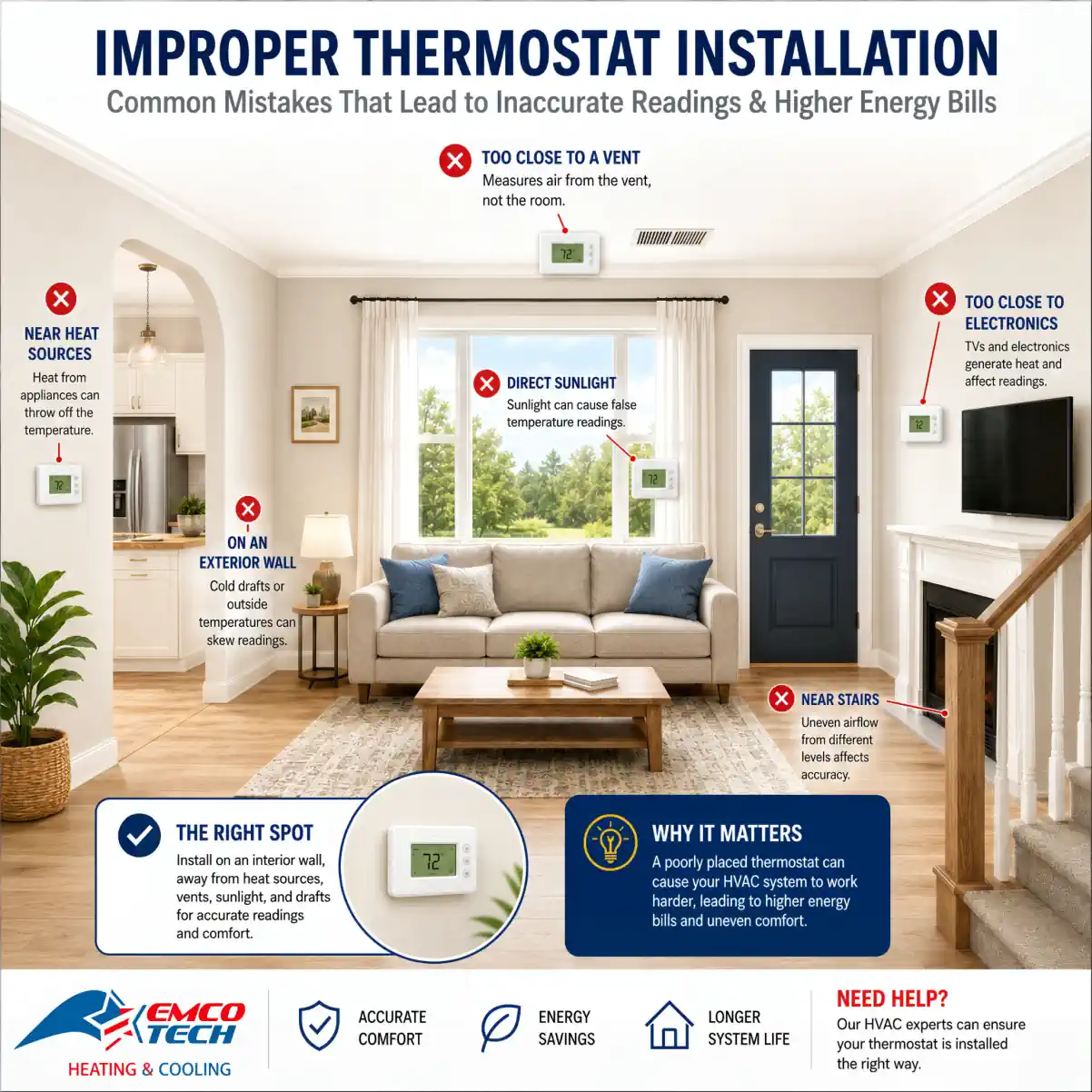
Put the thermostat on an interior wall, about 52 to 60 inches off the floor, in a room your household actually lives in: the living room, family room, or a central first-floor hallway that sees real traffic. That location reads the average air in the house, not a draft, a sunbeam, or last night’s leftover oven heat.
If you are weighing a move or an upgrade, our thermostat repair, replacement, and installation team does this correctly the first time.
How High Should a Thermostat Be?
Roughly eye level, 52 to 60 inches from the floor, is the sweet spot. Mount it too high and it reads the warm air that pools near the ceiling, so the system shuts off early and the room you actually sit in stays cool. Mount it too low and it reads cold floor air and overruns. Accessibility guidance puts controls around 48 inches, which is fine, just do not drop it to baseboard level.
Places That Quietly Ruin a Heating Season
Same house, same furnace, wrong wall. Any of these will make a healthy system look broken:
- Exterior wall. The wall itself runs colder than the room. The thermostat thinks the house is freezing and keeps calling for heat. You get a hot living room and a high gas bill.
- Next to a supply vent or return. The blast of warm air, or the pull of a return, fools the sensor. The system shuts off early, the room cools ten minutes later, and the cycle repeats until November.
- Direct sun, even for an hour. A west-facing hallway in late September convinces a thermostat that summer never ended. Then the sun drops and the house sits at 64°F.
- Kitchen, bath, or laundry. Cooking heat, shower steam, and dryer exhaust are not the house. They are local weather events.
- Dead-end hallway or an unused bedroom. The thermostat keeps that empty space perfect while the rooms you use run hot or cold.
- Right above a lamp, TV, or radiator. A small heat source next to the sensor means a false reading and extra runtime.
Older homes in Willow Grove, Abington, Horsham, and Northeast Philadelphia see this constantly. The thermostat went wherever the wire happened to come out of the wall in 1987. That was convenient for the builder. It was not a comfort plan.
Not sure the wall is the problem?
If your rooms will not hold temperature or the system short cycles on mild days, have the thermostat placement and wiring checked before the heat stays on for good.
Why Does My Thermostat Read Wrong After Summer?
This is the most common early-fall call. Nothing failed over the summer. What changed is the sun angle and the daily temperature swing. A spot that read fine in flat July heat starts telling lies in September, when mornings are 50°F and afternoons hit 75°F and the low sun reaches a wall it never touched all summer. If the house suddenly feels weird in September and felt fine in July, suspect the location before you suspect the furnace.
Two-Story Homes: The Classic Philly-Suburbs Problem
 Heat rises. If the only thermostat lives upstairs, the first floor stays cool while the second floor bakes. If it lives in a first-floor hallway with a vent blowing on it, the upstairs never catches up. The best pattern for most two-story homes across Montgomery, Bucks, Chester, Delaware County, and Philadelphia is a main thermostat on the first floor, on an interior wall in a central living area, with remote sensors upstairs and in the rooms you care about most.
That is one of the real reasons people upgrade. A smart thermostat with room sensors can average several spaces instead of trusting one lucky wall. A new Nest or Ecobee on the same bad wall will still lie. Location first, features second.
Heat Pumps and Dual-Fuel Systems Are Fussier
Placement matters even more with a heat pump. These systems run longer, gentler cycles and lean on backup or auxiliary heat on the coldest days, so a sensor fooled by a draft or a sunbeam can kick expensive backup heat on when it is not needed. Heat pumps and dual-fuel setups also need the right control wiring, which is where a casual relocation goes wrong. If you run a heat pump, get the thermostat placed and wired by someone who knows the system.
How to Tell Placement Is the Problem
- One room is always too hot or too cold no matter where you set it.
- The system short cycles on mild fall days.
- You keep nudging the setpoint up and down like a volume knob.
- The display temperature does not match a cheap thermometer in the same room.
- Everything felt fine in July, then September arrived and the house got weird.
Those are placement and control issues as often as they are equipment issues. A 15-year-old furnace can still be fine. The sensor driving it may not be. A seasonal heating maintenance visit is a good time to have the placement checked too.
Can I Just Move My Thermostat to Another Wall?
Sometimes yes. Sometimes the wire run, the wall cavity, or the system type makes it a real job, especially with heat pumps, dual-fuel setups, and boilers that need the right control wiring. DIY relocation is how C-wires get skipped, heat-pump reversing valves get crossed, and “it worked yesterday” becomes a no-heat call on the first cold night. If you want it done once, that is a job for a licensed tech.
Fall Timing That Actually Matters
Labor Day through mid-October is the window. You still have mild days to test a new location, the heating plant is not in emergency demand yet, and you are not discovering a wiring surprise at 9 p.m. on the first frost. If the thermostat sits in a bad spot, moving it or adding sensors often does more for comfort than another degree on the dial.
Thermostat Placement FAQ
Yes, an interior wall is best. Exterior walls run colder than the room and push the system to overheat the house. An interior wall in a central, lived-in room gives the most accurate average reading.
Usually location: sun, a nearby vent, a lamp or TV, or an exterior wall. Sometimes it is a failing sensor or a unit that has drifted out of calibration. Compare the display to a cheap thermometer in the same room to tell which.
Only if it is placed well. Room sensors help by averaging several spaces, but a smart thermostat on a bad wall still reads badly. Fix the location first, then add the smart features.
Cracked Boiler Heat Exchanger: Why Cast Iron Sections Leak and What to Do
Your Boiler Leaks Water, Not Carbon Monoxide
If you searched this after reading about cracked heat exchangers, most of what you found was probably about furnaces, and it does not apply to you. A furnace heat exchanger separates combustion gas from the air you breathe, which is why that topic is about carbon monoxide. A boiler heat exchanger separates combustion gas from water. When it cracks, water comes out.
That changes every symptom. You will not smell anything. A carbon monoxide detector will not alarm. What you will see is pressure dropping on the gauge, water on the floor, rust staining down the side of the boiler, and a system you keep having to refill.
A second thing worth knowing before you read further: much of the boiler advice online is British. If a page quotes prices in pounds, mentions Gas Safe engineers, or talks about combi boilers and plate heat exchangers, it is describing a different appliance than the one in most Philadelphia basements. American homes here overwhelmingly run cast iron sectional boilers, and those fail differently.
How a Cast Iron Sectional Boiler Actually Fails
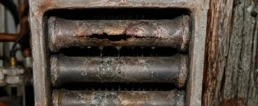
A cast iron boiler is not one piece. It is a stack of individual cast iron sections bolted together, joined either by push nipples or by gaskets, forming a water jacket around the combustion chamber. Weil-McLain, Burnham, Peerless, and H.B. Smith all build this way.
Leaks happen in two places, and the difference matters enormously to your wallet.
Between sections means a failed push nipple or gasket. That is a repair. The boiler comes apart, the seals get replaced, it goes back together.
Through a section means the cast iron itself has cracked or corroded through. That section has to be replaced, or the boiler does.
One diagnostic clue is worth knowing. On some cast iron boilers, leaks between sections appear when the boiler is cold and stop once it heats up and the iron expands. If your leak is worse in the morning and disappears by afternoon, that points toward seals rather than a cracked section, and that is the better outcome.
Boiler Losing Pressure or Leaking Water?
Before you accept a replacement quote, find out whether the leak is a gasket, a push nipple, or a cracked section. Those are three very different bills.
What Causes a Boiler Heat Exchanger to Crack
Cast iron does not simply wear out. Almost every cracked section traces back to one of these, and most of them are correctable, which matters because a new boiler installed into the same conditions will fail the same way.
- Thermal shock. Cold return water hitting hot cast iron. Seventy degree water returning to a one hundred eighty degree boiler stresses the metal hard. This is the single most common cause and it is a piping and controls problem, not a boiler defect.
- Low return water temperature. Systems without boiler protection, bypass piping, or outdoor reset run the return too cold continuously, which also causes flue gas to condense inside the passages and corrode the iron from the fire side.
- Scale and sediment. Mineral deposits settle on the hottest surfaces near the flame, creating hot spots where the iron expands unevenly and cracks.
- Fresh water and oxygen. Every time a system is drained or auto-fills to replace a leak, new water brings oxygen and minerals in. A system that has been quietly leaking and refilling for years corrodes from the inside.
- Overtightened sections. Assembly without a torque wrench cracks sections that were fine when they left the foundry, sometimes years later.
- Age and cycling. Decades of expansion and contraction eventually tell, particularly on boilers that short cycle.
Signs of a Cracked Boiler Heat Exchanger
- Pressure gauge dropping and needing to be refilled every week or two
- Water pooling under or beside the boiler, often clear and cool rather than hot
- Rust staining running down the outside of the jacket or between sections
- The auto-fill valve running more often than it used to
- A leak that appears when the boiler is cold and stops when it fires
- Rusty water when bleeding radiators, which points to internal corrosion
- Kettling, a banging or rumbling during a cycle, indicating scale and hot spots
- Corroded bolts and rusted section seams visible with the jacket panels off
Pressure loss with no visible leak anywhere in the piping or radiators is the one that most often turns out to be the heat exchanger. Before assuming that, though, a technician should rule out the expansion tank, the pressure relief valve, and the auto-fill, since a waterlogged expansion tank causes pressure symptoms that look similar and costs a fraction to fix.
Why Boiler Stop-Leak Usually Makes Things Worse
Search this problem and you will find stop-leak products recommended everywhere. Boiler sealer, boiler solder, epoxy, and various powders poured into the system. They do sometimes stop the leak.
The problem is what else they stop. Sealer travels the whole system, and it does not choose where to settle. It clogs circulator pumps, blocks air vents, fouls the expansion tank, and packs into the narrow water passages inside the boiler you were trying to save. The technicians who deal with the aftermath generally see it as trading a known repair for an unknown one.
Cast iron also cannot be reliably welded in place. It can be done by a skilled welder with nickel rod, preheating, and controlled cooling, but the heat routinely propagates the crack or opens a new one elsewhere. In a boiler section, it is almost never practical.
If a crack is genuinely in a section, the honest options are replacing that section or replacing the boiler. Anything else is buying time, which is a legitimate choice if you know that is what you are buying.
Boiler Heat Exchanger Replacement Cost
Cost depends far more on the type of failure than on the brand. Gasket and push nipple work sits at the low end because it is labor with inexpensive parts. Section replacement climbs quickly, since the boiler has to be dismantled, the section sourced, and the whole stack reassembled and pressure tested. On many residential boilers, section replacement approaches the cost of a new boiler once labor is counted.
Three things move the number: whether parts are still made for your model, how many sections are affected, and whether the failure was caused by something in the system that also needs correcting.
That last one is the part most quotes leave out. Replacing a section on a boiler that cracked from thermal shock, without fixing the piping or controls that caused it, buys you a repeat. A proper quote should say what caused the failure, not just what it costs to undo.
Ask for photographs. Any technician who found a cracked section can show you the crack, and on a repair this expensive that is a reasonable thing to want before you authorize the work.
Does a Lifetime Heat Exchanger Warranty Cover Labor?
No. Homeowners hear “lifetime warranty on the heat exchanger” and picture a simple, free fix decades later. The manufacturer will happily ship the new section. That part is true.
Sometimes. Most of these warranties are pro-rated, meaning the longer the heat exchanger has been in service, the larger the share of the current retail price you pay. After thirty years the discount can be small enough that it no longer changes anything.
The rest of the story is usually less cheerful.
On a thirty-year-old boiler, everything is either permanently fused together or rusted clean through. Bolts shear. Push nipples seize solid. Adjacent sections that looked fine crack the moment you try to separate them. What was supposed to be a one-section swap turns into a full rebuild about 90% of the time. Every other component has to be ordered separately, one by one. The homeowner waits days for parts, pays a small fortune in labor, and ends up with a rusty old boiler shell that now contains what is essentially a brand-new boiler inside.
The free part arrives. The free repair does not.
At that point it is almost always more cost-effective to stop fighting the dinosaur and simply replace the entire unit with a modern high-efficiency boiler. You get better efficiency, lower energy bills, modern controls and accessories, improved comfort, and a system that actually meets current code.
If you are weighing a warranty rebuild against a replacement, we will quote both. Estimates are free, and we normally lay out three paths: a straightforward cast iron replacement at the lower end, a mid-efficiency unit that balances cost against fuel savings, and a high-efficiency condensing boiler for anyone planning to stay in the house long enough to get that money back. Worth knowing what a warranty covers when it is not pro-rated: see our new system offer with up to 10 years full warranty, or ask about financing options when we quote.
Repair or Replace Your Boiler
Repair generally makes sense when the boiler is under roughly fifteen years old, the leak is at a gasket or push nipple rather than through the iron, only one section is involved, parts are still available, and the rest of the system is sound.
Replacement generally makes sense when the boiler is past twenty years, multiple sections are weeping, the bolts and seams show general corrosion rather than one clean crack, parts are obsolete, or you are looking at a second major repair within a couple of years.
There is a middle case worth naming. A boiler from the sixties or seventies that has run reliably for decades is often better built than what replaces it, and the instinct to keep it is not sentimental nonsense. But efficiency on those units is dramatically lower than a modern boiler, so the honest comparison includes fuel cost over the years you would keep it, not just the repair bill.
Cracked Boiler Repair in Philadelphia and the Surrounding Counties
Philadelphia has more old hydronic heat than almost anywhere in the country. Row homes, twins, stone colonials, and converted properties across the city and the surrounding counties still run cast iron steam and hot water boilers, many of them older than the people living with them. We work on these systems constantly, which means we know which brands have parts available, which failures are worth repairing, and which piping arrangements keep cracking sections.
We service Philadelphia, Montgomery, Bucks, Chester, and Delaware counties from stocked warehouses in Willow Grove and Northeast Philadelphia. Free estimates, financing available, and a written finding rather than a verbal diagnosis. See our boiler repair services or call 215.366.1001.
Cracked Boiler Heat Exchanger Questions
If the leak is at a gasket or push nipple between sections, yes, that is a repair. If the cast iron itself has cracked, no. Cast iron cannot be reliably welded in place, since the heat tends to run the crack further or open a new one. The options are replacing that section or replacing the boiler.
Check the cheap causes first. A waterlogged expansion tank, a weeping pressure relief valve, or a failing auto-fill all cause pressure symptoms that look like a cracked section and cost a fraction to fix. If those are ruled out and the piping and radiators are dry, the heat exchanger becomes the likely source.
Generally no, and this is where boilers differ from furnaces. A furnace heat exchanger separates combustion gas from the air you breathe, so a crack there is a carbon monoxide problem. A boiler heat exchanger separates combustion gas from water, so a crack there leaks water. Combustion and venting problems on a boiler are a separate concern worth checking, but the crack itself puts water on the floor rather than gas in the house.
It sometimes stops the leak, but sealer travels the whole system and does not choose where it settles. It clogs circulator pumps, blocks air vents, fouls the expansion tank, and packs into the narrow passages inside the boiler you were trying to save. Most technicians see it as trading a known repair for an unknown one.
That pattern usually points to gaskets or push nipples rather than a cracked section. Cast iron expands as it heats, closing the gap at the seams, so a seal that weeps cold can seal itself once the boiler fires. It is the better outcome of the two, since seal work is a repair rather than a section replacement.
Thirty years is common and older units are not unusual, particularly in Philadelphia housing stock. Age alone is not a reason to replace one. Efficiency is the honest argument, since a boiler from the sixties or seventies runs dramatically less efficiently than a modern unit, so the comparison should include fuel cost over the years you would keep it, not just the repair bill.
Thermal shock is the most common cause, meaning cold return water hitting hot cast iron. Low return temperatures, scale creating hot spots near the flame, oxygen entering through repeated auto-fill, and sections overtightened during assembly all contribute. Most of these are correctable, which matters because a new boiler installed into the same conditions will fail the same way.
No boiler manufacturer covers labor under a heat exchanger warranty, and most of these warranties are also pro-rated, so the longer the unit has been in service the more of the part cost you pay. On an old boiler the labor is the expensive part. A one-section job frequently turns into a full rebuild once seized bolts and adjacent sections start failing, which is why replacement is often the better value at that age.
More Boiler Related News & Tips

Is Mini Split Cleaning Safe for People With Allergies and Kids?
Why Parents and Allergy Sufferers Ask About Mini Split Cleaning
A few customers have called recently with the same good question: if their ductless mini split gets a chemical cleaning, is that air safe to breathe around young children and family members with allergies? The short answer is yes, when the work is done correctly. And for those households in particular, a proper cleaning usually makes the air easier to breathe, not harder. Here is why, in plain terms.
The important reframe up front: the thing most likely to bother sensitive lungs is a dirty mini split, not a freshly cleaned one. If you have been putting off a ductless mini split cleaning because of the chemicals, the buildup inside the unit is the bigger concern.
Sensitive household? Ask for a low-odor cleaning.
We can use a fragrance-free, low-VOC mini split cleaning that clears mold and allergens at the source instead of masking them.
Is Mini Split Cleaning Safe for People With Allergies and Kids?
A few customers have called recently with the same good question: if their ductless mini split gets a chemical cleaning, is that air safe to breathe around young children and family members with allergies? The short answer is yes, when the work is done correctly. And for those households in particular, a proper cleaning usually makes the air easier to breathe, not harder. Here is why, in plain terms.
The important reframe up front: the thing most likely to bother sensitive lungs is a dirty mini split, not a freshly cleaned one. If you have been putting off a ductless mini split cleaning because of the chemicals, the buildup inside the unit is the bigger concern.
What actually builds up inside a ductless unit
A mini split cools by running warm room air over a cold evaporator coil. That coil sweats, and the moisture combines with the dust and pollen that settle on the coil and the spinning blower wheel just behind it. Warm, damp, and full of organic dust is exactly the environment mold and dust mites like. Over a season or two, a thin film of mold and grime can coat surfaces you never see.
Here is the part that matters for allergies. Every time the unit runs, it pushes air across those surfaces and out into the room. Mold spores, dust mite debris, and pet dander ride along. Public-health guidance from the CDC links damp, moldy indoor spaces to coughing, congestion, eye and throat irritation, and worsened asthma, with stronger reactions in people who have allergies, asthma, or weaker immune systems. A common tell: symptoms that flare when the unit is running and ease when it is off. A moldy unit in a bedroom is the worst case, since it can blow spores into the air all night.
What we clean with, and why it is safe
The word “chemical” sounds alarming, so it helps to know what a professional cleaning really involves. Three things make it safe:
- It is applied to a part, not sprayed into your air. The cleaner goes directly onto the coil and blower wheel with the unit powered off. This is component-level work, not fogging a room.
- The products are made for living spaces. Modern coil cleaners are typically biodegradable and low in VOCs. For sensitive homes, fragrance-free options and EPA-registered products labeled specifically for HVAC use are available, several of which carry the lowest toxicity rating and use biodegradable, no-VOC formulas.
- We remove the source, we do not mask it. The real fix is mechanical: brushing and vacuuming loose debris, washing the coil, and pulling and washing the blower wheel where mold actually grows. No-rinse coil cleaners then clear away through the unit’s own condensate. A spray that only leaves a scent behind does not solve an allergy problem, and we do not treat it as a substitute for cleaning.
One honest caveat, because it is why brand and product choice matters: harsh acidic cleaners can corrode the delicate aluminum fins on a ductless coil. Using the right product for the equipment is part of the job, and it is a good reason to have the work done by a technician rather than reaching for whatever is under the sink.
Is it safe for kids and allergy sufferers specifically?
For these households, the honest math usually favors cleaning. A proper service takes allergens out of the air stream, so the net result is fewer triggers in the room, not more. That said, a little care makes it even smoother:
- Tell us in advance if anyone is chemically sensitive, and we will plan for a fragrance-free, low-VOC product and good ventilation.
- Keep young kids out of the room during the short service window and for a little while after, while the unit dries and the space airs out. Re-entry is quick with low-odor products.
- Open a window or run the fan afterward for a few minutes to clear any faint smell.
What you can do between professional cleanings
The single biggest thing you can do yourself is rinse the mesh filters every two to four weeks during heavy use. That catches a lot of surface dust before it reaches the coil. Keeping indoor humidity in the 30 to 50 percent range and letting the unit run its fan or dry mode after cooling both help the coil dry out so mold has nothing to feed on.
The coil, blower wheel, and drain pan are the parts you cannot safely reach without opening the unit and protecting the electronics, and those are exactly where mold grows. That is where a yearly deep clean earns its keep. If you want a set rhythm, pairing filter rinses with a seasonal cleaning or a routine mini split maintenance visit keeps things ahead of the buildup.
Call for a cleaning sooner rather than later if you notice a musty smell when the unit starts, weaker airflow than it used to have, visible dark spotting on the fins or blower wheel, or allergy symptoms that track with the unit running.
A note for our Philadelphia-area customers
Our summers here run humid, and humidity is the fuel for mold inside a ductless head. Homes across Montgomery, Bucks, Chester, Delaware, and Philadelphia counties that lean on mini splits through a sticky July are prime candidates for coil and blower-wheel buildup by season’s end. A cleaning before the heaviest cooling stretch, or right after it, keeps the indoor air fresh for the people breathing it most. EMCO has served the area since 2006, and our technicians handle this work every week.
Mini Split Cleaning Safety: Common Questions
Yes, when it is done correctly. A professional cleaning is applied directly to the coil and blower wheel with the unit powered off, not sprayed into the room. The goal is to remove the mold, dust, and allergens that trigger symptoms. Most quality coil cleaners are biodegradable and low in VOCs, and fragrance-free, EPA-registered options exist for sensitive households. Ask for a low-odor product and good ventilation, and the result is usually cleaner, easier air to breathe.
Generally yes, though many families prefer to keep young children out of the room during the short service window and for a little while after, while the unit dries and the room airs out. The products used are applied to a component and rinse away with the unit’s own condensate or a light rinse. If anyone in the home is very sensitive, tell us in advance so we can use a fragrance-free, low-VOC product and ventilate the space.
It can. The cold coil and blower wheel collect moisture and dust, which lets mold and dust mites grow inside the indoor unit. Every time the system runs, it can push those spores and particles into the room. People with allergies or asthma often notice symptoms that get worse when the unit is on and ease when it is off. Cleaning the unit removes that source.
You can and should rinse the mesh filters yourself every few weeks, and that handles a lot of surface dust. The coil, blower wheel, and drain pan are where mold actually grows, and reaching them safely means opening the unit and protecting the electronics, which is where a professional cleaning comes in. A yearly deep clean plus regular filter rinsing is a good rhythm for most homes.
It does not have to. Many coil cleaners have only a light citrus scent, and fragrance-free, no-VOC options are available for homes that want them. If smell is a concern, ask for a low-odor or fragrance-free product. Any brief odor clears quickly once the room is aired out and the unit runs.
Rinse the filters every two to four weeks during heavy use, and have the coil and blower wheel professionally cleaned about once a year. Homes with pets, allergy sufferers, high humidity, or a unit that runs almost constantly may benefit from cleaning twice a year.
Explore more about ductless mini splits
New to ductless or weighing your options? See how ductless mini split systems work and what a new mini split installation or replacement involves. Already have a unit? Keep it running clean with routine mini split maintenance, and know where to turn if you ever need a mini split repair.

How to Fix Hot and Cold Spots in Your House
What Causes Hot and Cold Spots in a House?
Hot and cold spots usually come down to airflow: some rooms get plenty of conditioned air and others do not. A handful of issues cause that imbalance, and often it is more than one working together.
- Leaky or disconnected ducts: air escapes into the attic or crawlspace before it reaches the room, so distant rooms starve for airflow.
- Blocked or restricted vents: closed registers, furniture over vents, or a crushed flex duct choke off a room’s supply.
- A dirty air filter: low airflow means the air never reaches the vents farthest from the unit.
- Poor insulation and sun exposure: rooms facing the afternoon sun or over a garage gain heat faster than the system can remove it.
- An undersized or aging system: older equipment often lacks the push to move air evenly to a second or third floor.
- Home layout: additions, finished attics, and rooms far from the air handler are naturally harder to reach.
One Room Always Too Hot or Too Cold?
Stubborn hot and cold spots usually trace back to airflow, and they are almost always fixable. Our technicians test airflow, find the cause, and balance your cooling system so every room feels the same.
Simple Checks You Can Do First
Before calling a pro, a few quick checks solve the easy cases: replace a dirty air filter, make sure supply and return vents are open and unblocked, and confirm no furniture or rugs are covering registers. Setting your thermostat fan to “On” instead of “Auto” keeps air circulating between cycles, which helps mix temperatures across rooms. If the spots persist after that, the cause is usually inside the ductwork or the system itself, and that is where professional help pays off.
Professional Fixes for Hot and Cold Spots
When the easy checks do not solve it, two fixes handle the large majority of stubborn hot and cold spots.
Duct Sealing and Repair
Because most hot and cold spots trace back to airflow, sealing and repairing your ductwork is usually the highest-impact fix. We inspect the duct runs for leaks, gaps, disconnected sections, and crushed flex duct, then seal and repair so each room gets the airflow it was designed for. See our air duct repair services.
Ductless Mini-Splits for Problem Rooms
For a room that never cools no matter what, a finished attic, a sunroom, an addition, a ductless mini-split delivers dedicated cooling to that space without touching your existing ducts. Each unit has its own thermostat, so the problem room finally matches the rest of the house. See our ductless mini-split installation.
If the whole house feels unbalanced rather than one or two specific spots, the issue is often broader than airflow to a single room. Our guide on why your cooling feels uneven covers whole-house temperature imbalance and zoning solutions.
When to Call a Professional
If you have swapped the filter, opened the vents, and still fight the same hot and cold rooms, it is time for an airflow diagnosis. Our technicians test airflow, find duct leaks and restrictions, and recommend the fix that actually matches your home rather than a one-size-fits-all answer. Balanced comfort is usually a straightforward repair once the real cause is found. Explore our AC repair and airflow diagnostics.
We fix hot and cold spots for homes across Greater Philadelphia and the surrounding suburbs, including Doylestown, West Chester, and the wider Philadelphia region.
Hot and Cold Spots FAQ
Start with the basics: replace a dirty air filter, open and unblock all vents, and set the thermostat fan to On to keep air circulating. If spots persist, the fix is usually sealing leaky ductwork or adding a ductless mini-split to a room that never cools. An airflow diagnosis pinpoints the exact cause.
The most common causes are leaky or disconnected ducts, blocked or restricted vents, a dirty filter, poor insulation, sun exposure, and an aging or undersized system. Rooms far from the air handler, additions, and finished attics are especially prone because air struggles to reach them evenly.
Cold spots often come from air leaks, poor insulation, or too much cooled air reaching one area. Sealing ductwork so air is distributed evenly, improving insulation in problem rooms, and balancing airflow between rooms usually resolves them. For a persistent problem room, a ductless mini-split gives you direct control.
Yes. Multi-story homes, additions, finished attics, and rooms far from the air handler are naturally harder to cool evenly because conditioned air loses pressure over distance. Layout is a common factor, but the fix is still improving airflow to those areas through duct repair, balancing, or a ductless unit.
Restricted airflow is the core issue: leaky ducts that lose air before it reaches the room, crushed or kinked flex duct, closed or blocked vents, a clogged filter, or an undersized return. Any of these starves certain rooms of conditioned air while others get plenty, creating the hot and cold pattern.
Water Heater Replacement Cost in Philadelphia (2026)
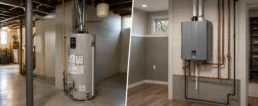
If you’re pricing out a new water heater, the first thing you want is a straight answer: what will this actually cost? The honest version is that water heater replacement in the Philadelphia area typically runs from around $1,300 for a basic electric tank up to $6,500 or more for a high-end gas tankless system, installed. Where your job lands depends on the type of unit, your fuel source, and what the installation involves. Below is a clear breakdown so you can plan, and get a firm number from a local water heater installer instead of a vague online estimate.
Average Water Heater Replacement Cost in Philadelphia
These are typical installed price ranges for the Philadelphia region in 2026, including the unit, labor, and standard removal of your old heater. Your exact cost depends on the factors further down this page.
| Water Heater Type | Typical Installed Cost | Best For |
|---|---|---|
| Standard electric tank (40 to 50 gal) | $1,700 to $2,600 | Homes without gas service |
| Standard gas tank (40 to 50 gal) | $1,800 to $2,800 | Most like-for-like replacements |
| High-efficiency or power-vent tank | $3,100 to $4,200 | Tighter spaces, better efficiency |
| Electric tankless | $2,000 to $4,000 | Smaller homes, point-of-use |
| Gas tankless | $4,500 to $6,500+ | Endless hot water, long-term savings |
Want Your Exact Number, Not a Range?
Every home is different. The fastest way to know what your replacement will cost is a quick look at your setup. Get a clear, itemized quote on water heater installation and replacement, often with same-day and next-day scheduling.
What Drives Water Heater Replacement Cost
Two homes on the same street can get very different quotes. Here is what moves the number:
- Fuel type: gas, electric, or tankless each carry different equipment and labor costs.
- Tank size and capacity: a 40-gallon unit costs less than a 75-gallon or a large commercial tank.
- Venting: power-vent and tankless systems need specific venting, which adds parts and labor.
- Gas line or electrical upgrades: switching fuel types or moving to tankless can require a new gas line or a panel upgrade.
- Code requirements: permits, an expansion tank, a drain pan, and updated connectors are often required and factored into a proper install.
- Access and location: a heater in a tight closet or finished basement takes longer to swap than one in an open garage.
Tank vs Tankless Replacement Cost
A tankless unit costs more upfront, but it lasts roughly 20 years compared to 10 to 12 for a standard tank, and it lowers monthly energy use by heating water only when you need it. Over the life of the system, that gap narrows. If you're weighing the two, our guide on tankless water heaters breaks down the trade-offs so you can decide what fits your home and budget.
Gas vs Electric: Which Costs Less?
Electric tank heaters are usually cheaper to install, especially in a home with no existing gas line, but they generally cost more to run month to month. Gas units cost a bit more upfront and are typically cheaper to operate. If your home already has gas, a gas water heater is often the better long-term value.
Should You Repair or Replace?
Replacement makes sense when the numbers point that way. Consider a new unit if your water heater is more than 10 years old, you see rust or discoloration in your hot water, the tank itself is leaking, your energy bills are climbing, or you're paying for repairs more than once a year. If it's a newer unit with a single failed part, a water heater repair is usually the smarter spend.
Ways to Keep the Cost Down
Right-sizing the unit to your household avoids overpaying for capacity you won't use, and regular water heater maintenance stretches the life of whatever you install. If the timing is tight, flexible financing lets you replace a failing heater now and spread the cost, instead of scrambling when it quits for good.
Water Heater FAQ
Most water heater replacements in the Philadelphia area run from about $1,300 for a basic electric tank to $6,500 or more for a high-efficiency gas tankless system, installed. Your exact cost depends on the unit type, fuel source, venting, and any code or gas line upgrades the job requires.
For many homes, yes. A tankless unit costs more upfront but lasts roughly 20 years versus 10 to 12 for a tank, and it lowers monthly energy use by heating water only on demand. Over the life of the system, the higher upfront price is often offset by longer lifespan and lower bills.
In most cases, yes. A proper water heater replacement is permitted and installed to code, which can include an expansion tank, a drain pan, and updated connectors. A licensed installer handles the permit and inspection so the job is done safely and legally.
Converting from a tank to a gas tankless system typically costs more than a like-for-like tank swap because it often requires new venting and, in some cases, a larger gas line. Expect a range starting around $3,500 and rising with the venting and gas work involved. An in-home assessment gives you an exact number.
Replace it if the unit is more than 10 years old, the tank is leaking, you see rust in your hot water, or you are paying for repairs more than once a year. If it is a newer unit with a single failed part, a repair is usually the better value.

Breathe Better Philly: Whole House Air Purifiers vs HVAC Filters
Why Your HVAC Filter Alone Might Not Keep Your Philadelphia Home’s Air Clean
Many Philadelphia homeowners wonder about whole house air purifiers vs HVAC filters and which truly keeps indoor air clean. While a good filter can protect your HVAC system from dust and debris, it’s not designed to capture the smallest allergy-triggering particles or neutralize airborne bacteria. In Philadelphia’s mix of city pollution, seasonal pollen, and humid summers, a standard filter can leave gaps in protection—especially for households with pets, smokers, or family members with asthma or allergies.
Want cleaner air without guessing?
Our indoor air quality specialists help Philadelphia-area homeowners choose the right purification or filtration system for their home and budget. No pressure, just honest advice.
HVAC Filter vs Air Purifier – What’s the Difference?
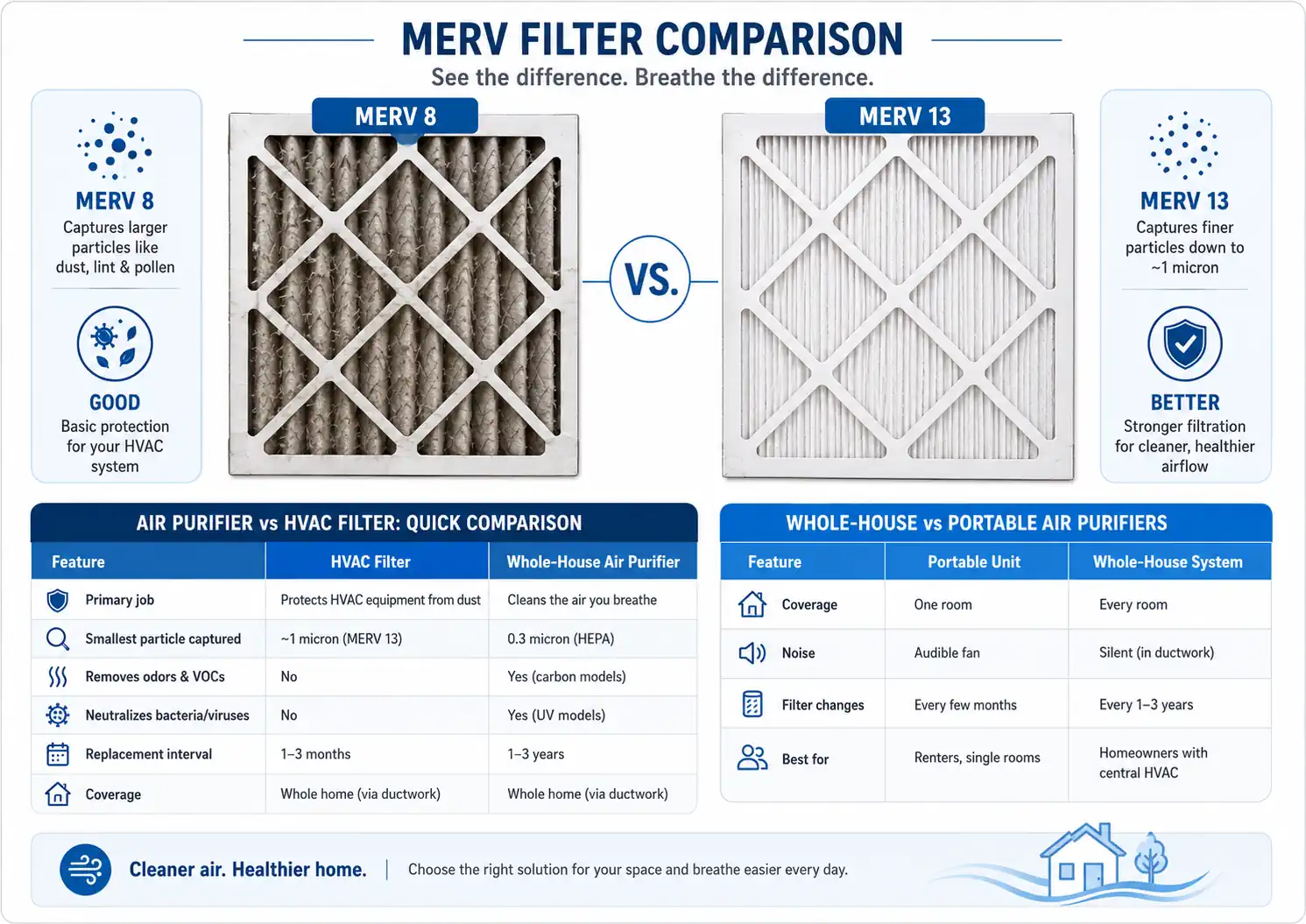
When comparing whole house air purifiers vs HVAC filters, it’s important to know that each has unique benefits. While a central air purifier integrates with your HVAC for full-home coverage, a standard filter mainly protects equipment. An HVAC filter—whether basic or a high-MERV HEPA air filter—mainly protects your system from dust buildup. An air purifier, especially a central whole-house model, actively removes microscopic allergens, odors, and even airborne germs from your air. This makes them complementary, not interchangeable. For the best results, many homeowners use both a properly rated HVAC filter and a dedicated whole-house air purifier with HEPA and carbon filtration.
How Whole House Air Purifiers Work with Your HVAC System
Many homeowners wonder about the difference between a HEPA air filter vs air purifier. While HEPA filters trap tiny particles, air purifiers often combine filtration with UV or activated carbon for a more complete clean. A whole-house air purifier is installed directly into your home’s HVAC system, so every time your heating or cooling runs, it cleans the air in every room. These systems go beyond what standard HVAC filters can do—most use HEPA filtration to capture particles as small as 0.3 microns, including dust, pollen, pet dander, and mold spores. Many Philadelphia homeowners choose models with activated carbon filters to remove odors and volatile organic compounds (VOCs), and some upgrade to include UV-C light technology—often called the best air purifier for an HVAC system with UV light—that neutralizes bacteria, viruses, and other airborne pathogens before they circulate through your ductwork.
Wildfire Smoke and Philadelphia Air Quality in 2026
Two summers of Canadian wildfire smoke changed the indoor-air conversation for Philadelphia homeowners. Wildfire smoke carries PM2.5 — fine particles about 30 times smaller than a human hair — that slip straight through the 1-inch fiberglass filters (MERV 1–4) most homes still run. The EPA recommends upgrading to a MERV 13 filter during smoke events and running your HVAC fan continuously — that combination can cut indoor PM2.5 by roughly half.
But filters have a hard limit: they trap particles, not gases. Wildfire smoke also carries VOCs and carbon monoxide that pass through any filter regardless of MERV rating. That’s the real filter-vs-purifier line — a MERV 13 filter is the smart baseline, but only a whole-house air purifier with activated carbon and UV can address the gases and germs a filter physically cannot.
Air Purifier vs HVAC Filter: Which Cleans Better
Not sure which system your home needs?
Our technicians assess your air quality and HVAC setup, then recommend the right air purification solution. No upsell.
Benefits of Whole-House Air Purifiers for Your Philadelphia Home
If you’re seeking the best air purifier for an HVAC system with UV light, Carrier’s Performance™ UV Germicidal models combine ultraviolet disinfection with advanced filtration to target both airborne pathogens and odors. At EMCO Tech Heating & Cooling, we offer two main types of Carrier whole-home air purification systems, each with unique advantages:
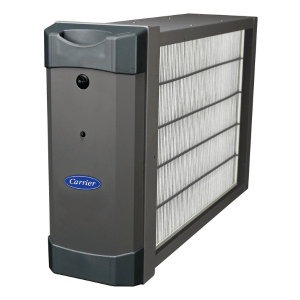
- Air purifiers with HEPA and carbon filters – Capture up to 99.97% of particles as small as 0.3 microns, including dust, pollen, and pet dander. Models like the Infinity® Air Purifier (DGAPA) and RMAP-ST deliver hospital-grade filtration and odor removal.
- UV Air Purifiers – Use ultraviolet light to neutralize airborne bacteria, mold spores, and viruses before they circulate. The Performance™ UV Germicidal Light also helps reduce odors and VOCs when paired with advanced filtration.
Why Philadelphia Homeowners Choose Whole-House Purifiers
For the most complete solution, an air purifier with HEPA and carbon filtration can capture allergens, neutralize odors, and reduce VOCs all in one system.
- Fewer Allergy & Asthma Symptoms — Capture tiny airborne irritants before they circulate.
- Odor & VOC Reduction — Eliminate lingering smells and harmful compounds.
- Low Maintenance — Filters last 1–3 years; smart models like the RMAP-SST and RMAP-SXL send service alerts.
- Quiet, Hidden Operation — Integrates into your HVAC for silent, out-of-sight purification.
- Energy-Efficient Performance — Cleans air without raising energy bills.
Are Whole-House Air Purifiers Worth It?
For most Philadelphia homes, yes — if someone has allergies, asthma, or pets, or if wildfire-smoke season leaves you closing windows and still smelling smoke. Filters last 1–3 years, run silent through your existing ductwork, and don’t restrict airflow the way an over-tight MERV filter can. If nobody in your home has air-quality complaints and you’re not smoke-sensitive, a properly rated MERV 13 filter is enough — we’ll tell you honestly which side you’re on.
Carrier Whole-Home Air Purifiers We Install
As a Carrier factory-authorized installer, we size, install, and service every unit for your home.
Infinity Air Purifier
Captures and kills pathogens down to the smallest particles. Carrier's top-tier whole-home purification.
See this unitPerformance Carbon with UV
Carbon filtration plus UV to cut odors, VOCs, and biological growth on the coil.
See this unitComfort EZ Flex Filter
High-capacity cabinet filter that traps more than a standard 1-inch filter, with fewer changes.
See this unitWhen to Upgrade from a Filter to a Whole-House Purifier
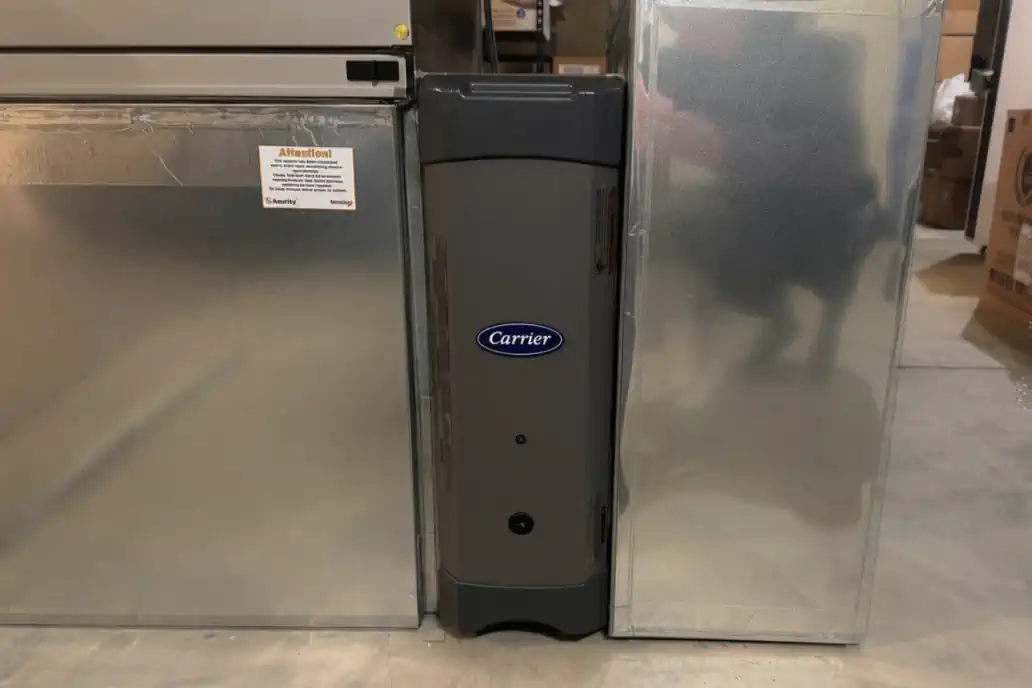 Upgrading to one of the best whole house air purifiers can make a dramatic difference for households with pets, allergy sufferers, or anyone sensitive to indoor pollutants. If your home still has dust buildup, lingering odors, or recurring allergy symptoms despite using high-quality HVAC filters, it may be time to consider a whole-home air purifier. These systems are especially beneficial for households with pets, smokers, or family members who have asthma or other respiratory conditions.
Other signs you might need an upgrade include frequent HVAC filter changes, musty smells from ductwork, or visible dust returning shortly after cleaning. A professionally installed central air purifier delivers cleaner, fresher air to every room—something portable units and standard filters can’t match.
Get Expert Advice Before You Buy
Still debating HVAC filter vs air purifier? Not all air purifiers are created equal — choosing the wrong type can waste energy, raise maintenance costs, or restrict HVAC airflow. We install air purification and filtration systems in Philadelphia homes year-round, and our Carrier-certified technicians assess your home’s air quality before recommending anything.
Whether you’re battling seasonal allergies, wildfire smoke, or household odors, we match you with a system that works year-round. All installations follow manufacturer specifications to protect your warranty.
Air Filter vs. Air Purifier: Common Questions
Premium HVAC filters often use higher MERV ratings to capture smaller particles like pollen, mold spores, and even some bacteria. While they can improve air quality, they may also restrict airflow if your system isn’t designed for them. This can cause your HVAC to work harder, reducing efficiency and lifespan. Always follow the MERV rating recommended by your manufacturer or consult a technician before upgrading.
Yes, if you want advanced air cleaning. A standard furnace filter mainly protects your HVAC equipment from dust buildup, but it won’t remove microscopic allergens, VOCs, or airborne germs. A whole-house air purifier can capture particles as small as 0.3 microns, while UV germicidal lights neutralize bacteria and viruses for cleaner, healthier air.
To a degree, yes. A clean, properly rated filter removes dust, pet hair, and larger airborne particles. However, it won’t address odors, volatile organic compounds (VOCs), or very fine allergens. That’s why many Philadelphia homeowners add whole-home purification systems for more complete indoor air quality protection.
They serve different purposes and often work best together. An HVAC filter is essential for system protection and basic particle removal, while an air purifier—especially a HEPA or UV model—targets pollutants your filter can’t catch. Combining both offers the most effective defense against indoor air pollution.
Some high-MERV filters can restrict airflow if your HVAC system isn’t sized or designed for them. Restricted airflow can cause temperature imbalances, longer run times, and even system damage. If you want finer filtration without risking your system, consider a whole-house air purifier instead of over-restrictive filters.
Yes, but with limits. A MERV 13 filter captures much of the fine particulate (PM2.5) in wildfire smoke, while a whole-house air purifier with activated carbon also removes the smoke odors and VOCs that pass straight through any filter. For Philadelphia’s recent smoke seasons, pairing both gives the most complete protection.
Explore Our Indoor Air Quality Services
Indoor Air Quality
Whole-home solutions for cleaner, healthier air year-round.
Air Purification & Filtration
HEPA, carbon, and UV systems installed to Carrier spec.
Humidifiers & Dehumidifiers
Balance humidity for comfort and cleaner air.
Air Duct Repair
Seal leaks that pull dust and allergens into your air.
Carrier Systems
Explore Carrier purifiers, filters, and UV options.

AC Troubleshooting Guide: Find Out Why Your Air Conditioner is not Working
Quick AC Troubleshooting Checklist
Before calling anyone, run through these five checks. They resolve a surprising share of “broken AC” calls in a few minutes:
- Thermostat: set to COOL, temperature below room temp, fresh batteries if it’s battery-powered.
- Air filter: if you can’t see light through it, replace it. A clogged filter is the single most common cause of weak cooling and frozen coils.
- Breaker panel: check for a tripped breaker labeled AC, condenser, or air handler. Reset it once — if it trips again, stop and call a technician.
- Outdoor disconnect: make sure the pull-out disconnect next to the condenser is fully seated.
- Condensate safety switch: a full drain pan trips a float switch that shuts the system down. If the pan is full, the drain line is clogged.
Still no cold air? The sections below match the symptom to the likely cause — and to the detailed guide for fixing it.
AC down and the house is heating up?
Skip the guesswork — our licensed technicians handle AC repair in Philadelphia and the surrounding suburbs with fast response any time.
AC Running but Not Blowing Cold Air
If the system runs but the air from the vents is warm or barely cool, the usual suspects are a clogged filter, a refrigerant leak, a frozen evaporator coil, dirty condenser coils, or a failed capacitor. We cover all ten causes, the DIY checks, and the fixes in our full guide: AC not blowing cold air.
AC Won’t Start or Struggles to Turn On
Clicking or humming at startup, short cycling, breaker trips, or lights dimming when the unit kicks on all point to a starting problem — most often a weak capacitor or an aging compressor fighting to spin up. Our guide to AC hard starting explains the causes, when a hard start kit helps, and when it’s just a band-aid.
Signs of Compressor Trouble
The compressor is the heart of the system and the most expensive part to replace. Warm air, grinding or rattling from the outdoor unit, repeated breaker trips, and short cycling are the classic warning signs. See our breakdown of a bad AC compressor — including when repair makes sense and when replacement is the smarter call.
Refrigerant Leaks and Frozen Coils
 An air conditioner never “uses up” refrigerant — if it’s low, it’s leaking. Low refrigerant drops the coil temperature below freezing, so humidity in the air ices the coil over and airflow collapses. The telltale signs: ice on the copper lines or indoor coil, a hissing sound near the unit, and cooling that gets worse the longer the system runs. Topping off refrigerant without fixing the leak just delays the same failure. A proper repair means locating the leak, sealing or replacing the component, and recharging to factory spec — licensed work, not a DIY job.
Drainage, Sensor, and Airflow Problems
Philadelphia’s humid summers push a lot of condensate through your AC’s drain line, and algae clogs are common by mid-season — water around the indoor unit or a system that shuts itself off usually means the drain pan float switch tripped. Thermostat sensor problems show up as an AC that short cycles or never stops running. And airflow problems — crushed or leaky ductwork, closed registers, blocked returns — leave some rooms warm while others freeze. Rooms cooling unevenly is almost always a duct or sizing issue, not a refrigerant one.
When to Stop Troubleshooting and Call a Pro
If the filter is clean, the thermostat is set right, and the breaker holds — you’ve done everything worth doing without a gauge set and a meter. Refrigerant, electrical, and compressor diagnostics need licensed hands. EMCO Tech’s NATE-certified technicians provide air conditioning repair in Philadelphia, Willow Grove, and across Montgomery, Bucks, Chester, and Delaware counties — with two stocked warehouses, most repairs are completed on the first visit. Flat-rate quote before any work begins.
Frequently Asked Questions
Check five things: the thermostat is set to COOL and below room temperature, the air filter is clean, the breaker hasn’t tripped, the outdoor disconnect is seated, and the condensate drain pan isn’t full. These checks take a few minutes and resolve many no-cool calls without a service visit.
The most common causes are a clogged filter restricting airflow, a refrigerant leak, a frozen evaporator coil, or a failing capacitor or compressor. Start with the filter and thermostat — if the air is still warm after that, the cause is likely refrigerant or electrical and needs a technician.
Turn the thermostat off, switch the AC breaker off at the panel, wait 5 minutes so system pressures equalize, then switch the breaker back on and set the thermostat to COOL. If the system won’t restart or trips the breaker again, stop resetting it — repeated trips signal an electrical or compressor fault.
It can be. For households with elderly residents, young children, or medical conditions, losing cooling during a Philadelphia heat wave is a genuine safety issue — and a system left running with a failing component often turns a small repair into a major one. We offer emergency service with fast response any time.
A healthy system typically runs 15 to 20 minutes per cycle in normal summer weather. Cycles under 10 minutes (short cycling) point to a starting problem, an oversized system, or a sensor fault. A system that never shuts off may be undersized, low on refrigerant, or fighting a dirty coil.
Once a year, ideally in spring before the cooling season. A tune-up catches weak capacitors, low refrigerant, and clogged drains before they turn into mid-July breakdowns, and keeps the system running at rated efficiency.
Post updated: July, 2026
Tank vs. Tankless Water Heater: Which Is Right for Your Home?
How Tank and Tankless Water Heaters Work
A tank water heater stores and continuously reheats 30 to 80 gallons of water, keeping a ready supply on hand at all times. This is the traditional setup most homes already have, available in both gas and electric models. A tankless water heater skips the storage tank entirely and heats water on demand as it passes through the unit, so it only uses energy when a faucet or appliance actually calls for hot water.
No Hot Water in Your Philadelphia Area Home?
Don't go another day with cold showers. EMCO Tech Heating & Cooling provides fast professional water heater repair across Montgomery County, Philadelphia, Bucks County, Chester County, and Delaware County. Same-day service available.
Upfront Cost and Installation
Tank water heaters typically cost less to purchase and install, with most Philadelphia-area installations running in the $1,200–$3,000* range depending on fuel type and tank size. Tankless units cost more upfront, often in the $3,000–$6,500* range, since many installations call for upgraded gas lines, venting, or electrical service. Homeowners planning a full water heater installation or replacement should weigh this higher initial cost against the long-term savings tankless units can offer.
Energy Efficiency and Operating Costs
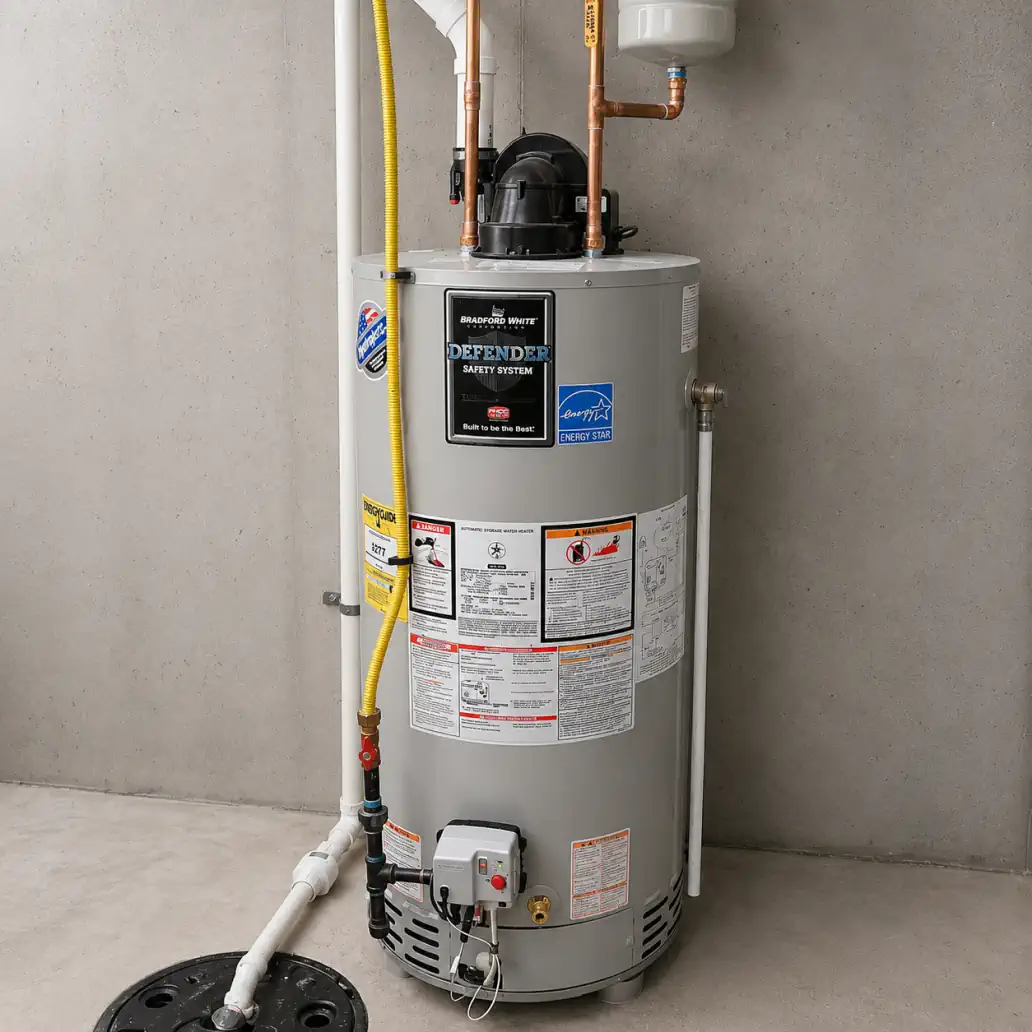 Because tankless units heat water only when needed, they avoid the standby heat loss that tank models produce from keeping a full tank hot around the clock. That difference typically translates into lower monthly energy bills for tankless owners, though the exact savings depend on household hot water usage, local utility rates, and fuel type.
Lifespan and Maintenance
A well-maintained tank water heater generally lasts 10 to 12 years, while tankless units often run 18 to 20 years with proper care. Both styles benefit from routine water heater maintenance, including flushing sediment and checking components, which helps either type reach its full expected lifespan.
Space and Installation Requirements
Tank water heaters need a dedicated closet, basement corner, or utility space large enough for the tank itself plus clearance for servicing. Tankless units mount directly to a wall and take up a fraction of that footprint, which makes them a practical option for homes with limited mechanical space.
Repair Considerations
Tank water heaters have simpler components and are generally quicker and less expensive to repair. Tankless systems have more electronic parts and can be pricier to fix, though they break down less often overall. Either way, catching problems early through water heater repair service keeps small issues from turning into full system failures.
| Feature | Tank Water Heater | Tankless Water Heater |
|---|---|---|
| Upfront Cost* | $1,200–$3,000* | $3,000–$6,500* |
| Average Lifespan | 10–12 years | 18–20 years |
| Energy Efficiency | Lower — standby heat loss from keeping a full tank hot | Higher — heats only on demand |
| Hot Water Supply | Limited to tank capacity | Continuous, but limited by unit sizing |
| Space Needed | Dedicated closet or utility space | Compact wall-mounted unit |
| Repair Complexity | Simpler components, generally lower repair cost | More electronic parts, can cost more to repair |
| Best For | Smaller households, lower upfront budget | Larger households with heavy simultaneous use |
*Pricing varies based on equipment type, fuel source, and installation complexity. Contact EMCO for an exact quote for your home.
Which Option Is Right for Your Home?
Larger households with heavy simultaneous hot water use, such as running a shower and a dishwasher at once, tend to benefit most from a tankless system’s continuous supply. Smaller households or anyone prioritizing a lower upfront cost often do just as well with a standard tank unit. If you’re replacing an aging water heater already, it’s worth checking our current water heater installation special before deciding which system fits your home and budget best.
*Pricing varies based on equipment type, fuel source, and installation complexity. Contact EMCO for an exact quote for your home.
Frequently Asked Questions About Tank vs Tankless Water Heaters
Tankless water heaters typically last 18 to 20 years, while tank water heaters generally last 10 to 12 years. Actual lifespan depends heavily on water quality and how consistently the unit is maintained.
For households with high or frequent hot water demand, the lower operating costs and longer lifespan often offset the higher upfront price over time. For lighter usage, a tank unit may deliver a better return on the initial investment.
Yes, most homes can switch from tank to tankless, though the changeover often requires updated gas lines, venting, or electrical service depending on the model chosen.
Tankless units don’t run out the way a tank does, but a single unit can be maxed out if too many fixtures draw hot water at the same time. Proper sizing during installation prevents this.
Installation typically runs $3,000–$6,500*, depending on whether existing gas, venting, or electrical service needs to be upgraded to support the new unit.
Larger households that use hot water from multiple fixtures at once, such as showers and laundry running together, usually do better with a tankless system or a larger-capacity tank sized for that demand.