


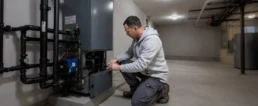
Who Fixes Boilers? When to Call a Boiler Repair Technician
If your boiler stops heating, starts leaking, loses pressure, or keeps shutting down, the right person to call is usually a licensed HVAC contractor or boiler repair technician. Boilers are not simple appliances. They involve fuel, water pressure, electrical controls, circulator pumps, venting, and safety devices that need proper diagnosis.
In Philadelphia and the surrounding counties, many homes still rely on gas, oil, hot-water, steam, tankless, and combi boiler systems. The right technician should understand the type of boiler you have, how the system is piped, and whether the problem is related to ignition, circulation, pressure, controls, or heat distribution.
EMCO Tech provides boiler repair in Philadelphia for residential and light commercial systems, including gas, oil, hot-water, tankless, combi, and selected steam boiler repairs.
Boiler Not Heating, Leaking, or Shutting Down?
If your boiler is already giving you trouble, schedule professional boiler repair services in Philadelphia before a small problem turns into a no-heat emergency.
Who Should You Call to Fix a Boiler?
Call a licensed HVAC company or boiler repair technician that works on heating systems. Boiler problems usually involve more than one trade. A no-heat call may involve combustion, electrical controls, water pressure, air in the system, a failed pump, a bad zone valve, or a venting issue. That is why experience with boiler diagnostics matters.
A plumber may be the right call for a domestic water pipe leak or a drain problem, but many boiler issues fall into heating-system territory. If the problem is no heat, strange boiler noises, low pressure, lockouts, uneven radiator heat, or repeated shutdowns, you want a company that handles boiler repair every day.
Signs You Need a Boiler Repair Technician
Most boilers give warning signs before they fail completely. Homeowners should pay attention to no heat, no hot water, low pressure, leaking water, banging or kettling noises, short cycling, uneven radiator heat, repeated ignition failures, and rising heating bills without a clear reason.
If your boiler keeps locking out, needs frequent resets, smells unusual, or leaves water around the unit, do not treat that as normal wear. That is the point where a repair call is cheaper than waiting for a no-heat breakdown in the middle of winter.
Problems That Should Not Wait
Some boiler issues are more urgent than others. A boiler that is leaking heavily, throwing fault codes, showing a yellow flame, losing pressure fast, or refusing to stay on needs professional attention quickly. If there is no heat during freezing weather, that also becomes urgent fast in older Philadelphia homes, rowhouses, and multi-unit buildings.
If you smell gas or suspect combustion trouble, shut the system down and call for service immediately. Do not keep restarting a boiler that is already telling you something is wrong.
What Does a Boiler Technician Actually Check?
A real boiler diagnosis is not just “take a look and guess.” A technician checks thermostat operation, zone controls, ignition sequence, burner operation, circulator pumps, relief valve behavior, expansion tank condition, venting, water pressure, air in the system, leak points, and safety controls.
That inspection matters because different failures can produce the same symptom. A cold house might be caused by a bad thermostat, but it could also be low pressure, a failed circulator pump, an air-bound loop, an ignition lockout, or a control problem. Good diagnosis is what saves people from paying for the wrong repair.
Does the Type of Boiler Change Who You Call?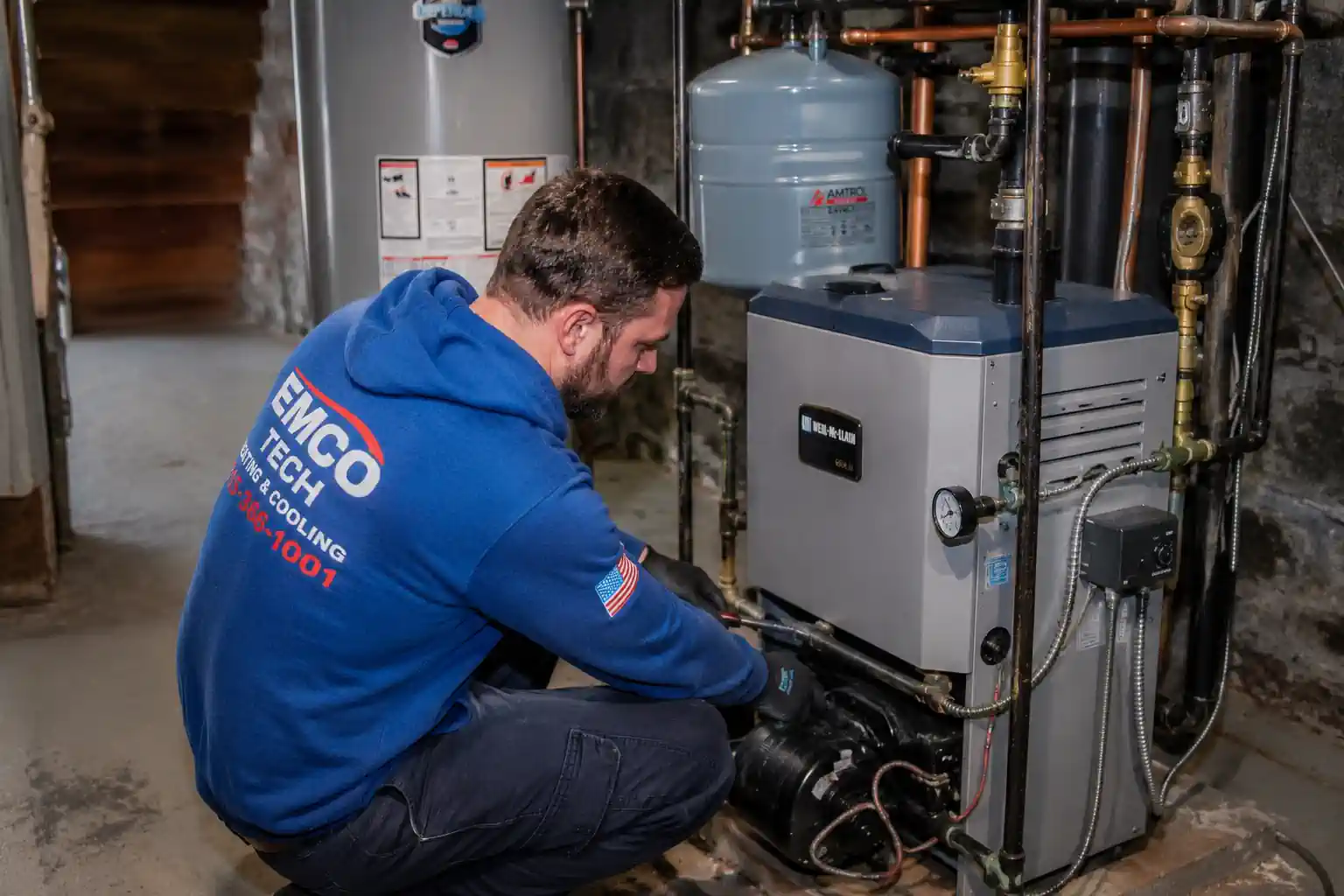
Yes. The more specialized the system, the more important it is to call someone who actually works on that boiler type. Gas systems have different failure patterns than oil systems. Steam systems are their own category. Tankless and combi boilers introduce their own controls, sensors, venting, and flow issues.
Gas Boiler Problems
Gas boilers often develop ignition faults, flame-sensor issues, gas-valve problems, venting faults, pressure issues, or circulation problems. If you have a gas-fired system, it helps to work with technicians who regularly service gas boiler systems instead of treating every no-heat call like a generic furnace job.
Oil Boiler Problems
Oil systems bring burner, nozzle, filter, pump, and combustion concerns into the picture. They need clean setup and correct diagnostics, not guesswork. If your home runs on oil heat, learn more about EMCO Tech’s oil boiler services and the types of repairs that commonly show up on older systems.
Steam Boiler Problems
Steam boilers are different from hot-water boilers, and that difference matters. Water hammer, surging, steam trap issues, pressuretrol problems, and uneven radiator heat are all signs that the technician needs real steam-system experience. For one-pipe and two-pipe systems, see our steam boiler repair services.
Tankless and Combi Boiler Problems
Tankless and combi boilers can fail on ignition, flow sensors, heat exchangers, venting, error codes, and domestic hot water priorities. If that is your setup, EMCO Tech also handles tankless boiler service for on-demand and combination systems.
Is It a Repair Call or a Maintenance Call?
If the system is already leaking, not heating, short cycling, or shutting down, that is a repair issue. Maintenance is preventive. Repair is corrective. People mix those up all the time.
If the boiler is still running and you mainly want to reduce breakdown risk, improve efficiency, and catch wear before it turns into a bigger problem, that is where boiler maintenance comes in. Service and maintenance matter, but they do not replace a real repair diagnosis when the system is already failing.
Should You Repair the Boiler or Replace It?
That depends on age, condition, repair history, efficiency, and what actually failed. A newer boiler with one isolated issue is often worth repairing. An older boiler that leaks from the block, needs repeated expensive work, or is becoming unreliable may be heading toward replacement instead.
If you are weighing cost against remaining lifespan, read our breakdown of whether boilers are worth fixing. If replacement is starting to make more sense, you can also review options for boiler replacement in Philadelphia.
Who Fixes Boilers in Philadelphia?
Licensed HVAC contractors with boiler experience fix most residential and light commercial boiler problems in the Philadelphia area. The important thing is not the label. It is whether the company actually diagnoses and repairs boiler systems every week and understands gas, oil, steam, hot-water, and tankless equipment.
If your boiler is not heating, keeps shutting down, leaks water, or is making noises that were not there before, EMCO Tech offers boiler repair services throughout Philadelphia and nearby counties.
Still deciding whether it makes sense to repair the system? Read our guide on whether old boilers are worth fixing, or compare your options for boiler replacement in Philadelphia.
Boiler Repair Questions Homeowners Ask
Repair usually makes sense when the boiler is in decent condition and the failure is isolated. Replacement may make more sense when the boiler is old, inefficient, leaking from the block, or needing repeated major repairs.
A technician checks thermostat operation, system pressure, ignition sequence, burner operation, circulator pumps, zone valves, expansion tank condition, relief valve operation, venting, air in the system, leaks, and safety controls.
No heat can become urgent during cold weather, especially in older homes, apartments, and buildings with children, elderly occupants, or vulnerable residents. Heavy leaks, gas odors, pressure relief discharge, or repeated lockouts should be handled quickly.
Some plumbers work on hydronic heating, but not every plumber repairs boiler controls, burners, pumps, zone valves, combustion issues, or heating diagnostics. For heating performance problems, call a boiler repair technician or HVAC contractor experienced with boiler systems.
Need Boiler Help? Start With the Right Service
Boiler Repair
No heat, leaks, pressure problems, lockouts, and boiler system diagnostics.
Gas Boilers
Gas boiler service, repair, replacement, ignition diagnostics, and heating support.
Oil Boilers
Oil boiler repair, burner service, filter issues, combustion checks, and heating repairs.
Steam Boilers
Steam boiler help for water hammer, surging, uneven radiator heat, and pressure issues.
Boiler Maintenance
Preventive boiler service to reduce breakdowns, improve efficiency, and catch problems early.

How Central Air Conditioning Works: The Parts and the Process
Central air conditioning does not make cold air out of nothing. It moves heat from inside your home to the outside, using a closed loop of refrigerant and a handful of key parts. Once you understand how that loop works, weak cooling, strange noises, and high bills all start to make sense. Here is the whole system, explained simply.
Central Air Issues?
If your HVAC system wouldn't turn on or not working properly, EMCO Tech provides central air services with fast response and prompt repairs for homes and businesses.
How Central Air Conditioning Works
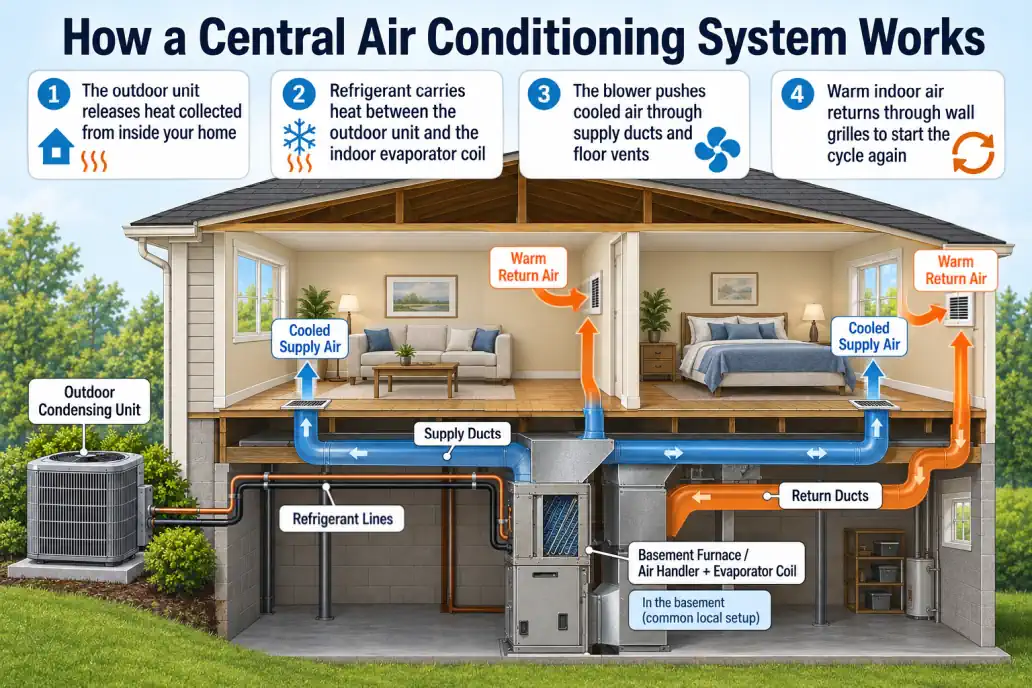
A central air system cools your whole home from one unit, sending conditioned air through a network of ducts. It works by moving heat, not by creating cold. Refrigerant circulates between an indoor coil and an outdoor unit, absorbing heat inside your home and releasing it outdoors. A blower pushes the cooled air through the ducts and into each room, while warm indoor air is drawn back to start the cycle again.
The Main Parts of a Central AC System
Most central air systems share the same core components, split between an outdoor unit and an indoor unit:
- Compressor — the pump in the outdoor unit that pressurizes refrigerant and drives the whole cycle. If you suspect trouble here, see our guide on a bad AC compressor.
- Condenser coil — also outdoors, it releases the heat collected from inside your home.
- Evaporator coil — sits indoors above the furnace or in the air handler, and absorbs heat and moisture from the indoor air.
- Refrigerant — the fluid that carries heat between the coils. Low levels cause weak cooling, as our low refrigerant guide explains.
- Air handler or blower — moves cooled air through the ducts. Learn more about air handlers.
- Thermostat and ductwork — the control and the delivery network that send conditioned air to each room.
The Cooling Cycle, Step by Step
Here is the loop that repeats every time your AC runs:
- Warm indoor air is pulled in and passed over the cold evaporator coil, which absorbs its heat and moisture.
- The refrigerant, now carrying that heat, flows to the outdoor unit.
- The compressor pressurizes it, and the condenser coil releases the heat into the outside air.
- The cooled refrigerant returns indoors, and the blower sends the freshly cooled air through your ducts.
- The cycle repeats until the thermostat reaches your set temperature.
What Goes Wrong, and What Each Part Does
Knowing the parts makes troubleshooting easier. A failing compressor means little or no cooling. A dirty condenser coil traps heat outside and raises bills. A frozen evaporator coil usually points to low refrigerant or poor airflow. A weak blower or leaky ductwork leaves rooms uneven. If your system runs but the house will not cool, our guide on an AC not blowing cold air walks through the usual causes.
Need Central Air Service or a New System?
From repairs to full installs, our team keeps central air running across the Philadelphia area. Explore our central air conditioning services.
FAQ
Central air conditioning cools your home by moving heat outdoors rather than making cold air. Refrigerant absorbs heat at the indoor evaporator coil, the compressor pumps it to the outdoor unit, the condenser coil releases that heat outside, and a blower sends the cooled air through your ducts.
The core parts are the compressor and condenser coil in the outdoor unit, the evaporator coil in the indoor unit, refrigerant that carries heat between them, an air handler or blower that moves the air, and the thermostat and ductwork that control and deliver cooling.
The evaporator coil sits indoors and absorbs heat and moisture from the air passing over it, which is what actually cools and dehumidifies your home. If it freezes or fails, you get weak or no cooling.
AC Related Posts & Pages

What Size Water Heater Do I Need?
Tank Water Heater Sizing by Household Size
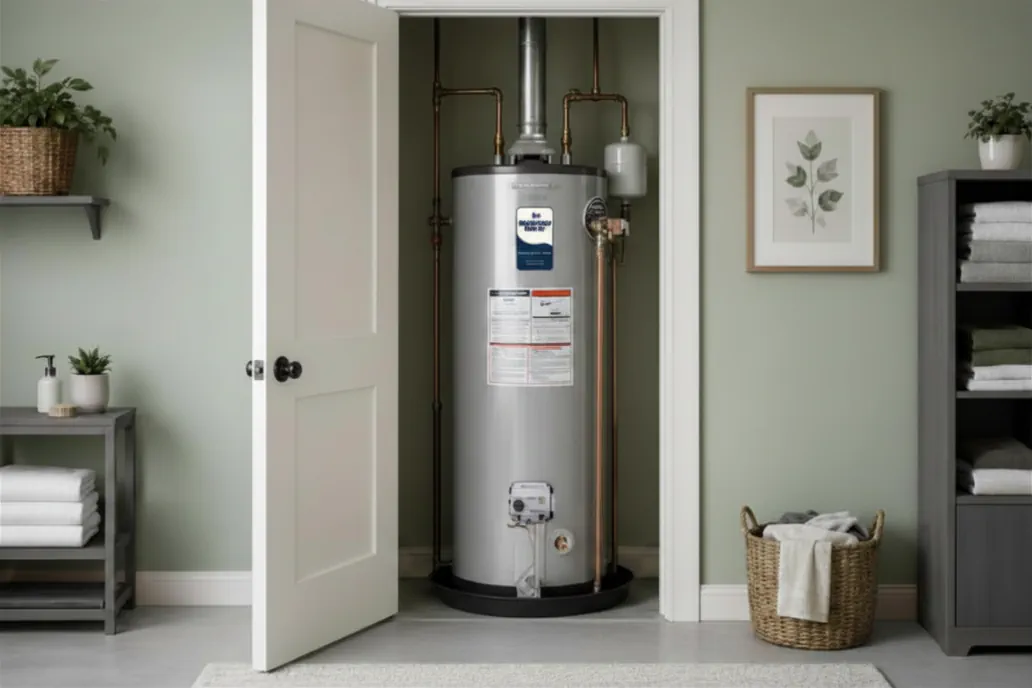
For a single person or couple, a 30 to 40-gallon tank is typically enough. Households of three to four people generally do well with a 50-gallon tank, while homes with five or more residents, or those with large soaking tubs and multiple bathrooms, often need 65 to 80 gallons of capacity. These are general starting points. Your actual usage pattern, such as running the dishwasher, laundry, and a shower back-to-back, can push you toward the next size up.
Understanding First Hour Rating (FHR)
Tank capacity alone doesn’t tell the whole story. The first hour rating, listed on every water heater’s EnergyGuide label, shows how many gallons of hot water the unit can deliver in a single hour starting from a full tank. A good rule of thumb is matching the FHR to within a few gallons of your home’s peak-hour hot water use, rather than just matching the tank size to household headcount.
Running Out of Hot Water in Your Philadelphia Area Home?
If your water heater can't keep up, it may simply be the wrong size for your household. EMCO Tech Heating & Cooling offers professional water heater installation and replacement with proper load calculations across Montgomery County, Philadelphia, Bucks County, Chester County, and Delaware County.
 Sizing a Tankless Water Heater
Tankless units are sized differently, based on flow rate in gallons per minute (GPM) rather than storage capacity. Because a tankless water heater heats water on demand, the unit needs enough GPM capacity to cover every fixture that might run at the same time, such as a shower and a washing machine running together. Undersizing a tankless unit is the most common mistake homeowners make when switching from a tank system, so this is worth getting right during installation rather than after the fact. For a full breakdown of how the two styles compare, see our tank vs. tankless water heater comparison.
Gas vs. Electric Sizing Differences
Fuel type also affects sizing. Gas water heaters recover heat faster than electric models, so a slightly smaller gas tank can often keep pace with the same household that would need a larger electric water heater to match its output.
Signs Your Current Water Heater Is the Wrong Size
Consistently running out of hot water before everyone in the house has showered, needing to space out laundry and dishwashing to avoid cold water, or a tank that runs almost constantly to keep up with demand are all signs the current unit no longer matches your household’s needs. A professional load calculation during a water heater installation or replacement visit accounts for fixture count, bathroom layout, and usage habits, rather than relying on rough size guidelines alone.
Get the Right Size the First Time
Sizing mistakes are expensive to fix after installation, since they usually mean living with the problem for years or paying to swap the unit early. If you’re not sure whether your current tank is properly sized, or you’re planning a replacement, our current water heater installation special is worth a look before you buy.
Water Heater Sizing Table
| Household Size | Recommended Tank Size | Typical First Hour Rating |
|---|---|---|
| 1–2 people | 30–40 gallons | 40–50 gallons |
| 3–4 people | 50 gallons | 50–65 gallons |
| 5+ people | 65–80 gallons | 65–85 gallons |
| Large tubs / multiple bathrooms | 80 gallons or tankless | Sized by peak-hour demand |
Figures are general guidelines. A professional load calculation accounts for fixture count and usage habits for a precise recommendation.
FAQ
Most four-person households do well with a 50-gallon tank water heater, though homes with large tubs, multiple bathrooms, or heavy simultaneous use may need up to 65 gallons.
Yes, a 40-gallon tank is typically sufficient for a household of two, unless usage habits like long showers or a large soaking tub push demand higher than average.
An undersized unit runs out of hot water during peak use, such as back-to-back showers, and may cycle more often, adding wear that shortens its lifespan.
An oversized tank wastes energy keeping unused water hot and costs more upfront than necessary, so bigger isn’t always better once it exceeds your household’s actual demand.
Tankless units are sized by flow rate in gallons per minute rather than storage capacity, based on how many fixtures need hot water at the same time.
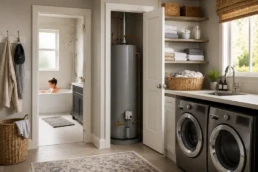

Bad AC Compressor: Signs, Causes, and Replacement Cost
Your air conditioner has one part that does the heavy lifting: the compressor. It pressurizes refrigerant and drives the entire cooling cycle, so when it weakens or fails, the whole system goes down with it. It is also the single most expensive component to replace, which is why catching trouble early matters so much. Below, we break down the warning signs of a failing compressor, what wears one out, and how to think through your repair-versus-replacement options.
What the AC Compressor Actually Does
The compressor lives in your outdoor unit and works like a pump for refrigerant. It raises the pressure and temperature of the refrigerant so it can release heat outside and then absorb heat from inside your home. Without a healthy compressor, refrigerant cannot circulate properly, and your AC simply cannot move heat out of the house, no matter how long it runs.
Because it runs under high pressure and heat all season, the compressor takes more wear than almost any other part. That is also why protecting it is the smartest money you can spend on AC care.
How Long Does an AC Compressor Last?
Typical lifespan of an AC compressor
A compressor installed and maintained correctly usually runs 10 to 15 years, in line with the rest of the system around it. Some go 20 years in a mild climate with light use and a filter that always gets changed on time. Others struggle to make it past year 5 because of something that went wrong at install or a filter that never got touched.
The compressor is almost never the weak link on a healthy system. It is a sealed, factory-built unit designed to run for decades. What actually shortens its life is everything around it: airflow, refrigerant charge, electrical supply, and how consistently the system gets serviced. A 12 year old compressor working inside a system that gets a yearly tune-up and clean coils will usually outlast a 3 year old compressor sitting inside a system nobody has looked at since installation day.
Philadelphia area summers push the compressor hard for months at a stretch. A system that runs constantly through July and August needs its airflow and refrigerant charge in spec more than a system in a milder climate does, because there is less margin for error when the compressor rarely gets a break.
Is it common for an AC compressor to go bad?
Compressor failure on its own, meaning a healthy system where the compressor simply wears out from age, is not that common before year 10. What is common, and what drives most of the compressor calls we get, is failure caused by something else: a refrigerant leak that ran the compressor low on charge for months, a dirty coil that made it overheat, an electrical fault that damaged the motor windings, or an install issue that showed up two or three years later.
In other words, a bad compressor is usually a symptom, not a random event. Something in the system created the condition that killed it. That is why fixing the compressor without figuring out what caused the failure is a partial repair. The replacement compressor is sitting inside the same conditions that killed the last one.
Warning Signs of a Failing AC Compressor
A compressor rarely dies without warning. These are the symptoms that most often point to compressor trouble specifically, rather than a simple thermostat or filter issue.
Warm air from the vents while the outdoor unit runs
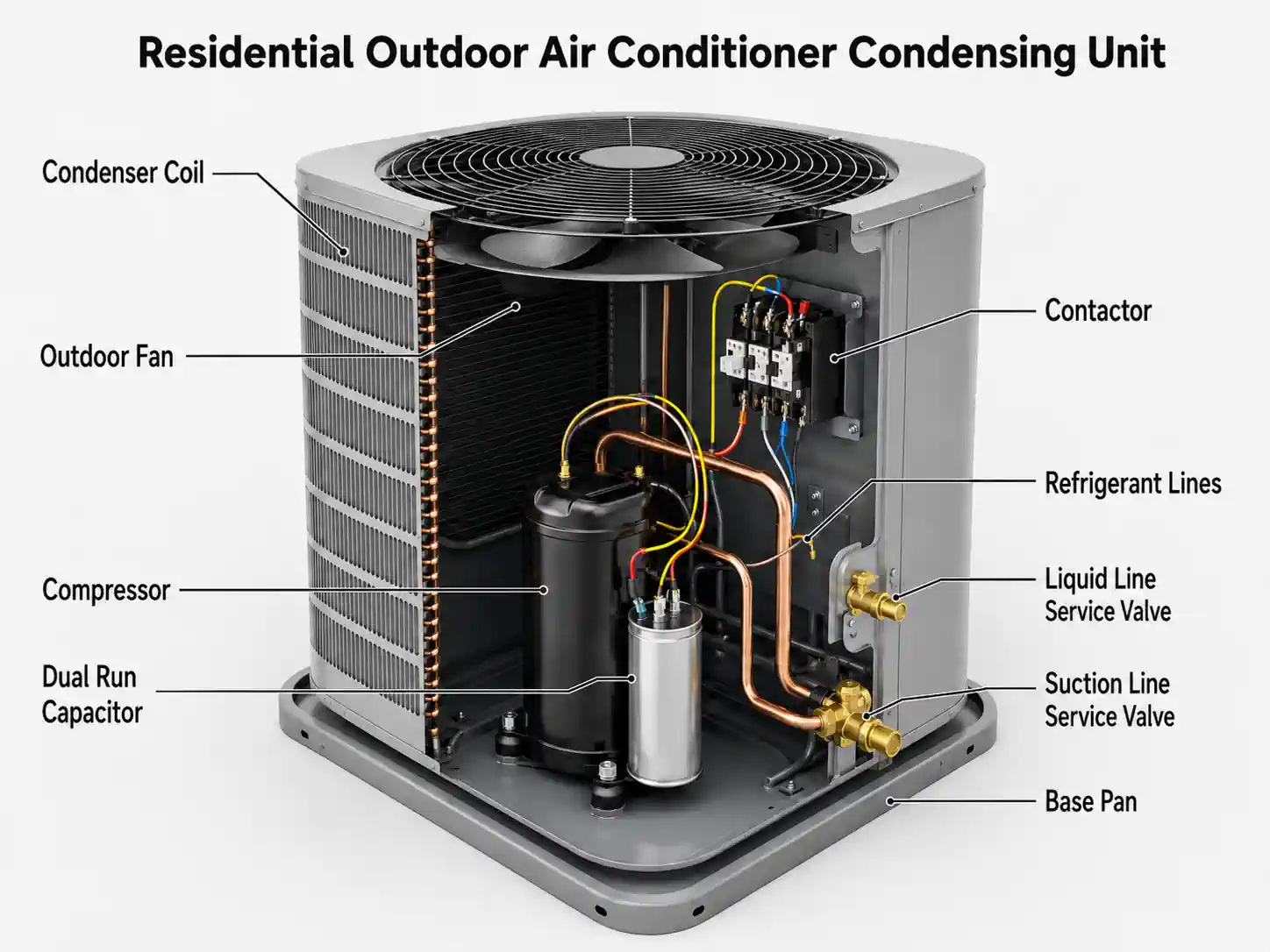
If the outdoor unit is running but the air inside stays warm, the compressor may not be pressurizing refrigerant the way it should.
Loud or unusual noises from the outdoor unit
Grinding, rattling, or a harsh metallic clatter from the outside unit can signal worn internal compressor parts or loose components.
The outdoor unit vibrates hard when it starts
A strong shudder on startup, sometimes called hard starting, often points to a compressor straining to turn over. If your unit hums, dims the lights, or trips the breaker on startup, see our guide to AC hard starting and how to prevent compressor failure.
The circuit breaker trips repeatedly
A compressor pulling too much current as it degrades can keep tripping the breaker. Never keep resetting it, as that only adds stress.
Higher energy bills with weaker cooling
A struggling compressor runs longer and harder to deliver less comfort, which shows up as a climbing electric bill.
What Causes an AC Compressor to Go Bad
Compressors usually fail because of stress that built up over time. The most common causes include:
Low or leaking refrigerant
Running low on refrigerant forces the compressor to work harder and run hotter, which is one of the fastest ways to burn it out. If you suspect a charge problem, read our breakdown of low refrigerant signs and symptoms before it reaches the compressor.
Electrical problems
Failing capacitors, worn contactors, and wiring faults can starve or overload the compressor motor until it gives out.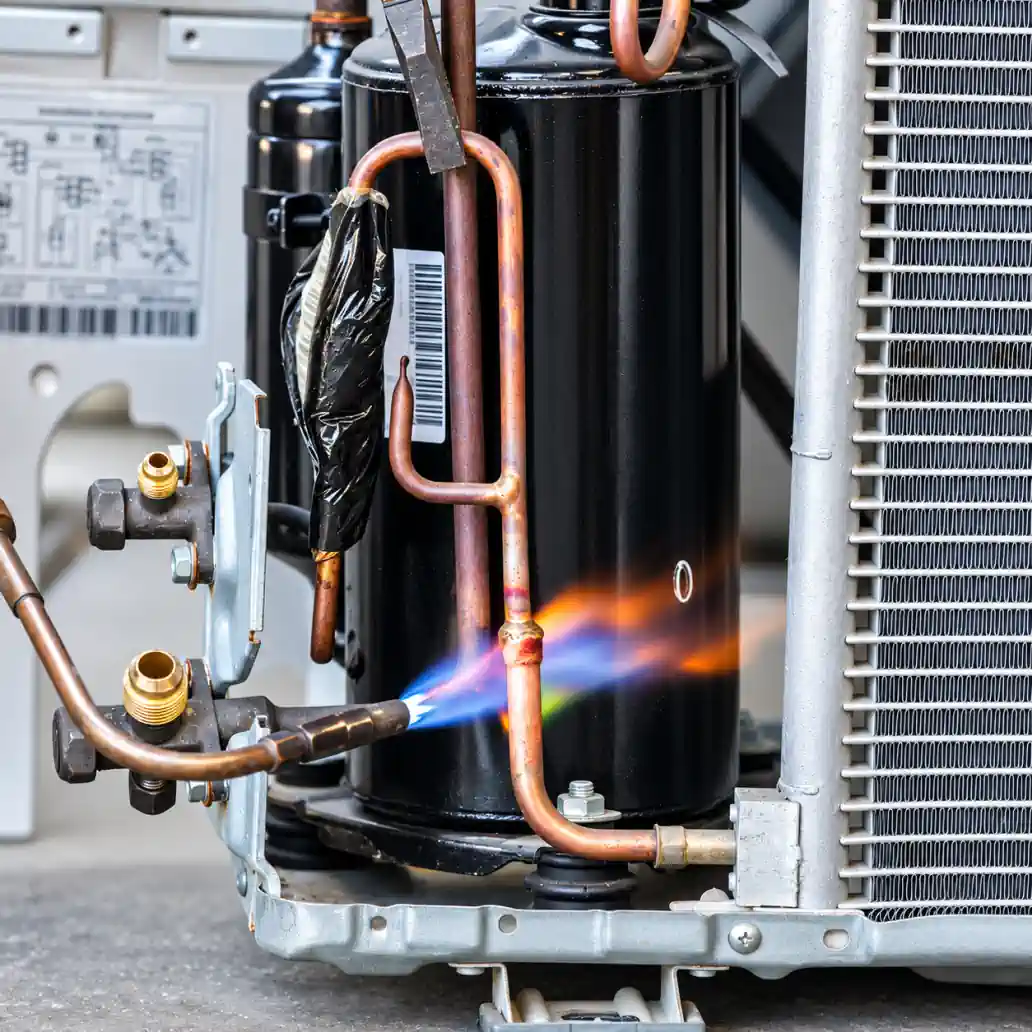
Dirty coils and poor airflow
Clogged condenser coils and blocked airflow trap heat around the unit, pushing the compressor past its safe operating temperature.
Lack of maintenance and age
Skipped tune-ups let small issues snowball, and most compressors simply wear out toward the end of a system’s typical lifespan.
Why a compressor can fail on a system that is still under warranty
This is the question we hear the most. A 2 or 3 year old system fails, the parts are still covered, and the homeowner wants to know how a new compressor breaks at all. Warranty coverage tells you who pays for the part. It does not tell you why the part died.
Most early compressor failures trace back to how the system was installed, not a flaw in the equipment itself.
Moisture left in the line set. If the system was not properly evacuated before it was charged, trapped moisture mixes with refrigerant oil and forms an acidic sludge. That sludge slowly eats through the motor windings from the inside. It can take a year or two to finish the job, which is exactly why the failure shows up on a system that looked fine at startup.
Refrigerant charge set wrong from day one. A compressor depends on refrigerant gas returning to cool its motor. Too little charge starves that cooling. Too much charge spikes pressure the motor was never built to run against. Either mistake, made once at install, shortens the compressor’s life on a clock that runs whether anyone notices or not.
A damaged or poorly sealed line set connection. A slow leak from a bad flare joint drains the charge gradually. The system keeps running, cooling gets a little weaker every month, and the compressor works harder until it gives out.
An actual manufacturer defect. This does happen, and it is the one case where the part simply failed on its own. It is also the least common cause of the four.
Parts warranty covers the replacement compressor. It typically does not cover the labor to install it, and it will not fix whatever caused the first one to fail, so the same problem can take out a second compressor if the root cause is never addressed. That is why a proper compressor replacement includes finding out why the last one died, not just swapping the part.
AC Compressor Repair and Replacement Cost
Pricing depends on your unit’s size, refrigerant type, warranty status, and how accessible the part is. As a rough guide, a minor electrical fix that protects the compressor, such as a capacitor or contactor, tends to land in the lower hundreds of dollars*. Replacing the compressor itself is far more involved and typically runs from the mid hundreds into the low thousands of dollars or higher*, since it involves labor, refrigerant handling, and often a long warranty claim.
Here is the part many homeowners miss: on an older system, a new compressor can cost a large share of what a brand-new outdoor unit would. When that happens, replacement often makes more financial sense than sinking money into aging equipment. Our full repair or replace your HVAC system guide walks through the math.
Should You Repair the Compressor or Replace the System?
A compressor failure is one of the few repairs big enough to tip the scale toward a new system. If your AC is still young and under warranty, a compressor repair is usually worth it. If the unit is older, out of warranty, and already needing other fixes, replacing the whole system is often the smarter long-term move.
Not sure which way to go? Our team can diagnose the compressor, confirm whether it is repairable, and give you honest numbers before you commit. Explore our air conditioning repair services or schedule an appointment and we will help you decide with no pressure.
Is it cheaper to replace just the compressor or the whole unit?
Replacing only the compressor is cheaper up front. A compressor swap runs roughly $1,200 to $2,800 or more depending on the tonnage, accessibility, miscellaneous parts or job complications, and whether the unit is still under parts warranty. Replacing the whole outdoor unit, or the full system including the indoor coil, costs significantly more.
Cheaper up front does not always mean cheaper overall. A compressor-only repair makes sense when the system is young, the rest of the equipment is in good shape, and the failure has a clear, fixable cause. It stops making sense once the system is old enough that other parts are approaching the end of their life too, or once the refrigerant type in an older system is being phased out and becoming harder and more expensive to source.
A rough guide we use in the field: if the system is under 10 years old and the failure has an identifiable, correctable cause, repairing the compressor is usually the better value. If the system is past 12 to 15 years, or this is not the first major repair, replacing the full unit is usually the better long-term move, because a new compressor bolted onto an aging system is still surrounded by aging parts.
*Pricing is shown as a general range only. Depending on supply, demand, and the availability of refrigerant types that are being phased out, prices may vary dramatically, and refrigerant costs can change without prior notice. Contact us for a current estimate specific to your system.
FAQ
Common signs include warm air from the vents while the outdoor unit runs, loud or unusual noises from the outside unit, hard shaking on startup, a breaker that keeps tripping, and rising energy bills with weaker cooling. Several of these together strongly point to the compressor.
It depends on the age and warranty of your system. On a newer unit still under warranty, replacing the compressor is usually worth it. On an older, out-of-warranty system, a new compressor can cost a large share of a full replacement, so a new system often makes more sense.
Costs vary with unit size, refrigerant type, warranty, and labor. Replacing the compressor typically runs from the mid hundreds into the low thousands of dollars or higher*. Because pricing and refrigerant availability change, we recommend getting a current estimate for your specific system.
Warranty covers the cost of the part, not the reason it failed. Most compressor failures on a young system trace back to how it was installed, usually moisture left in the line set during charging, or the refrigerant charge being off from day one. A true manufacturer defect happens too, but it is the least common cause. Warranty labor is usually not included, and if the underlying cause is not fixed, a new compressor can fail the same way.
A straightforward compressor swap on a residential system typically takes 3 to 6 hours, including recovering the old refrigerant, replacing the compressor, pulling a proper vacuum on the line set, and recharging the system by weight. It can run longer if the failure damaged other components, if the line set needs to be flushed to clear debris from the old compressor, or if the refrigerant type is harder to source. Same-day completion is common when parts and refrigerant are on hand.
No. Compressor replacement involves recovering and handling refrigerant, which by federal law requires EPA Section 608 certification. It also requires pulling a deep vacuum to remove all moisture from the system and charging it precisely by weight, steps that determine whether the new compressor lasts 15 years or fails again in two. A compressor swap done without the right equipment and certification is also how a warranty claim gets denied, since most manufacturers require a licensed technician’s documentation to honor the parts coverage.
No. If the compressor has failed completely, the system will run the indoor blower without producing any cooling, which wastes electricity for no benefit. If the compressor is failing rather than fully dead, meaning it is hard-starting, overheating, or tripping the breaker, continuing to run it can cause more damage and turn a compressor repair into a full system replacement. If the outdoor unit is tripping a breaker or making unusual noises, shut the system off at the thermostat until it has been looked at.

Is Your AC Failing? How to Spot Commercial Air Conditioning Problems
Signs Your Commercial HVAC System Is Failing in Greater Philadelphia
When a commercial heating or cooling system starts to fail, it almost never quits all at once. It warns you first—warmer air at the registers, a floor that won’t hold temperature, a bill that creeps up for no obvious reason. Catching those early signals is the difference between a quick service call and a shut-down dining room, a server closet over 90°F, or a waiting room full of uncomfortable patients.
For a business, a down HVAC system isn’t just discomfort—it’s lost productivity, walk-outs, spoiled inventory, and overtime to recover. Below are the 12 most common signs of a failing commercial HVAC system we diagnose for businesses across Philadelphia, Montgomery, Bucks, Chester, and Delaware counties—what each symptom usually means, and how urgent it is. Most appear in summer on the cooling side, but the same warning signs apply to your heating system in winter.
★★★★★
4.9 from 359 Google reviews — see why local businesses call us
Business AC down or barely cooling?
Don't lose a day of business to a failing system. Our team provides emergency commercial AC service across Greater Philadelphia—fast response any time.
12 Signs Your Commercial HVAC System Is Failing
1. Your energy bill spiked for no reason
If your cooling habits haven’t changed but your bill jumped, the system is working harder than it should to deliver the same comfort. A commercial AC can keep running while it loses efficiency—low refrigerant, a dirty coil, a failing capacitor, or a fan motor dragging all force the unit to pull more power. Because the unit still “runs,” the problem is easy to miss until the bill arrives. A sudden climb of 15–30% is worth a professional look.
2. Strange noises that weren’t there before
A healthy system hums. Anything louder is a clue:
- Rattling or banging — loose hardware, a failing blower assembly, or a motor mount coming apart.
- Squealing — a worn or slipping belt on a belt-driven rooftop unit, or a bearing going bad.
- Hissing or bubbling — a refrigerant leak under pressure.
- Clicking that won’t stop — an electrical/relay or control issue.
- Grinding — metal-on-metal; shut the unit down and call before it seizes.
New noise is the cheapest warning you’ll ever get. Acting on it early usually means a small part instead of a compressor.
3. Odors coming from the vents
What you smell narrows the cause fast. A musty smell points to mold or mildew in the ductwork, drain pan, or on a damp coil. A burning or hot-electrical smell means stop the unit now—it can signal overheating wiring or a motor. A rotten-egg smell near a gas-fired rooftop unit can indicate a gas issue and warrants leaving the area and calling immediately. In a commercial space, poor air quality also shows up as headaches, stuffiness, and staff complaints, not just odor.
4. It’s running but blowing warm air
One of the most common calls we get: the unit is on, the fan is moving air, but the air isn’t cold. Usual culprits are low refrigerant from a leak, a frozen evaporator coil, a tripped compressor, or a controls/thermostat fault. On rooftop units, a failed contactor or capacitor can leave the fan running while the compressor is dead. This one rarely fixes itself—warm air on a hot day is a same-day issue for most businesses.
5. Some areas cool fine, others never do
 Uneven cooling across floors, wings, or zones is classic in larger commercial buildings. Causes include blocked or leaky ductwork, a dirty filter starving airflow, a zoning damper stuck shut, or—commonly—a system that’s undersized or out of balance for how the space is actually used. If one conference room is an icebox and the one next door is sweltering, the system is straining to compensate, which wears components faster.
6. Weak airflow at the registers
If the air coming out is noticeably feeble, the system isn’t moving the volume it should. Think clogged filters, a failing blower motor, a slipping belt, or duct obstructions. Weak airflow makes everything downstream worse—it’s a leading cause of frozen coils (see #8) and short cycling (see #7).
7. It turns on and off every few minutes (short cycling)
A commercial AC should run in steady cycles. When it switches on and off rapidly, it’s short cycling—and that’s hard on the most expensive part you own, the compressor. Causes range from an oversized unit, to low refrigerant, to a dirty coil, to a thermostat placed in a bad spot. Short cycling burns energy, never properly dehumidifies the space, and shortens equipment life. Don’t wait this one out.
8. Ice on the coil or refrigerant lines
Ice on a cooling system in summer feels backwards, but it’s a real warning sign. Restricted airflow (dirty filter, weak blower) or low refrigerant drops the coil temperature below freezing and moisture freezes onto it. Once iced, the unit can’t cool and the backup of pressure can damage the compressor. If you see ice, shut the system off, let it thaw, and have it diagnosed before running it again.
9. Water leaking or pooling around the unit
A commercial AC pulls humidity out of the air and drains it away. When you see water pooling near an air handler or dripping from a ceiling below a rooftop unit, the condensate drain is usually clogged with algae or sludge, the drain pan has rusted through, or the coil froze and is now thawing. Left alone, this leads to water damage, ceiling stains, and mold—an expensive secondary problem on top of the AC repair.
10. The air feels sticky even when the AC is on
Commercial cooling should control humidity as it cools. If the space feels damp and clammy despite the thermostat reading “cool,” the system isn’t removing moisture properly—often from short cycling, an oversized unit, or low refrigerant. High indoor humidity is uncomfortable, encourages mold, and can damage paper goods, electronics, and inventory.
11. The thermostat or controls aren’t responding
A blank thermostat, settings that won’t hold, or a building-management system reading that doesn’t match reality can all point to control faults, wiring problems, sensor drift, or simply dead batteries. Because the thermostat is the brain of the system, a fault here can masquerade as a much bigger mechanical problem—worth ruling out early.
12. You’re calling for repairs more than once a season
One repair is normal wear. A pattern of repairs is the system telling you it’s near the end of its useful life. Most commercial AC units last roughly 10–15 years with regular maintenance; past that point, efficiency drops, parts get harder to source, and small failures multiply. When repair calls cluster, it’s time for a straight repair-versus-replace conversation (see below).
Rooftop & Packaged Units: What’s Different for Commercial Buildings
Most Philadelphia-area businesses cool with rooftop units (RTUs) or packaged systems rather than the split systems found in homes. They live outdoors year-round, run long hours, and are out of sight—so problems often go unnoticed until comfort drops. A few rooftop-specific warning signs to watch:
- Belt squeal or shredded belt on belt-driven RTUs—an easy, inexpensive fix if caught early.
- Standing water or rust streaks on the curb, which can lead to leaks into the ceiling below.
- Debris, nests, or storm damage blocking the condenser—common after Philadelphia summer storms.
- Economizer dampers stuck open or closed, quietly wasting energy or pulling in hot outside air.
Because rooftop access and safety matter, RTU diagnosis is a job for a technician with the right equipment. If your roof unit is showing any of the symptoms above, our team handles commercial AC service across Greater Philadelphia, and we keep restaurants and other high-runtime spaces cooling through peak season.
Why Commercial AC Problems Aren’t the Same as Home AC
Commercial systems are built for tougher demands—multiple zones, longer runtimes, bigger loads, and tighter requirements for places like medical offices and schools. That complexity means more places for things to go wrong: zoning dampers, economizers, building controls, and multi-stage compressors all add failure points a home system doesn’t have. It also means the cost of downtime is higher, so early diagnosis pays off faster. A problem that’s an inconvenience at home can stop a business cold.
What You Can Check Yourself vs. When to Call a Pro
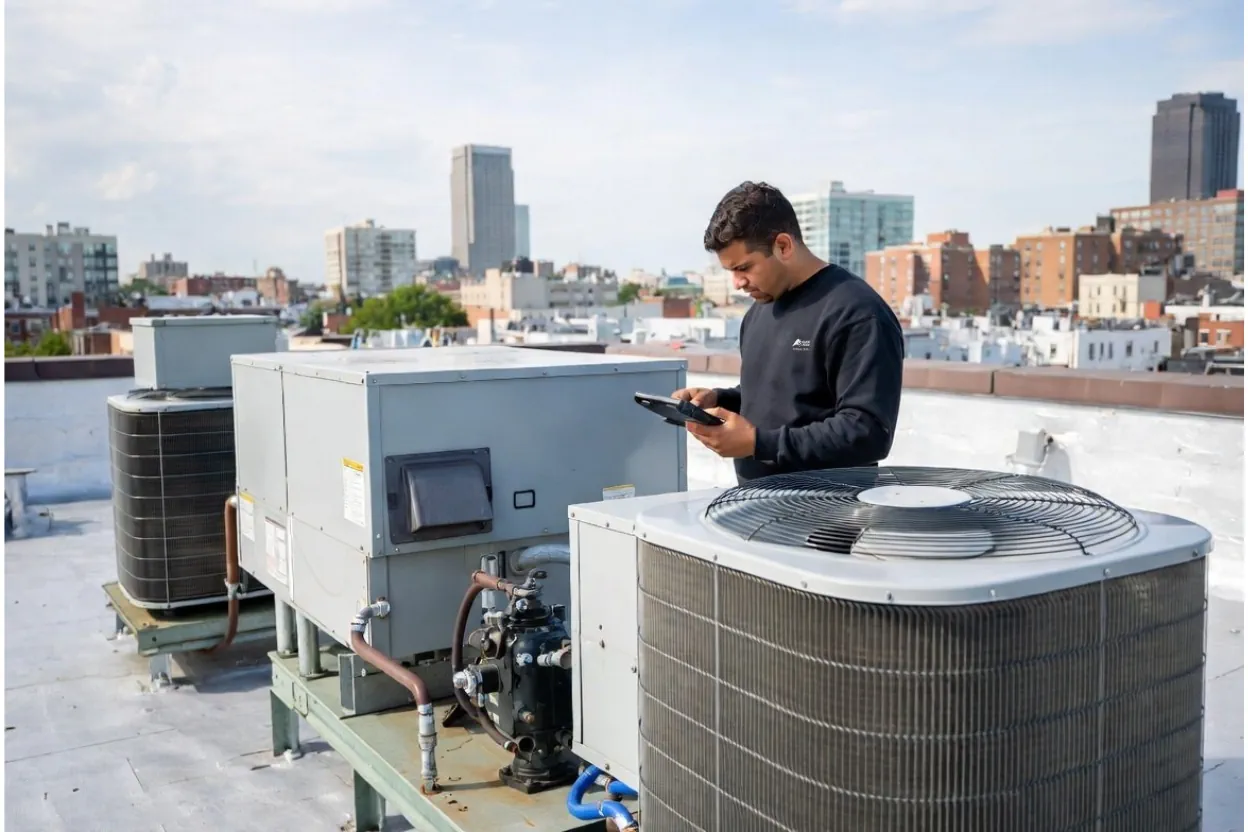 A few quick checks are safe for any facility manager before you pick up the phone:
- Confirm the thermostat is set to cool, at the right temperature, with live batteries.
- Check the breaker—a tripped breaker is a common, simple cause.
- Look at the air filter; a clogged filter causes weak airflow, freezing, and short cycling.
- Make sure supply and return vents aren’t blocked by furniture, stock, or equipment.
Stop and call a professional for anything involving refrigerant, electrical components, the compressor, rooftop access, gas, ice, or burning smells. These aren’t DIY territory—handling refrigerant requires EPA certification, and rooftop work carries real safety risk. If your business is already without cooling, our emergency HVAC team offers fast response any time, and routine commercial maintenance plans catch most of these problems before they start.
Repair or Replace? How to Think About It
A useful rule of thumb: if a major repair costs more than about half the price of a new system and the unit is already past 10 years old, replacement usually wins over time. Beyond age and repair cost, factor in how often it’s breaking down, how much it’s adding to your energy bills, and whether it’s keeping up with the space at all.
One more piece for 2026: newer commercial equipment now uses next-generation low-GWP refrigerants such as R-454B, while older systems run on R-410A. Your existing R-410A system is fine to keep, service, and recharge—you don’t have to replace a working unit. But as R-410A supply tightens, the cost to recharge an older system is climbing, which can tip a borderline repair-versus-replace decision. It’s worth asking your technician which refrigerant your system uses and what that means for future service costs. When you’re ready to weigh options, our team walks you through commercial AC service and replacement with no pressure.
This is general guidance, not a recommendation for your specific system—an on-site diagnosis is the only way to know for sure.
This is a custom heading element.
A commercial AC that runs but blows warm air usually has low refrigerant from a leak, a frozen evaporator coil, a tripped or failed compressor, or a controls/thermostat fault. On rooftop units, a failed contactor or capacitor can keep the fan running while the compressor is dead. Because warm air on a hot day stops most businesses, it’s typically a same-day repair.
Short cycling—turning on and off every few minutes—means the system can’t complete a normal cooling cycle. Common causes are an oversized unit, low refrigerant, a dirty coil, or a poorly placed thermostat. It strains the compressor, wastes energy, and leaves the space humid, so it should be diagnosed quickly.
Rooftop units pull humidity from the air and drain it away. Leaks usually mean a clogged condensate drain, a rusted-through drain pan, or a coil that froze and is now thawing. Because the water can drip into the ceiling below, it’s worth addressing promptly to avoid stains, water damage, and mold.
Most commercial AC systems last about 10 to 15 years with regular maintenance. Past the 10-year mark, efficiency declines, parts get harder to source, and repairs cluster. If you’re calling for service more than once a season on an older unit, it’s a good time to weigh repair against replacement.
A healthy system runs with a steady hum. Rattling or banging points to loose parts or a failing blower, squealing to a worn belt or bearing, hissing to a refrigerant leak, and grinding to metal-on-metal wear. New or louder noises are early warnings—acting on them usually means a small repair instead of a major one.
Ice forms when airflow is restricted (a dirty filter or weak blower) or refrigerant is low, dropping the coil below freezing. A frozen coil can’t cool and can damage the compressor. Shut the unit off, let it thaw, and have it diagnosed before running it again.
Plan on professional maintenance at least twice a year, with filter checks more often in high-dust or high-traffic spaces. Regular service catches most of the warning signs in this guide early, extends equipment life, and keeps energy costs down. A commercial maintenance plan makes this routine and adds priority scheduling.
Commercial HVAC Problems FAQ

What Is AC Hard Starting — and How to Fix It Before Your Compressor Fails
Post Updated: June 2026
What Is AC Hard Starting?
Hard starting is when your air conditioner struggles every time it tries to switch on. You’ll hear it try: a hum, a click, sometimes a brief surge. Then, it either stalls out or finally lurches into operation a few seconds late. Each attempt pulls an abnormally high inrush of current, strains the compressor windings, and shaves life off the most expensive component in your AC system.
A healthy central AC fires up cleanly within about half a second. If yours hesitates, hums, dims the lights, or trips the breaker before it kicks in, you’re watching hard starting in real time.
Signs Your AC Has a Hard Start Problem
Humming but no startup
The outdoor unit buzzes for several seconds without the fan spinning. That’s the compressor trying — and failing — to overcome internal pressure. Almost always a weak start capacitor.
The breaker trips when the AC tries to start
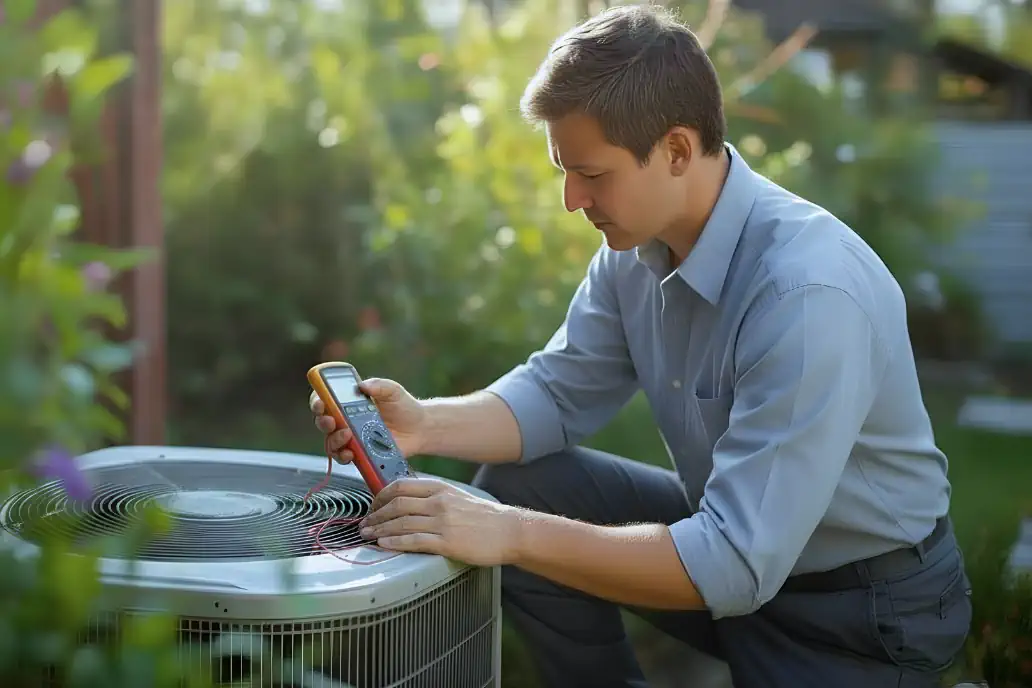 A hard-starting compressor pulls several times its normal running amperage during the startup attempt. If a breaker trips immediately on start, you’ve got either a failing capacitor, a degraded compressor, or both.
Lights dim or flicker the moment the AC kicks on
Brief dim is normal. If the lights drop noticeably every cycle, the compressor is drawing far more startup current than it should — a classic hard-start fingerprint.
The system starts, then shuts off seconds later
Known as short cycling on startup. The internal overload protector is sensing the abnormal current and cutting power to protect the compressor. It’s doing exactly what it’s designed to do.
Clicking from the outdoor unit followed by silence
The contactor is closing, but the compressor isn’t catching. Often a dead capacitor or a stuck rotor.
If any of these match what you’re hearing, schedule AC repair before the next heat wave. Continuing to run a hard-starting system is the fastest way to convert a minor repair into a major compressor replacement.
AC Humming, Clicking, or Tripping the Breaker?
Do not keep forcing the system to start. AC hard starting can damage the compressor and turn a smaller repair into a major replacement.
EMCO Tech Heating & Cooling provides AC startup diagnostics, capacitor testing, hard start kit evaluation, and air conditioning repair across the Philadelphia metro area.
What Causes Hard Starting?
Weak or failed run capacitor
The most common cause by a wide margin. The capacitor stores the electrical jolt that gets the compressor and fan motor moving. Capacitors degrade with heat and age — most fail between years 5 and 10. When capacitance drops below spec, the compressor doesn’t get enough kick to spin up cleanly.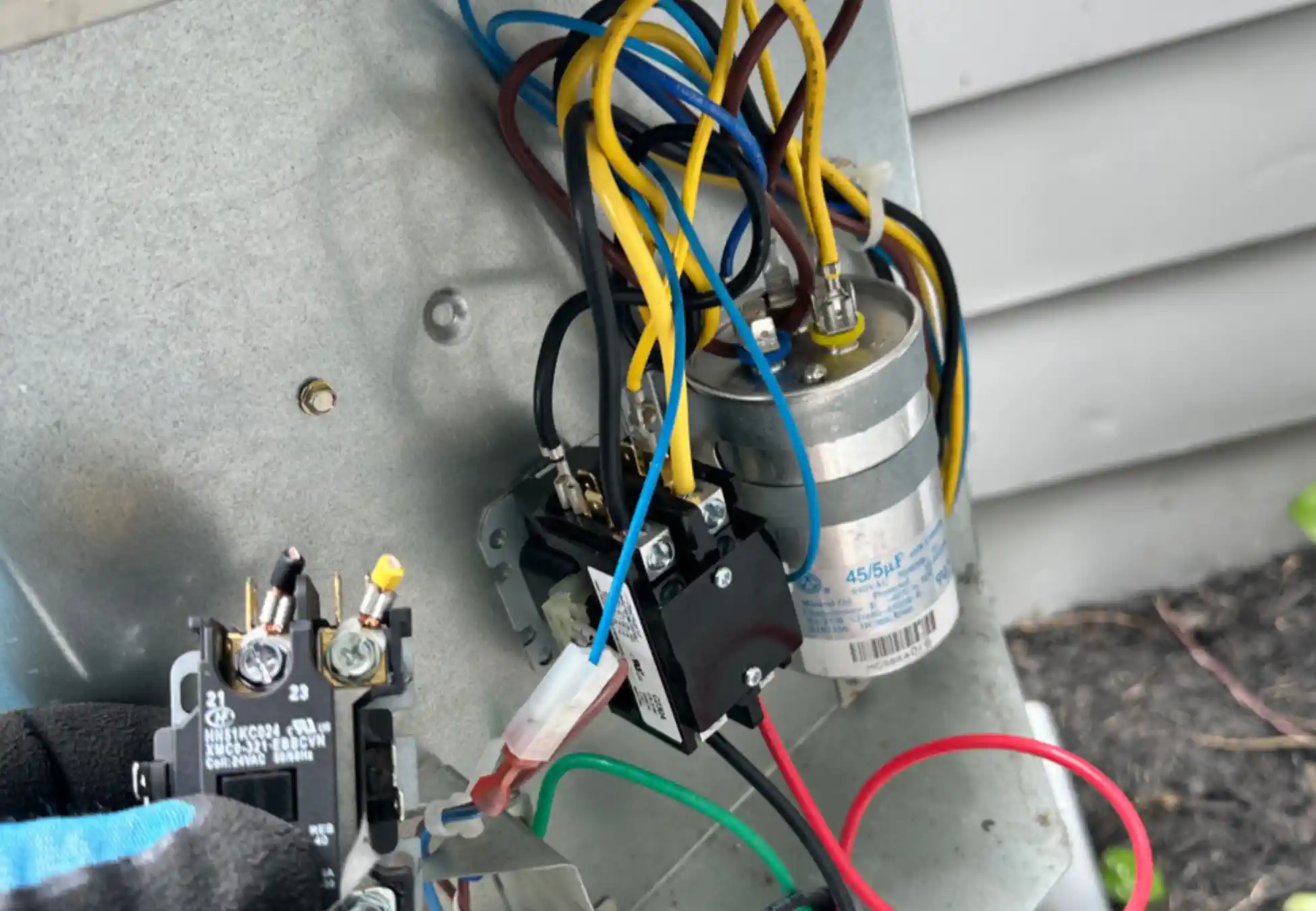
Aging compressor
After 10–12 years, internal compressor bearings and windings start to wear. A compressor that started fine for years can begin hard starting as mechanical resistance increases. At this stage, a hard start kit can buy time, but it isn’t a permanent fix.
Low incoming voltage
Brownouts, undersized service wiring, or long electrical runs can deliver less than the voltage the compressor expects. The compressor still tries to start, but without enough voltage to overcome rotor inertia.
Worn contactor or relay
The contactor is the electrical switch that powers the outdoor unit. Pitted or corroded contacts cause intermittent power delivery, which mimics hard starting.
Refrigerant pressure imbalance
If the system shuts off and tries to restart before equalizing pressure (usually within a few minutes), the compressor has to fight residual high-side pressure. This is why short cycling and hard starting tend to show up together.
Why Does My AC Unit Start So Hard?
An AC usually starts hard when the compressor needs more electrical force than normal to begin running. That can happen because the capacitor is weak, the compressor is aging, voltage is low, the contactor is worn, or the system is trying to restart before refrigerant pressure has equalized.
The important part is simple: hard starting is not just a noise problem. It is an electrical and mechanical stress problem. Every rough startup sends extra heat through the compressor windings and shortens the life of the system.
Is a hard start bad for AC?
Yes. One hard start does not automatically destroy an air conditioner, but repeated hard starts are bad for the compressor. If the outdoor unit hums, clicks, struggles, or trips the breaker more than once, stop cycling the system and schedule AC diagnostics.
Can a hard start damage a compressor?
Yes. A hard-starting compressor pulls high startup amperage. That heat can weaken the winding insulation, stress the internal overload, and turn a small capacitor problem into a compressor failure. This is why hard starting should be handled early, not after the unit stops completely.
How do you fix AC hard starting?
The fix depends on the test results. If the run capacitor is weak, replace the capacitor. If the capacitor tests good but the compressor still struggles, a hard start kit may help. If the compressor windings or mechanical parts are failing, a hard start kit will not solve the real problem.
What Is a Hard Start Kit?
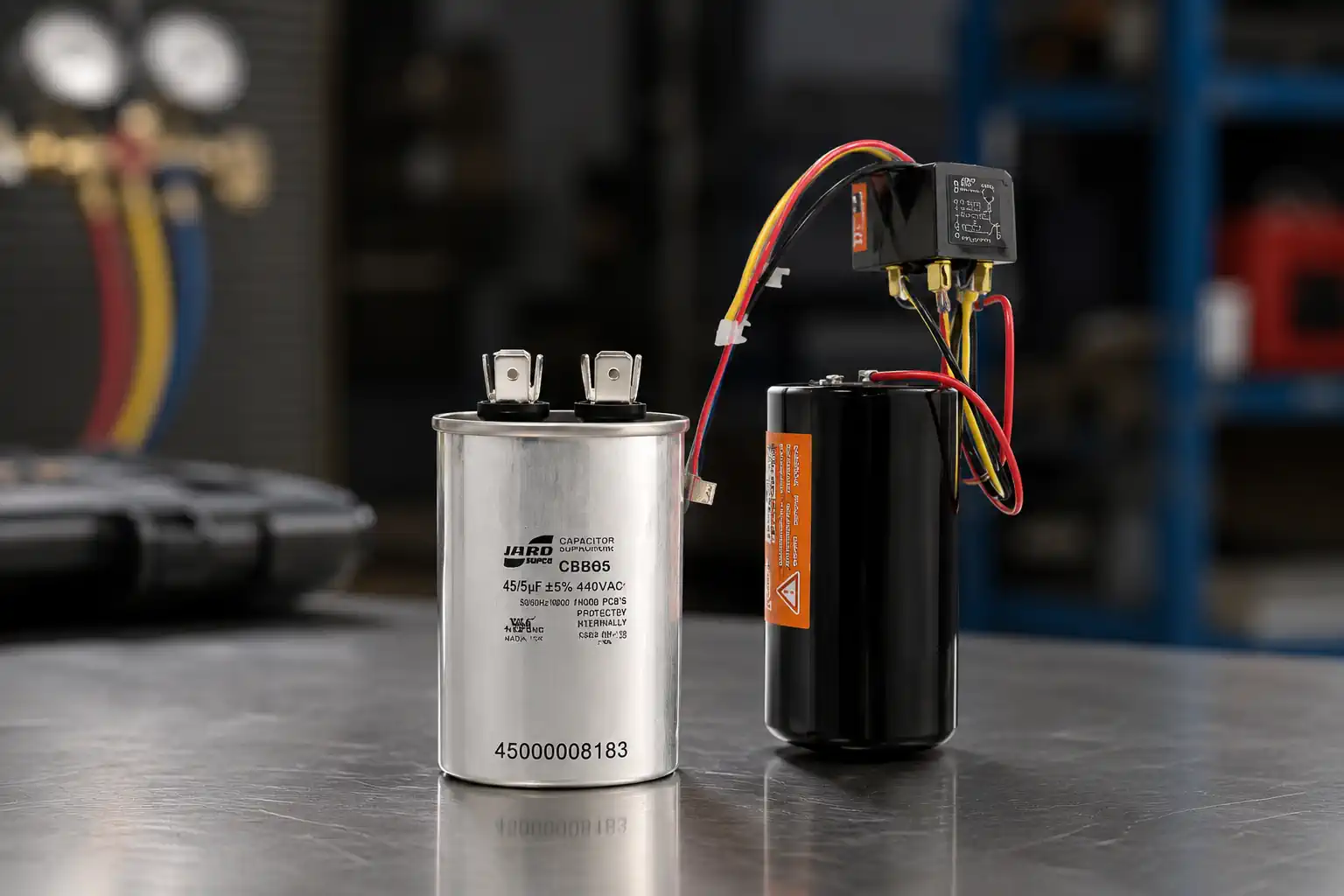
A hard start kit is a small auxiliary capacitor (sometimes paired with a relay) wired into your AC’s start circuit. It delivers an extra burst of current at the exact moment the compressor needs it, helping the motor overcome the initial mechanical and electrical load.
Think of it as a jump-start for your compressor: it doesn’t fix what’s actually worn out, but it gives the system enough boost to get over the hump.
How a hard start kit works
When the thermostat calls for cooling, the contactor closes and power reaches the compressor. The hard start kit’s capacitor discharges a high-amperage pulse for a fraction of a second, then a built-in relay disconnects it once the motor reaches running speed. The run capacitor takes over from there.
When a hard start kit is the right fix
- The compressor is starting to hesitate but still running fine once it’s up
- The system is around 8–12 years old and otherwise healthy
- The run capacitor was just replaced and you want extra startup margin
- The home has known voltage issues
- You’re trying to extend the life of an aging system until planned replacement
When a hard start kit is just a band-aid
- The compressor is 15+ years old and showing other failure signs
- The system was hard starting from day one (sizing or wiring problem)
- The breaker is tripping every cycle
- The refrigerant charge is wrong (no kit will fix a charge problem)
Typical hard start kit cost
Parts alone are inexpensive — the kit itself is one of the lower-cost capacitor-based components on an AC system. Installed by a licensed HVAC technician with proper diagnostic testing, the total visit cost generally falls in a modest service-call range that varies by region, system access, and what else is found during diagnostics. We provide a flat-rate quote before any work begins, so you’ll know the number before you approve.
Hard Start Kit vs. Capacitor Replacement vs. New Compressor
A weak run capacitor needs to be replaced, not boosted. A hard start kit added to a failing capacitor is a temporary patch that will fail again within months. A proper diagnosis distinguishes between the three paths:
- Capacitor replacement — the run capacitor itself tests out of spec on a meter. Replace it and the hard start usually disappears.
- Hard start kit add-on — the capacitor tests good but the compressor still struggles. The kit gives it the extra startup torque it needs.
- Compressor replacement — the compressor windings or bearings are failing. No kit will save it; at this price point, AC replacement is often the smarter call.
The only way to know which path you’re on is a meter test on the capacitor, an amp-draw test on the compressor at startup, and a voltage check at the disconnect. That’s a short diagnostic visit, not a guessing game.
How to Tell If the AC Compressor Is Blown
A blown or failing compressor may hum without starting, trip the breaker immediately, pull locked-rotor amperage, overheat, or fail electrical winding tests. Sometimes the fan runs but the compressor stays silent. Other times the outdoor unit clicks, buzzes, and shuts down.
The only honest way to confirm compressor condition is testing. A technician should check capacitor rating, startup amperage, winding resistance, voltage at the disconnect, contactor condition, and refrigerant pressures. Guessing from sound alone is not enough.
Will a hard start kit fix a bad compressor?
No. A hard start kit can help a compressor that is healthy but struggling to start. It cannot repair damaged windings, worn bearings, internal mechanical failure, or a locked compressor. If the compressor is already failing, the kit may only delay replacement for a short time.
When is AC replacement smarter than compressor repair?
If the system is older, uses expensive repairs, has repeated electrical failures, or the compressor is failing, replacement may be the better long-term option. Compressor repair is often one of the most expensive AC repairs, so the age and condition of the whole system matter.
Why Hard Starting Damages Your AC If Ignored
Every hard start pulls several times the normal current through the compressor windings. Heat builds up. Insulation on the windings degrades. The internal overload protector cycles more often, which itself wears out. Refrigerant oil breaks down faster under repeated high-stress starts.
A compressor that should last 15 years can fail at 9 or 10 if it’s been hard starting for two summers straight. And compressor failure is the most expensive single repair an AC system can have — at which point you’re no longer deciding between a small capacitor swap and a hard start kit, you’re weighing a major compressor repair against a full system replacement.
Catching hard starting early is one of the highest-leverage maintenance moments in an AC’s life.
When to Call a Pro
Call for service if you notice any of these:
- Humming or buzzing from the outdoor unit without the fan spinning
- The AC trips its breaker on startup more than once
- Lights dim noticeably every time the AC kicks on
- The compressor short cycles within seconds of starting
- The system is over 8 years old and starting to hesitate
- You smell anything electrical or burnt near the outdoor unit
These aren’t symptoms to “wait and see” on. The longer a hard-starting AC runs, the more compressor life you’re burning through with every cycle.
Our techs run a full startup diagnostic: capacitor capacitance test, compressor inrush amp reading, contactor inspection, incoming voltage check, and refrigerant pressure verification. You get a clear answer — capacitor, hard start kit, or replacement — backed by meter readings, not guesses.
AC Humming, Clicking, or Tripping the Breaker?
Prevention: Stop Hard Starting Before It Starts
Most hard-start failures are catchable months before they become breakdowns. A spring tune-up checks capacitance values against the manufacturer spec sheet, tests inrush current at startup, and flags a weakening capacitor while it’s still in tolerance.
A spring AC tune-up or an annual maintenance plan typically catches a failing capacitor months before it strands you in July.
What Not to Do When Your AC Will Not Start
Do not keep resetting the breaker
If the breaker trips once, you can reset it one time after checking for obvious issues. If it trips again, stop. Repeated resets can damage equipment and may point to a serious electrical problem.
Do not spray WD-40 on a residential AC compressor
Residential central AC compressors are sealed electrical components. WD-40 will not fix a hard-starting home AC compressor. Advice about compressor clutches usually applies to vehicles, not residential air conditioning systems.
Do not try to force the compressor to kick on
Forcing the unit to start without testing the capacitor, voltage, contactor, and compressor amperage can make the failure worse. Hard starting is a symptom. The goal is to find the cause before the compressor is damaged.
Follow the 3 minute rule
After turning an AC off, wait at least 3 minutes before turning it back on. Many systems already have a built-in delay. This gives refrigerant pressure time to equalize, which makes the compressor easier to restart.
FAQ
Hard starting is when your AC struggles to switch on — humming, clicking, dimming the lights, or tripping the breaker before the compressor finally engages. A healthy AC starts cleanly in about half a second. Anything longer, louder, or rougher than that is hard starting, and it’s stressing the compressor every cycle.
Installed by a licensed HVAC technician, an AC hard start kit typically runs $150–$300 in the Philadelphia area. That includes the kit itself, labor, and a proper diagnostic to confirm a hard start kit is the right fix rather than a capacitor replacement or compressor repair.
No. A hard start kit gives a healthy-but-aging compressor extra startup torque — it cannot revive a compressor that’s mechanically failing. If the windings or bearings are worn, a kit will buy a few months at most before the compressor needs full replacement.
Common bad capacitor symptoms include a humming outdoor unit with no fan movement, a clicking sound followed by silence, slow or hesitant startup, and the AC short cycling within seconds of starting. The only definitive test is measuring capacitance with a meter — values more than 6% below the rated microfarads mean it’s time to replace.
A humming outdoor unit that won’t start is almost always a failed start capacitor. The contactor is closing and delivering power, but the compressor isn’t getting the electrical kick it needs to overcome internal pressure. Don’t keep flipping it on — repeated attempts overheat the windings.
A hard-starting compressor draws 5–8 times its normal running amperage at startup. When that inrush exceeds the breaker’s rating, it trips. The usual culprits are a failed run capacitor, a stuck compressor, or — less commonly — a wiring or breaker problem. Have it diagnosed before resetting the breaker again.
We don’t recommend it. The kit wires into a circuit carrying 240V and stored capacitor charge that can deliver a dangerous shock even with the disconnect pulled. Beyond safety, a DIY install skips the diagnostic step that confirms whether a hard start kit is the right fix at all.
A quality hard start kit typically lasts 5–8 years, often outliving the run capacitor it’s paired with. If it fails earlier, that usually points to an underlying issue — a deteriorating compressor or voltage problem — that the kit was masking.
If the run capacitor tests out of spec, replace the capacitor. If the capacitor tests good but the compressor still struggles, add a hard start kit. Many homes need just one — installing a kit on a failing capacitor is a temporary patch that masks the real problem.
Yes. A capacitor that’s drifting out of spec is detectable months before it fails. Annual maintenance includes capacitance testing, inrush current measurement, contactor inspection, and voltage checks — exactly the readings that catch hard starting while it’s still cheap to fix. Ask about our maintenance plan.
Related AC Repair & Maintenance Services
AC Repair
Same-day diagnostics and repair for systems that won't start, short-cycle, or run inefficiently.
AC Maintenance
Annual tune-ups that catch failing capacitors and weak components before they leave you sweating.
Spring AC Tune-Up
Seasonal tune-up special — full startup diagnostics, capacitance test, and performance check.
Emergency HVAC Repair
Fast response for no-cooling, no-startup, and breaker-tripping emergencies across the Philly metro area.
AC Replacement
When the compressor is past saving, we install high-efficiency systems with transparent flat-rate pricing.
Maintenance Plans
Twice-yearly visits, priority scheduling, and discounts on parts — built to prevent breakdowns.

Does Your AC Need a Recharge? What It Really Means (Leak, Cost, and Options)
AC Recharge vs Refrigerant Leak: The Real Fix (and What It Costs)
If you were told your AC needs a recharge, pause. Refrigerant does not get used up. A recharge without leak repair is a short-term bandage that can lead to repeat service calls, higher costs, and compressor damage.
Many homeowners ask “Do I need an AC recharge or AC repair?” or “Does my AC need to be recharged?”. The short answer is that refrigerant doesn’t just disappear — a recharge is rarely the complete solution. If your system keeps losing refrigerant, it’s almost always a sign of a leak that needs proper attention.
Not Sure If You Need an AC Recharge or AC Repair?
Stop the guessing games and don't pay twice for the same problem. Let the pros find the real cause with a proper AC repair & leak diagnosis instead of a temporary top-off.
Why “Just Recharging It” Is Usually a Mistake
Most central AC systems are sealed. If the refrigerant is low, it usually means it leaked out through a worn valve core, corroded coil, loose flare fitting, vibration damage, or a pinhole leak. Adding more refrigerant without fixing the leak may cool briefly, then you’re right back where you started, except now the compressor has been working overtime.
Not sure your system is actually low yet? Start by checking the signs and symptoms of low refrigerant. If you’ve already confirmed the problem, this guide focuses on what a recharge or repair costs and which option makes sense.
If you’re dealing with poor cooling right now, you may also want to read our guide on how to stay cool when your AC is broken while you wait for service.
Does Your AC Need a Recharge — Or Is It a Leak?
What a Proper Repair Looks Like
A legitimate fix is not “top off and go.” It includes verifying system charge with pressure + temperature readings, confirming superheat/subcooling, locating the leak, repairing the failed part, and then recharging to manufacturer specs. If you want it handled correctly, start with professional AC repair instead of rolling the dice on a recharge-only visit.
Before summer hits, it’s also smart to prepare your AC system for warm weather so small issues don’t turn into emergency calls.
When a Recharge Might Make Sense
A recharge can be appropriate after a confirmed repair, or after a component replacement that required opening the system. If no leak was repaired, the “recharge” is typically temporary.
The Role of Refrigerant
In an air conditioner, electricity facilitates the movement of liquid and gas through lineset. Through a process of evaporation and condensation, refrigerant absorbs and releases heat, effectively transferring it from the interior of your home to the exterior. Importantly, the refrigerant level should remain constant at its factory-set level throughout the life of your air conditioning unit.
Why Repeated Recharges Cost You More
Each time you pay to “recharge” without repairing the leak, you’re paying again while the system keeps running under strain. That’s the real money pit: a manageable leak repair gets put off, the compressor works harder, and what could’ve been a routine fix can turn into a major compressor failure — one of the most expensive repairs in HVAC.
The math is simple: fixing the leak once is almost always cheaper than recharging over and over. If you want to understand how low refrigerant stresses the system in the first place, see our full guide on the signs and risks of low refrigerant.
Need a Real Diagnosis, Not a Guess?
If your system keeps “needing refrigerant,” there’s a reason. EMCO Tech pinpoints leaks, checks pressures, confirms superheat/subcooling, and restores proper cooling the right way. Call: 215-366-1001 | Schedule: book service online
AC “Needs a Recharge”? Make Sure It’s Fixed Correctly.
Refrigerant does not get used up. If your system is low, there’s usually a refrigerant leak or component failure behind it. Adding refrigerant without repairing the source is temporary and can overwork your compressor. EMCO Tech verifies system charge, locates leaks, confirms superheat and subcooling, and recharges according to manufacturer specifications.
Refrigerant Type Matters: R-22, R-410A, and the New A2L Refrigerants (and Why It Changes Your Decision)
Not all refrigerants are equal, and your options depend on what your system uses. Older systems may still run on R-22, which has become expensive and difficult to source. Most systems installed in recent years use R-410A. As of 2025, the industry is transitioning to newer low-GWP A2L refrigerants such as R-32 and R-454B, which are more environmentally friendly and now standard in most new equipment.
If your system is older and keeps needing refrigerant, it’s often smarter to weigh replacement versus repair rather than paying for repeated recharges — especially since a new system will use one of the newer, more efficient refrigerants.
Homeowners with heat pumps often ask the same question — do heat pumps need to be recharged? the answer is the same as with central AC: only if there’s a leak. If you have a heat pump, see our heat pump repair services.
Common “Recharge” Scenarios We See
- Small leak + accessible repair: fix the leak, recharge correctly, and you’re good.
- Coil leak or heavy corrosion: may require coil replacement or full system replacement depending on age and cost.
- Recurring low charge on an older unit: repeated recharges are usually wasted money.
Recharge vs Full Repair vs Replacement – Quick Decision Guide
- Small, fixable leak: Repair + recharge = best value
- Old R-22 system with recurring issues: Consider AC replacement
- Multiple failed components: Repair may not be worth it
EMCO Tech gives you honest recommendations based on your system’s age, condition, and your budget.
Many customers also find it helpful to review our vacation prep HVAC energy saving tips and our article on end-of-summer AC maintenance to keep their system running efficiently year-round.
How Much Does an AC Recharge Cost?
The honest answer: it depends on your refrigerant type and how much your system needs. As a general guide, a recharge on a newer R-410A system typically runs in the lower-to-mid hundreds, while older R-22 (Freon) systems can cost several times more — often $300 to $600 or higher* for a single recharge — because R-22 is being phased out and has become scarce and expensive. Systems using the newer A2L refrigerants like R-32 and R-454B are priced separately again, since availability and handling requirements differ.
But here’s the part that saves you money: if your system is low on refrigerant, recharging alone is rarely the real fix. Refrigerant doesn’t get used up, so a low charge almost always means a leak. Paying to recharge without repairing the leak usually means paying again a few months later. See professional AC repair for a proper diagnosis.
Refrigerant Leak Detection & Repair Costs
A proper leak repair has two parts: finding the leak, then fixing the failed component and recharging to spec. Costs vary widely depending on where the leak is and how accessible it is:
- Leak detection / diagnosis: often a modest flat fee or included with repair*
- Minor leaks (valve core, loose flare fitting): generally the most affordable to repair*
- Coil or line-set leaks: mid-range, since they require more labor and refrigerant*
- Evaporator coil replacement: the most expensive repair, sometimes approaching the cost of partial replacement*
Because refrigerant is part of every repair, the type of refrigerant your system uses has a big effect on the final bill. Get clear, upfront numbers with a professional AC leak repair visit.
Freon (R-22) Leak Repair Cost: Why It’s So Expensive
If you have an older system running on R-22 (commonly called Freon), expect higher costs across the board. R-22 has been phased out of production, so what’s left is limited and priced accordingly — and those prices can change quickly with supply. For an aging R-22 system that keeps losing refrigerant, repeated recharges are usually wasted money, and AC replacement with a modern, efficient system often makes more financial sense.
Do Heat Pumps Need to Be Recharged? (And What It Costs)
Heat pumps work on the same sealed-refrigerant principle as central AC, so the answer is the same: a heat pump should only need recharging if there’s a leak or a component was opened for repair. A properly working heat pump never “runs out” of refrigerant on its own.
Heat pump refrigerant leak repair costs fall in the same ranges as central AC — driven mostly by the leak location and the refrigerant type. If your heat pump keeps coming up low, that’s a leak to find, not a recurring recharge to budget for. See our heat pump repair services for a real diagnosis.
Recharge vs. Repair vs. Replacement: Which Makes Sense?
| Your Situation | Best Move | Why |
|---|---|---|
| Small, accessible leak on a newer R-410A system | Repair + recharge | Best long-term value — fixes the root cause |
| Recurring low charge on an older R-22 system | Consider replacement | R-22 is scarce and pricey*; repeated recharges add up fast |
| Major coil failure or multiple bad components | Replacement often wins | Repair cost approaches the price of a new system |
| Refrigerant low but no leak found yet | Leak detection first | Recharging without finding the leak is temporary |
Regular maintenance helps catch small leaks before they drain your system. A seasonal AC tune-up keeps charge levels and components in check.
FAQ
Only if a leak has already been repaired or a component was replaced. If no leak was fixed, recharging is usually a temporary fix and not the real solution.
No — not under normal conditions. A properly sealed AC system should never need refrigerant added. If it does, there is almost always a leak that must be repaired first.
It usually means there is a refrigerant leak. Refrigerant does not get “used up.” The most common causes are worn valve cores, corroded coils, or loose fittings.
It depends on refrigerant type and how much is needed. R-410A systems are generally less expensive, while older R-22 systems can run $300 to $600 or higher* per recharge due to limited supply. Remember, a recharge without leak repair is usually only temporary.
Most of the time the answer is “no” until the leak is fixed. Simply adding refrigerant without repairing the leak is a short-term bandage that wastes money.
A recharge only adds refrigerant. Fixing the leak is the actual repair. Without repairing the leak, the system will go low again quickly.
No. Recharging is only refilling the refrigerant. Fixing the leak is the permanent solution.
Only after the leak has been located and repaired, or after replacing a part that required opening the system.
If your R-22 system needs frequent recharges, replacement is often cheaper in the long run. We’ll give you honest repair vs replacement options.
It ranges widely based on the leak’s location and accessibility — minor fittings are the most affordable, while evaporator coil repairs are the most expensive. The refrigerant type also affects the total.* A professional diagnosis gives you an exact, upfront number.
R-22 has been phased out of production, so remaining supply is scarce and prices can rise sharply.* On an older system that keeps leaking, replacement often makes more sense than repeated R-22 recharges.
Only if there’s a leak or a component was opened during repair. Like central AC, a sealed heat pump should hold its factory refrigerant charge for life. Recurring low charge means a leak to repair, not a routine recharge.
*Pricing shown is a general estimate only and is not a quote. Refrigerant costs — especially for types being phased out, such as R-22 — can change significantly and without prior notice based on supply, demand, and availability. Actual cost depends on your specific system, the refrigerant required, and the nature of the repair. Contact us for a current, accurate estimate.
Post Updated: June 2026

10 Air Conditioning Tips for an Efficient Summer
Your Complete Home AC Guide for the Philadelphia Area
Keeping your air conditioner running well through a Philadelphia-area summer comes down to a few things: routine maintenance, catching problems early, and knowing when to repair versus replace. This guide pulls together our most useful resources in one place — pick the topic you need and dive into the full guide.
Annual AC Tune-Ups & Maintenance
A yearly tune-up is the cheapest insurance against a mid-heatwave breakdown — it checks refrigerant, cleans coils, and catches small issues early. See our spring AC tune-up special and what is included.
Starting Your AC After Winter
Before the first hot day, a quick startup check prevents surprises. Our after-winter AC startup checklist walks you through testing your system safely.
AC Hard Starting & Compressor Trouble
If your AC struggles or stutters when it kicks on, the compressor may be hard starting — a fixable problem if caught early. Learn the causes, fixes, and hard start kit options.
Low Refrigerant & Warm Air
Warm air, longer cooling cycles, or a frozen coil often point to low refrigerant — which almost always means a leak. Check the signs and symptoms of low refrigerant.
AC Recharge vs. Repair (and Costs)
Before you pay to recharge, understand why topping off rarely fixes the real problem. Our guide breaks down recharge versus repair and what each costs.
AC Not Cooling Like It Should?
Why Your AC Bills Are So High
If cooling costs feel out of control, several hidden issues could be to blame. See why running your AC costs so much and how to fix it.
When to Call for AC Repair
 Some problems no DIY tip can solve. If your system is failing, get fast, honest help with professional AC repair across Greater Philadelphia.
Repair or Replace? Upgrading an Aging System
If your unit is over 12 years old or needs frequent repairs, replacement often pays back in lower bills. Explore high-efficiency replacement and ductless options.
Smart Thermostats & Settings
The right thermostat strategy quietly cuts cooling costs all summer. See whether a smart thermostat is worth it for your home.
Indoor Air Quality & Humidity
Comfort is not just temperature — humidity matters too. Learn the difference between humidifiers and dehumidifiers and when to use each.
Need Hands-On Help?
Whether it is a tune-up, a repair, or a full replacement, our team keeps homes comfortable across the Greater Philadelphia area. Schedule service online or call 215-366-1001.
Home AC Guide – Frequently Asked Questions
Once a year, ideally in spring before cooling season. An annual tune-up catches small problems early and keeps the system efficient. See our spring AC tune-up details.
Repair usually makes sense for newer systems with a single fixable issue. If your unit is over 12 years old or needs frequent repairs, replacement often pays back in lower energy bills. Explore replacement options.
Common causes include low refrigerant from a leak, a dirty filter, a frozen coil, or a failing capacitor. If a filter change does not fix it, it is time for a professional diagnosis. Get fast AC repair.

Will Your AC Survive Summer 2026? A Breakdown Risk Checklist for Philly-Area Homes
Why Summer 2026 Will Stress Test Your AC
NOAA is again forecasting an above-average summer for the Mid-Atlantic, and every Bucks and Montgomery County cooling system is about to be stress-tested. The question isn’t whether your AC can run — it’s whether it can run for 90 straight days without giving up during a heat wave. This guide is a fast, honest readiness check: score your system, learn the warning signs that almost always show up before a breakdown, and know exactly when to call a technician versus when a quick DIY fix is enough.
The 5-Minute AC Breakdown Risk Score
Answer the questions below. Count each “yes” as one point.
- Is your AC 10 years or older?
- Did you skip a professional tune-up in the last 12 months?
- Have you noticed weaker airflow, longer run times, or warm rooms upstairs?
- Does the outdoor unit make new noises — buzzing, clicking, or grinding?
- Is your electric bill climbing month over month with no usage change?
- Have you had two or more repairs in the past two cooling seasons?
- Is your air filter grey, bent, or older than 60 days?
Score 0–1: Low risk — keep up monthly filter changes and book a routine AC tune-up.
Score 2–4: Moderate risk — schedule a pre-season inspection before July.
Score 5–7: High risk — a heat-wave failure is likely. Consider AC repair now or evaluate replacement options.
Scored 2 or Higher? Don't Wait for a Heat Wave.
Most summer breakdowns are preventable when caught in spring. Lock in a 22-point AC tune-up with EMCO Tech and let a NATE-certified technician verify refrigerant, capacitor health, airflow, and electrical safety before peak demand hits.
Warning Signs That Predict an AC Breakdown
Most failures don’t happen out of nowhere. They give signals — usually 2 to 6 weeks in advance. Watch for:
- Short-cycling. The compressor kicks on and off every few minutes. Often a refrigerant, capacitor, or thermostat issue.
- Ice on the indoor coil or copper line. Almost always low refrigerant or restricted airflow.
- Water pooling near the air handler. Clogged condensate drain — cheap to fix now, expensive if it floods a ceiling.
- Hot air from vents. The system runs but doesn’t cool. See our deeper guide on why your AC runs but isn’t cooling.
- Tripped breakers. The outdoor unit is drawing more current than it should — typically a failing capacitor or compressor.
What to Do Before the First Heat Wave
1. Replace the air filter — and set a reminder
A clogged filter is the #1 cause of frozen coils and avoidable service calls. Swap monthly during cooling season; quarterly minimum.
2. Hose down the outdoor condenser
Power off at the disconnect, then rinse from the inside out with a garden hose. Dirty coils can reduce efficiency by up to 30%.
3. Clear two feet around the unit
Remove mulch, shrubs, and patio furniture. The condenser needs free airflow on all sides.
4. Test before you need it
Run the AC for 20 minutes on a mild day. If it short-cycles, smells musty, or doesn’t cool 18–20°F below the return air temperature, schedule service before the first 90° day fills the dispatch board.
5. Book the tune-up early
Our 22-point AC tune-up covers refrigerant pressure, capacitor health, condensate flow, electrical connections, and airflow — the five failure points behind nearly every summer breakdown.
Want the Full Pre-Season Game Plan?
See exactly what to check before warm weather arrives in our March AC Maintenance Checklist for the Philadelphia area — a step-by-step HVAC changeover guide our technicians use every spring.
When DIY Stops and a Technician Starts
Homeowners can safely handle filters, condenser rinsing, vent cleaning, and thermostat batteries. Call a licensed HVAC technician for anything involving refrigerant, electrical components, sealed-system parts, or repeated breaker trips. If your AC is older than 12 years and needs a major repair, get a side-by-side repair-vs-replace estimate before approving the work.
Local Service Across Bucks & Montgomery County
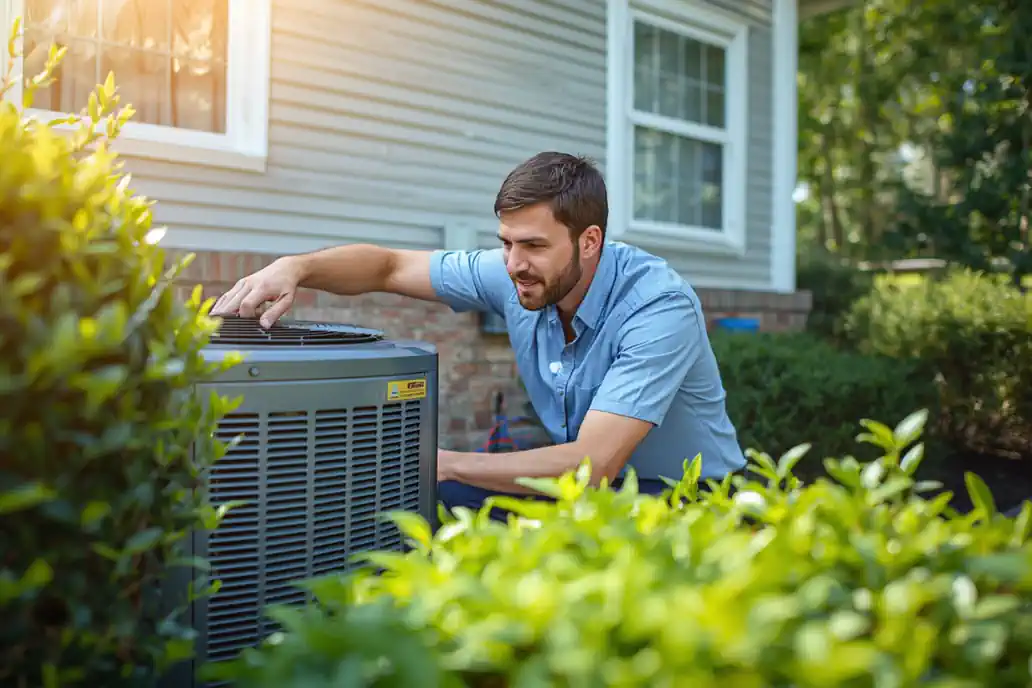 EMCO Tech has been servicing AC systems across the Philadelphia suburbs since 2006. If you’re in a high-demand zip code, book early — these are our busiest neighborhoods during heat waves:
Frequently Asked Questions
How often should I service my AC to prevent summer breakdowns?
Once per year, ideally in March or April before peak demand. Systems older than 8 years benefit from a second mid-season check.
What’s the most common cause of AC failure during a heat wave?
A failed start capacitor on the outdoor unit. Heat soak plus heavy load kills weak capacitors first. It’s a 20-minute, low-cost fix when caught early.
Is it worth repairing an AC that’s 12+ years old?
If the repair quote is above 30% of replacement cost, replacement usually pays back faster in efficiency gains and avoided repeat repairs.
How long does a professional AC tune-up take?
Roughly 60–90 minutes for a residential split system. Our techs run a 22-point inspection and document refrigerant pressures, capacitor microfarads, and amp draw so you have a baseline year over year.
Post Date

AC Installation in Doylestown, PA
Air Conditioning Installation in Doylestown, PA
Maximize home comfort and lower your energy bills with an upgraded cooling system. As an authorized Carrier heating and cooling dealer serving Bucks County, EMCO Tech delivers expert setup, accurate sizing, and dependable long-term performance for homes throughout Doylestown.
Free AC Installation Estimate in Doylestown
Ready to upgrade your cooling system? EMCO Tech is an authorized Carrier AC installation dealer serving 18901, 18902, and surrounding Bucks County neighborhoods. Same-week scheduling and flexible financing available.
Why Upgrade Your Air Conditioner in Doylestown 18901
Summer in Bucks County brings heavy humidity and stretches of 90-degree heat. An aging, inefficient cooling system works harder to keep up, driving up monthly utility bills and shortening the life of the equipment. A new air conditioner in Doylestown 18901 keeps your home consistently cool while reducing energy consumption. Modern systems offer higher SEER2 efficiency ratings, quieter operation, and advanced humidity control — three things older units simply can’t match.
Professional AC Installation in Doylestown, PA
A successful cooling installation depends on precise sizing and clean execution. Our team evaluates your home’s square footage, insulation, window exposure, and ductwork before recommending a system. Certified technicians manage every step of your AC installation in Doylestown, PA — from refrigerant charging to airflow balancing. Correct installation protects your manufacturer warranty and prevents the premature breakdowns that come from oversized, undersized, or sloppy setups.
Cooling System Options for Doylestown Homes
Central Air Installation in Doylestown
Traditional central systems use your existing ductwork to deliver filtered, evenly distributed air to every room. Replacing an outdated central unit with a modern high-efficiency model significantly reduces electricity use. We handle every central air conditioning installation with strict attention to airflow calibration and proper refrigerant levels.
Ductless Mini-Split Installation in Doylestown, PA
Ideal for historic Doylestown homes that lack ductwork, additions, finished basements, and tricky upstairs bedrooms. Mini-splits pair independent indoor air handlers with an outdoor compressor, letting you set different temperatures for different rooms. Learn more about our ductless mini-split installation options.
Heat Pump Installation in Doylestown
Heat pumps provide year-round flexibility — pulling heat out of your home in summer and reversing the process in winter for efficient heating. Federal tax credits and utility rebates make them especially attractive right now. See full details on our heat pump installation page.
Authorized Carrier Heating and Cooling Dealer
As a factory-authorized Carrier dealer, we specialize in installing industry-leading, energy-efficient comfort systems. Carrier equipment is built for long service life, advanced humidity management, and quiet operation. That said, our certified technicians are trained on every major HVAC brand — if you prefer a different manufacturer for your Doylestown AC installation, we’ll accommodate your choice and design a system around it.
Flexible HVAC Financing in Doylestown
An unexpected system failure shouldn’t force a compromise on quality. EMCO Tech offers accessible HVAC financing plans designed to fit a typical household budget, so you can install a high-efficiency system today and pay it off in convenient monthly installments. Ask your technician about current promotional rates during your estimate.
Why Doylestown Homeowners Choose EMCO Tech
- Local expertise: Familiarity with Bucks County architectural styles and regional climate demands.
- Accurate sizing: Manual J load calculations prevent short-cycling, hot spots, and humidity problems.
- Certified technicians: Factory-trained installers execute every project to manufacturer standards.
- Transparent pricing: Clear, upfront estimates with no hidden fees or surprise charges.
Ready to upgrade? Schedule a free in-home estimate with EMCO Tech today for premier AC installation in Doylestown and throughout Bucks County.
Modern high-efficiency cooling systems installed in Willow Grove, PA can improve comfort, lower operating costs, and reduce temperature fluctuations throughout the home.
Frequently Asked Questions
Most residential changeouts wrap up in a single day. Projects involving new ductwork, mini-split runs across multiple rooms, or upgrades to higher-capacity equipment may take two to three days.
A central AC only cools, while a heat pump provides both efficient cooling in summer and heating in winter from one outdoor unit. Heat pumps cost more upfront but reduce annual energy bills and currently qualify for federal tax credits in many cases.
If your system is over 10 to 15 years old, requires frequent repairs, struggles to maintain a consistent temperature, or uses R-22 refrigerant, it’s probably time to replace it rather than repair it again.
Yes — we serve 18901, 18902, and surrounding Bucks County areas including Buckingham, New Britain, Chalfont, and Warrington.
HVAC Services in Bucks County, PA
EMCO Tech provides AC installation, repair, and full HVAC services throughout Bucks County. Explore service details for nearby communities.
Newtown
Full HVAC services for 18940 homes and businesses.
Jamison
Local AC and heating installation, repair, and maintenance.
Chalfont
Trusted HVAC contractor serving Chalfont neighborhoods.
New Hope
Heating, cooling, and ductless service for historic homes.
Upper Makefield
Premium HVAC installation and service for township homes.